

 7 mins read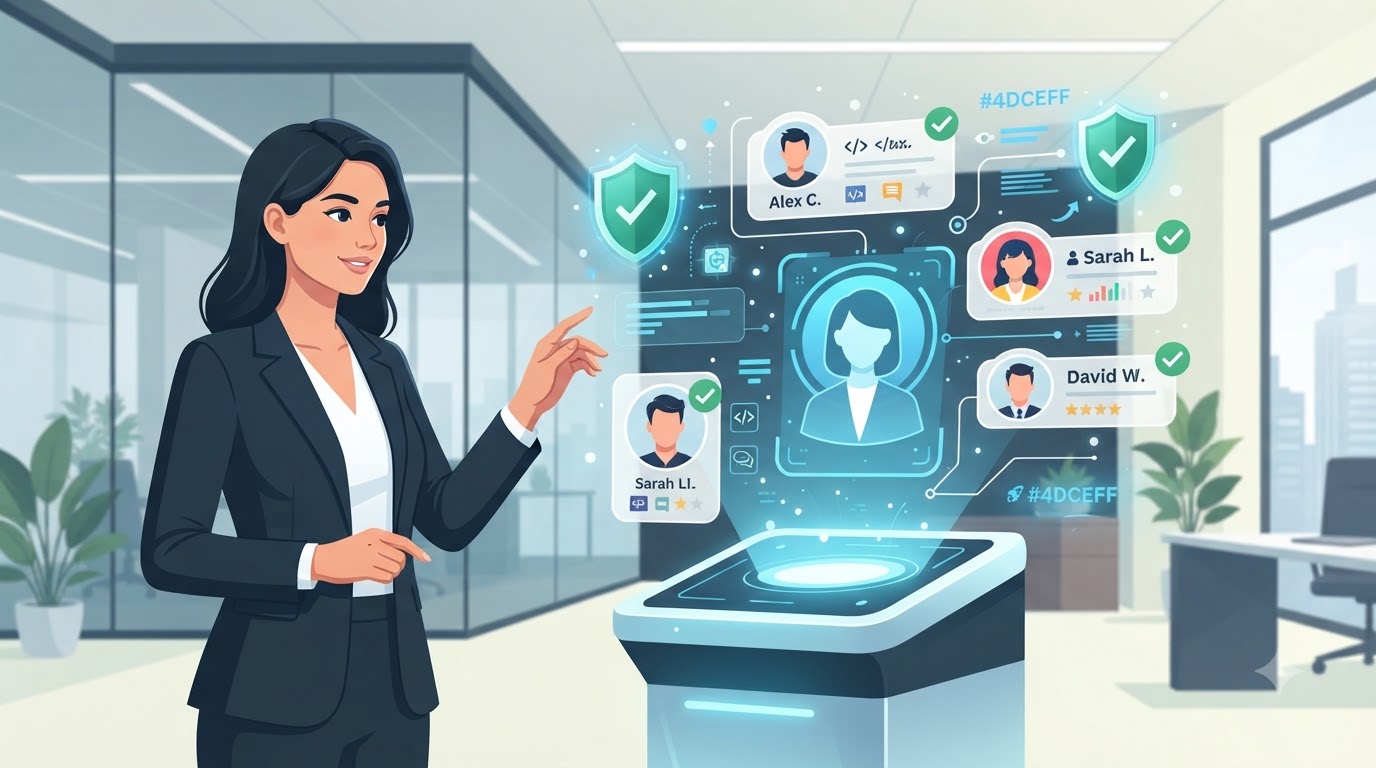
From AI Copilots to AI Avatar Interviewers: The Next Evolution of High-Volume Hiring
Much of the conversation about AI in recruiting has focused on assistance: tools that summarize interviews, suggest questions or help recruiters review applications faster.
These capabilities are useful. But high-volume talent acquisition teams face a capacity problem that assistance alone cannot solve. If every first-round interview still requires a recruiter’s time, screening capacity remains tied to recruiter availability.
AI avatar interviewers expand that capacity. They can conduct initial conversations, ask relevant follow-up questions and collect structured candidate evidence before a human interviewer joins the process.
The opportunity goes beyond automating questions. It is about making early-stage screening more responsive while keeping candidate experience, interview integrity, and human evaluation connected throughout the hiring process.
The High-Volume Screening Bottleneck
Anyone who has hired at scale, in retail, BPO, logistics or seasonal roles, knows the challenge: applications can arrive faster than recruiters can have meaningful conversations.
Resume filters help organize that volume. Asynchronous video interviews reduce scheduling demands. But candidates can still experience a disconnected process: upload a resume, receive an automated link, record answers and wait.
There may be little opportunity to clarify a question, explain an unusual career move or ask about the role.
An AI avatar interviewer can make this stage more interactive. Instead of presenting a fixed recording prompt, it can listen to an answer, ask for more detail and guide the candidate through a structured conversation.
That distinction matters. For many candidates, screening is one of their first substantial interactions with an employer. The experience should help people demonstrate their suitability while giving recruiters evidence they can use.
The challenge is making those conversations available at scale without sacrificing their quality
Why AI Avatar Interviewers Deserve a Bigger Role
A live AI copilot supports a recruiter who is already conducting an interview. An AI avatar interviewer can conduct the initial screening conversation itself, within the criteria and boundaries the hiring team defines.
This changes where recruiting teams spend their time.
Rather than repeating introductory questions across hundreds of applicants, recruiters can review the evidence collected during avatar interviews and focus their conversations on candidates who need deeper evaluation.
But the avatar’s appearance is only one part of the experience. A lifelike face reading a rigid script still delivers a rigid interview.
The capabilities worth evaluating are conversational:
● Does the interviewer ask relevant follow-up questions?
● Can it retain context from an earlier answer?
● Does it give candidates time to pause and clarify?
● Can it answer approved questions about the role?
● Does its evaluation connect back to what the candidate actually said?
These are the qualities that make an AI avatar interviewer useful in high-volume hiring. Visual presence supports the interaction; responsive conversation gives it substance.
AI Avatar Screening First, Human Interviews Next
AI avatar interviewers and live copilots serve different stages of the process. Their value grows when the handoff between them preserves context.
Round 1: AI Avatar Interviews for Screening at Scale
An AI avatar interviewer handles the initial structured conversation, gathering information about relevant experience, role requirements and candidate availability.
When an answer is vague, it can ask for an example. When a candidate shares something relevant, it can probe further within the interview playbook.
The output should give recruiters a reviewable account of the conversation: responses, supporting evidence, areas requiring clarification and an evaluation against agreed criteria.
The goal is to make an initial conversation available without requiring a recruiter to conduct every screen personally.
Round 2: Human Judgment Supported by a Live Copilot
Later rounds require deeper discussion and human judgment. Recruiters and hiring managers explore trade-offs, test role-specific depth and build a relationship with the candidate.
A live copilot can support those conversations with structured prompts, note-taking and feedback capture.
Crucially, the human interviewer should receive the context from the avatar interview. Candidates should not have to repeat their entire story because the tools failed to carry it forward.
Three Gaps AI Interview Infrastructure Must Address
Adding an avatar to the screening stage is only useful if the surrounding process addresses the problems that make high-volume hiring difficult.
1. Candidate Engagement During Automated Screening
A one-way recording gives candidates a task to complete. An adaptive avatar interview can give them a conversation to participate in.
That creates opportunities for clarification, relevant follow-ups and a clearer sense of progress. However, engagement depends on execution: slow responses, interruptions or repetitive questions can undermine the experience.
Teams should measure completion rates, abandonment points and candidate feedback during a pilot. A polished demonstration cannot establish how the system performs with real applicants.
2. Interview Integrity and Impersonation
Remote screening also requires a considered approach to identity and interview integrity.
Buyers should understand which checks a platform performs, what those checks can establish and how potential concerns reach a human reviewer.
A flagged behavior is not proof of misconduct. Integrity signals need context, review and a clear process for resolving uncertainty.
For AI avatar interviews, this layer should support confidence in the evidence collected without turning the candidate experience into an unnecessarily intrusive exercise.
3. Consistent Evaluation Across Stages
An adaptive conversation still needs a consistent evaluation framework.
Candidates may receive different follow-up questions because their answers differ. But the competencies being assessed and the standards applied should remain aligned.
The same principle should carry into human rounds. If the avatar evaluates against one rubric and the hiring manager uses another, automation has simply moved the inconsistency.
A shared playbook helps connect screening, follow-up interviews and the final review
Building a Connected Process Around AI Avatar Interviews
A useful architecture starts before the avatar asks its first question and continues after the conversation ends.
● Define the interview playbook. Translate the job requirements into role-specific competencies, questions and evaluation criteria, with recruiter review before use.
● Conduct adaptive avatar screening. Give candidates a structured, two-way conversation that gathers relevant evidence and allows clarification.
● Carry context into human rounds. Share the screening evidence and unresolved questions so interviewers can build on the initial conversation.
● Return structured feedback to the ATS. Keep interview records and evaluations accessible to the people responsible for the decision.
JobTwine applies this connected approach through JayT, its conversational AI recruiter. Its AI avatar interviewers are designed to conduct initial screening conversations, while the Interviewer Copilot supports subsequent human interviews. The goal is to connect both stages through structured playbooks and candidate evidence, giving recruiters a clearer starting point for deeper evaluation.
For buyers, that connection deserves as much scrutiny as the avatar itself. What information survives the handoff? Can the human interviewer see why a follow-up was asked? Can a reviewer trace an evaluation back to the candidate’s answer?
Those details determine whether the system reduces work or simply shifts it downstream.
A Practical Checklist for TA Leaders
When evaluating AI avatar interviewers, test the experience as a candidate and review the output as a recruiter.
● Conversation quality: Does the avatar respond to the substance of an answer or simply move to the next question?
● Candidate control: Can applicants clarify questions, correct answers and access support or an alternative process?
● Transparency: Is it clear that the candidate is interacting with AI and how the interview will be reviewed?
● Evaluation evidence: Can recruiters trace ratings to candidate responses and the agreed rubric?
● Integrity review: What triggers a flag, and how does a person assess it?
● Human handoff: Do later interviewers receive useful context from the avatar conversation?
● ATS integration: Which records transfer automatically, and what manual work remains?
Run the pilot against operational measures: recruiter time per completed screen, completion rates, candidate feedback and the usefulness of the evidence in later rounds.
An avatar that looks convincing is a starting point. An avatar that conducts a useful interview and supports a better handoff is what matters operationally.
The Next Step in High-Volume Hiring
AI copilots help recruiters conduct interviews more efficiently. AI avatar interviewers extend the team’s ability to offer initial conversations at scale.
Together, they can support a process in which candidates receive responsive screening, recruiters spend more time on deeper evaluation, and interview evidence remains connected across stages.
The next improvement in high-volume hiring will depend on how well these pieces work together, from the first avatar-led question to the final human decision. For TA leaders, the key is not simply adopting an AI interviewer, but building a screening process that combines efficiency, candidate experience, reliable evidence, and human judgment.
Want to see how this approach could work for your team? Try us out
