

 19 mins read
HR in 2026 sits at the intersection of three forces: AI moving faster than governance can keep up, a workforce that's quietly disengaged even when it isn't quitting, and a hiring process under more identity and fraud pressure than at any point in recent memory. Below is the most current, credible global data across nine categories, from talent acquisition to candidate identity verification.
1. Talent Acquisition & Recruitment
Hiring is moving faster and getting pickier at the same time, AI is compressing time-to-hire, skills-based hiring is displacing degree requirements, and internal mobility is quietly outperforming external hiring on every metric that matters.
The global Net Employment Outlook stood at 24% for Q1 2026, with India (52%) and Brazil (54%) posting the strongest hiring momentum of any surveyed market.
Source: ManpowerGroup Employment Outlook Survey, 39,000+ employers across 41 countries (2026)
- India's hiring rate is up 40% compared to pre-pandemic levels, the strongest gain of any major economy tracked.
Source: LinkedIn Economic Graph, January 2026 - 73% of employers say skills-based hiring is a priority for 2026.
Source: LinkedIn Talent Solutions, “The Future of Recruiting” - Dropping degree requirements has expanded the talent pool by up to 10x for some roles.
Source: LinkedIn Economic Graph - Companies that drop degree requirements see 5x stronger predictivity from skills assessments than from academic credentials alone.
Source: Deloitte, Skills-First Research - The number of LinkedIn job postings without degree requirements grew roughly 36% between 2019 and 2024.
Source: LinkedIn Economic Graph - Teams using AI to handle screening and scheduling report 20–40% lower cost-per-hire.
Source: Greenhouse & GoodTime, AI ROI in TA study - The average cost-per-hire in the U.S. is approximately $4,700 in direct recruiting costs; executive hires can run 3–4x higher once search fees and relocation are included.
Source: SHRM - 45% of employers report difficulty finding qualified candidates, citing a persistent global skills gap.
Source: MSH, Recruitment Trends & Statistics (2026) - 73% of job seekers are passive candidates, open to offers but not actively searching.
Source: LinkedIn Global Talent Trends - Referred candidates are hired an average of 29 days faster than the roughly 44-day average across all other hiring channels, and referred employees show meaningfully higher two-year retention than hires sourced from job boards.
Source: SHRM / Recruiter.com hiring-channel benchmark data - 81% of HR leaders consider people analytics essential for strategic planning; data-driven organizations report 32% better business outcomes.
Source: MSH, Recruitment Trends & Statistics (2026)
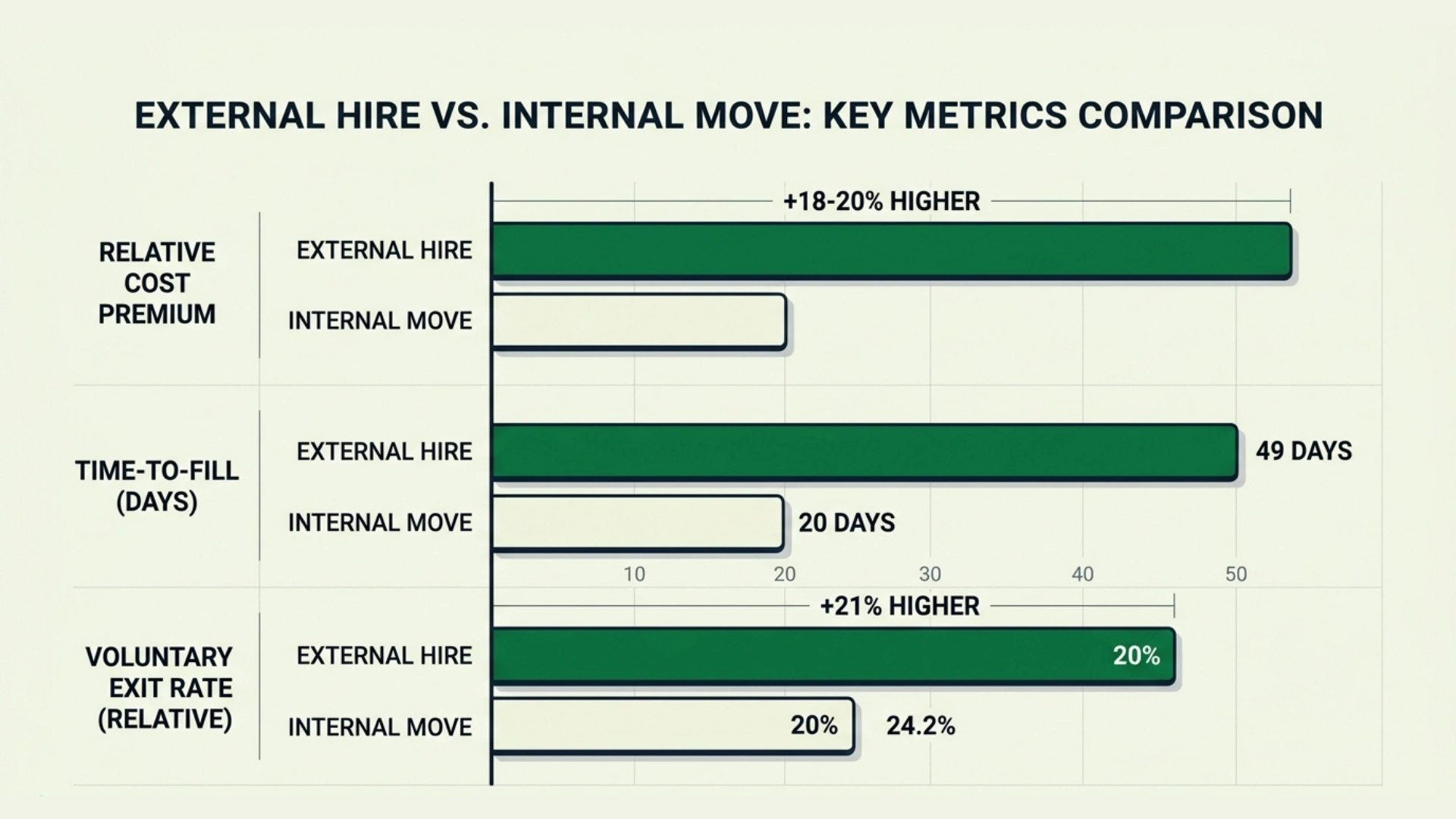
- External hires cost 18–20% more than equivalent internal moves and take 2–3 years to match the performance of internally promoted employees.
Source: Matthew Bidwell, Wharton School - External hires are 61% more likely to be laid off or terminated, and 21% more likely to leave voluntarily, compared with internal promotions.
Source: Matthew Bidwell, Wharton School - Time-to-fill for external hires averages roughly 49 days, compared with 20 days for internal moves.
Source: Fuel50, "The State of Skills-Based Work" (2026) - Employees stay 41% longer at companies with strong internal mobility than at companies with weak internal mobility, independent of pay.
Source: LinkedIn workforce data, cited in Fuel50 (2026) - Employee referrals remain employers' single top hiring source, accounting for roughly 30% of all external hires and closer to 45-50% of internally sourced hires at organizations with mature referral programs.
Source: SHRM, “Employee Referrals Remain Top Source for Hires” - Companies with structured, incentivized referral programs report meaningfully higher diversity in their referred candidate pool when the program includes explicit diversity goals and unconscious-bias training for referrers.
Source: SHRM referral-program research (2025) - Return-to-office mandates measurably hurt hiring: 62% of HR leaders with RTO policies reported increased difficulty hiring for professional roles, up 15 points from the prior year.
Source: Academic analysis of 3M+ LinkedIn profiles, Baylor University & University of Pittsburgh - 52% of talent acquisition leaders say office mandates are actively hindering recruitment; 72% say remote roles are easier to fill.
Source: MSH, Recruitment Trends & Statistics (2026)
2. Identity, Verification & Trust
Hiring fraud has moved from occasional resume padding to AI-assisted deception at scale, and the data shows a widening gap between how often it's happening and how confident employers feel about catching it.
- 44% of job seekers admit to lying during the hiring process; 24% specifically admit to falsifying their resume.
Source: Resume Builder survey (January 2025) - 64.2% of employees admit to misrepresenting skills, experience, or references, up from 55% in 2022.
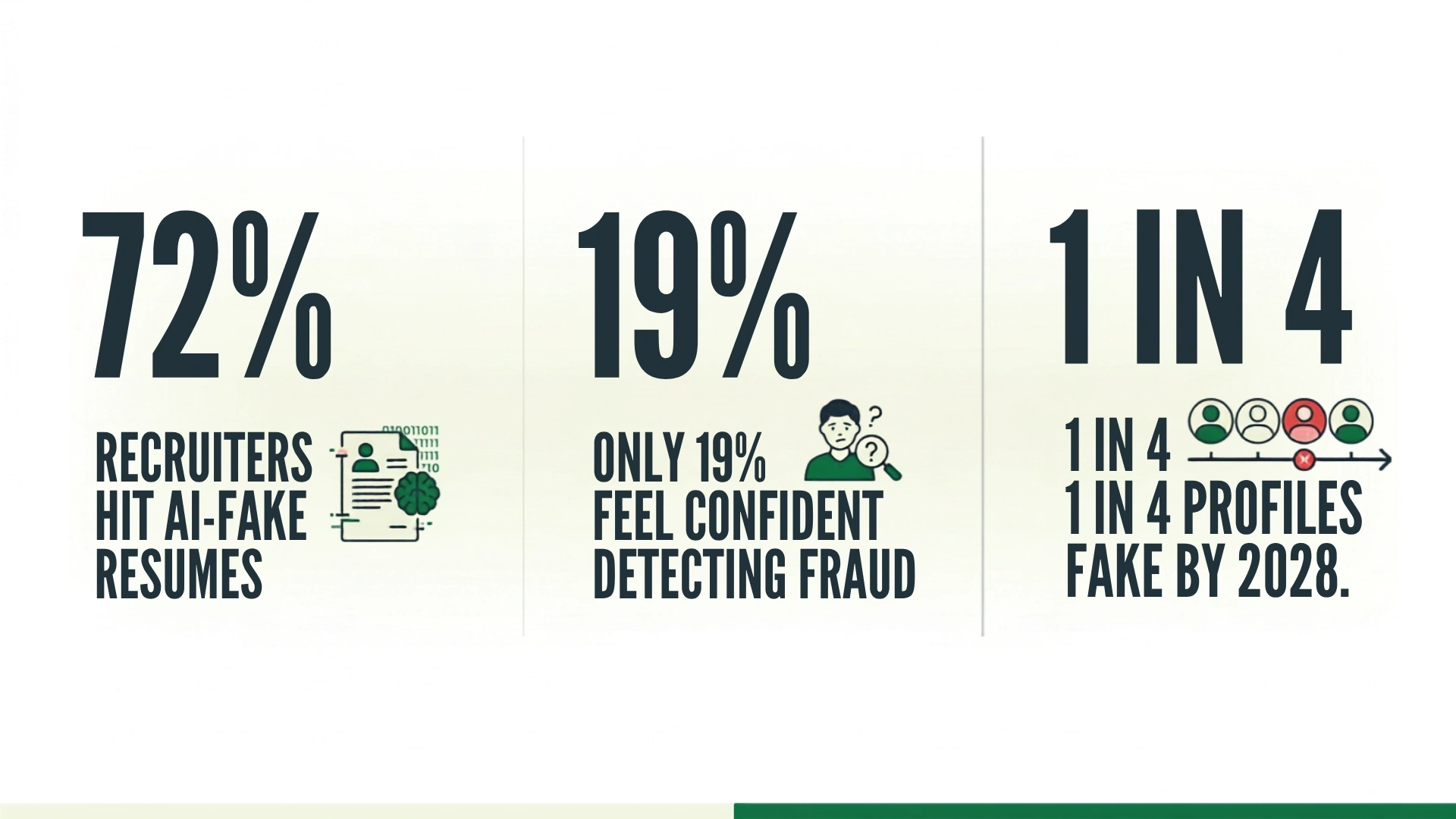
Source: StandOut CV, via HRO Today (2024) - 72% of recruiters have already encountered AI-fabricated resumes, portfolios, or credentials in their pipeline.
Source: Software Finder survey of 874 HR professionals (August 2025) - Only 19% of hiring managers feel confident in their ability to detect fraudulent applicants.
Source: Avvanz, hiring-fraud detection analysis (2025) - Gartner projects that as many as 1 in 4 candidate profiles could be fake by 2028.
Source: Gartner, cited in StaffingHub (2026) - Only 31% of companies currently run any AI or deepfake detection software during hiring; 10% run none at all.
Source: GetReal Security / Software Finder survey (2025) - 41% of organizations have unknowingly hired a fraudulent candidate.
Source: GetReal Security (2025) - 48% of HR professionals have received zero training on AI-driven hiring fraud.
Source: Software Finder survey (2025) - An EY analysis of over 1 million pre-employment background checks across 90+ mid-to-large Indian organizations found that fraud offenders were overwhelmingly experienced professionals, 96% in healthcare, 88% in financial services, and 79% in IT/ITeS had already spent several years in the workforce.
Source: EY India, "The First Firewall: Background Checks as India Inc.'s Frontline Defense" (May 2025) - Background investigations and reference checks are now considered standard due-diligence practice across most industries, though HR is widely cautioned to apply the same structured verification process to every candidate, including referrals, who research shows can otherwise receive reduced scrutiny.
Source: SHRM, "Conducting Background Investigations and Reference Checks" toolkit (2025) - Roughly 33% of candidates misrepresent their educational background; close to 40% have altered a previous job title; around 30% have manipulated employment dates to hide gaps.
Source: CrossChq resume fraud research (2025) - 38.5% of candidates were flagged for AI-cheating behavior across 19,368 live interviews tracked between July 2025 and January 2026, a rate that tripled in three months.
Source: Fabric AI Platform interview data (2026) - 61% of interview "cheaters" scored above the passing bar and would have advanced undetected.
Source: Fabric AI Platform (2026) - 83% of candidates say they would use live AI assistance during an interview if they believed they wouldn't be caught.
Source: Codepanion candidate survey (2026) - In-person interview requests jumped from 5% of roles in 2024 to 30% in 2025, as employers push back against AI-enabled interview fraud.
Source: The Interview Guys, State of Hiring Fraud report (2026) - Reported employment-fraud losses in the U.S. climbed from roughly $90 million in 2020 to $362.9 million in 2025, as employment scams became a standalone tracked crime category.
Source: FBI Internet Crime Complaint Center (IC3), 2025 Annual Report - Synthetic identity fraud increased by 45% in a single year, as fraudsters increasingly combine real and fabricated information to build convincing but false identities.
Source: Association of Certified Fraud Examiners, 2025 trends report - Digital document forgeries increased by 244% year-over-year, and deepfake attempts now occur roughly every five minutes on average across monitored platforms.
Source: Entrust, Identity Fraud Report (2025)
3. HR Technology & AI Adoption
Executive enthusiasm for AI in HR is running well ahead of measurable results, most CHROs expect deeper adoption in 2026, but most HR leaders admit they haven't seen real business value from it yet.
- 39% of organizations currently have AI adopted in their HR function; SHRM projects that share will reach 46% by the end of 2026.
Source: SHRM, State of AI in HR 2026 (n=1,908–1,722 HR professionals) - AI adoption is heavily concentrated by company size: 60% of extra-large organizations (5,000+ employees) have implemented AI in HR, versus 35% of midsize organizations and 33% of small employers.
Source: SHRM (2026) - 92% of CHROs expect AI to be further integrated into the workforce in 2026; 87% forecast greater AI adoption specifically within HR processes, up from 83% in 2025.
Source: SHRM, CHRO Priorities and Perspectives (2026) - Recruiting is the single largest AI use case inside HR, used by 27% of organizations; 66% of AI-adopting organizations apply it to job descriptions, and 44% use it for resume screening.
Source: SHRM (2026)
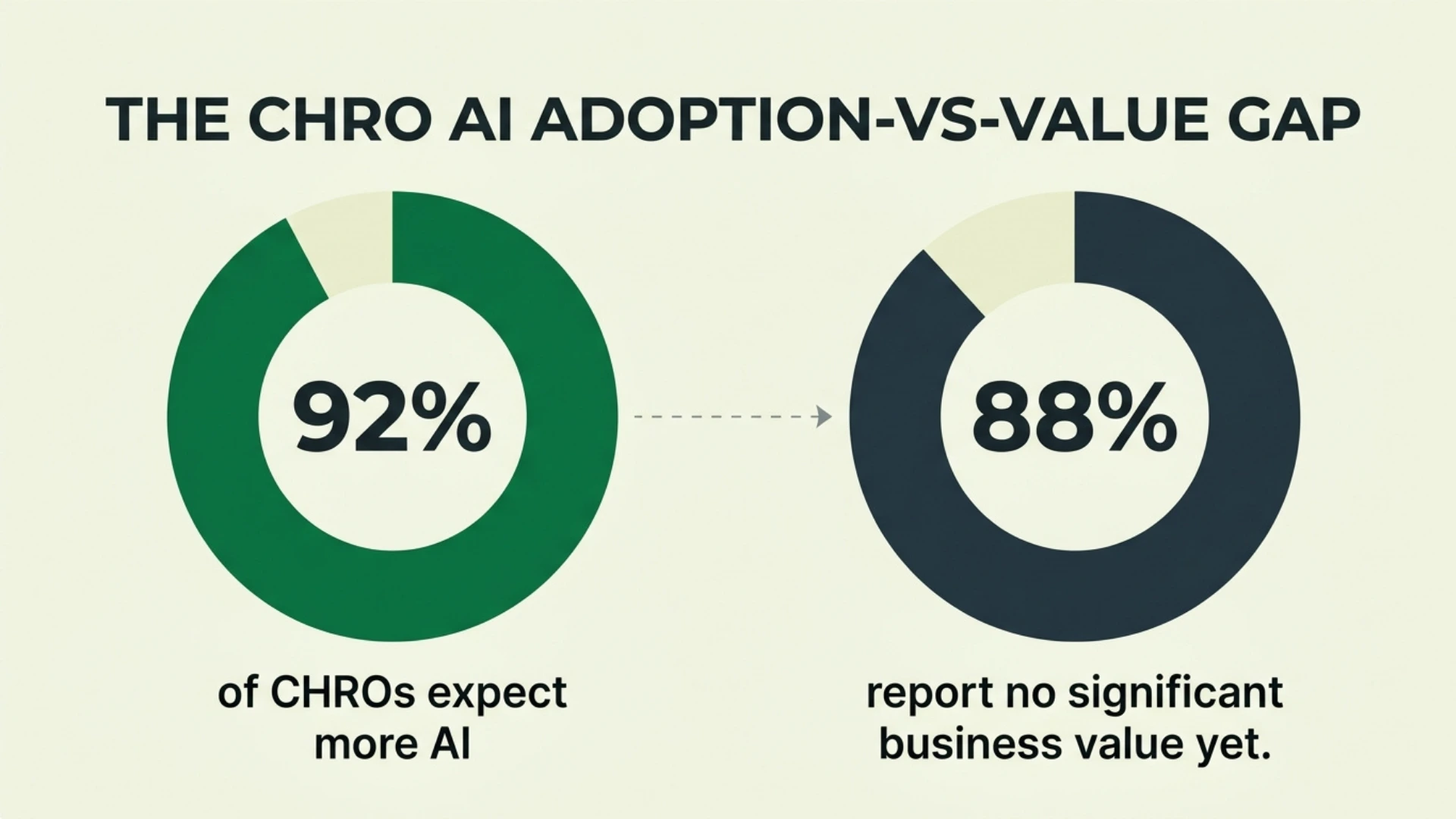
- Despite adoption, 88% of HR leaders report they haven't yet seen significant business value from their AI tools.
Source: Gartner survey of 114 HR leaders (October 2025) - 82% of HR leaders plan to deploy agentic AI within 12 months, though Gartner separately predicts more than 40% of agentic AI projects will be canceled by the end of 2027 due to cost, unclear value, or weak risk controls.
Source: Gartner, CHRO Priorities 2026 - There's a sharp trust gap around AI in hiring: only 8% of job seekers believe AI makes hiring more fair, while 70% of hiring managers say they trust AI for faster, better decisions.
Source: Greenhouse (2025) - 42% of U.S. job seekers say AI is contributing to declining trust in the hiring process overall.
Source: Greenhouse (2025) - Among HR directors and above, 73% have personally adopted AI tools, compared with 66% of managers/supervisors and 65% of individual contributors, adoption is led top-down.
Source: SHRM (2026) - The EU AI Act's Annex III obligations for employment-related AI systems become enforceable on August 2, 2026, carrying fines of up to €15 million or 3% of global turnover for high-risk violations.
Source: EU AI Act enforcement schedule (2026) - More than half of organizations (54%) have not adopted any form of AI in HR and have no plans to in 2026, the "adoption gap" remains wide despite executive enthusiasm.
Source: SHRM, State of AI in HR 2026 (n=1,722) - The global online recruitment technology market is projected to grow from $17.5 billion in 2026 to $46 billion by 2034.
Source: MSH, Recruitment Trends & Statistics (2026)
4. Employee Attrition & Retention
Global engagement just hit its lowest point in five years, and most departures were preventable, the data points to culture and management, not compensation, as the real driver of who stays and who leaves.
- Global employee engagement fell to 20% in 2025, its lowest level since 2020, costing the world economy an estimated $10 trillion in lost productivity.
Source: Gallup, State of the Global Workplace 2026 (5.7M+ respondents, 140+ countries/territories) - Voluntary turnover costs U.S. employers more than $1 trillion per year.
Source: Gallup - Replacing an employee costs 50–200% of their annual salary depending on role: roughly 40% for frontline workers, 80% for technical/professional roles, and up to 200% for leaders and managers.
Source: Gallup - 42% of employees who voluntarily left a job say their manager or organization could have done something to prevent it.
Source: Gallup (2024) - More than half of the U.S. workforce is either actively job-searching or "watching" the market, the highest self-reported flight risk since 2015.
Source: Gallup - McKinsey's "Great Attrition" research found that toxic workplace culture is over 10 times more predictive of voluntary attrition than compensation.
Source: McKinsey & Company
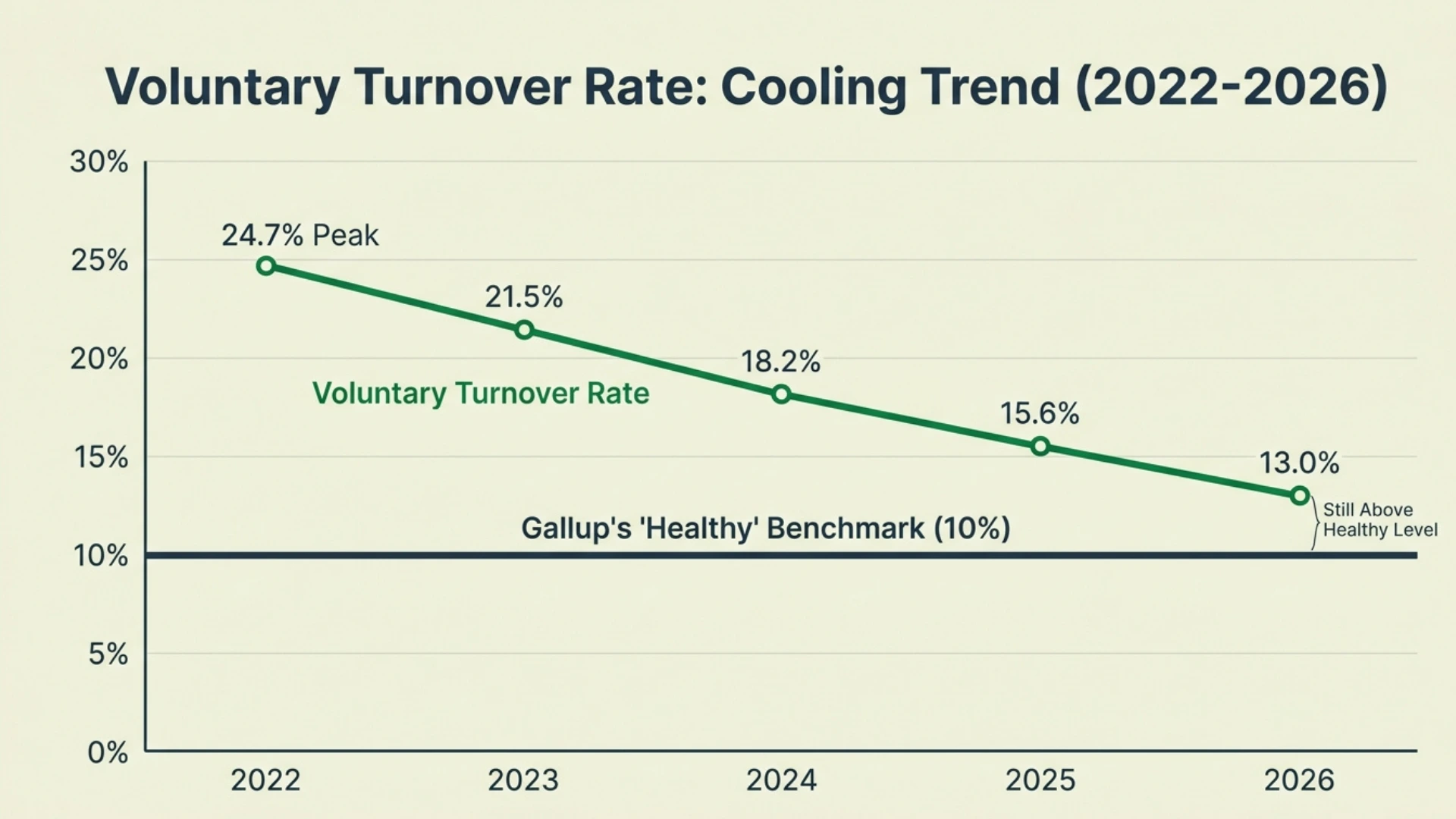
- Average voluntary turnover across a survey of 2,617 organizations sits at 13%, down from the Great Resignation peak of 24.7% in 2022, but still above Gallup's "healthy" 10% benchmark.
Source: Mercer, US Turnover Survey - Highly engaged employees are significantly more likely to stay, and organizations with strong engagement report meaningfully lower turnover and higher profitability.
Source: Gallup, State of the Global Workplace - Turnover varies sharply by industry: hospitality and food service run turnover multiples above the all-industry average, while government, insurance, and professional services sit far below it.
Source: Mercer / BLS JOLTS compilation (2026) - Backfilling a mid-level role typically costs $30,000–$45,000 before factoring in lost productivity, onboarding time, and cultural disruption.
Source: Gallup-derived industry estimates
5. Compensation & Benefits
Pay increases have settled into a steady, unspectacular rhythm, but pay transparency and rising benefit costs are reshaping compensation strategy far more than base salary budgets are.
- Employers project an average total salary increase budget of 3.5% for 2026, including 3.2–3.3% for merit increases, the third consecutive year of relative stability after the sharper increases of 2021–2023.
Source: Mercer, QuickPulse U.S. Compensation Planning Survey (Sept 2025, n=1,157 compensation leaders) - Compensation growth is moderating fastest in sales, marketing, customer service, and especially entry-level/non-specialized IT roles, even as top AI and ML talent continues to command a premium.
Source: Mercer (2026) - Fully remote employees are seeing smaller year-over-year pay increases (3.6%) compared with the broader employee population (4.0%).
Source: Mercer (2026) - Employer preparedness for pay transparency compliance rose to nearly 50% in 2025, up from 32% in 2024, but only 14% of organizations have fully implemented their transparency strategy across the business.
Source: Mercer, Global Pay Transparency Survey, 1,600+ organizations across 60 markets (2026) - The share of job postings disclosing hiring pay ranges is expected to rise from 60% in 2024 to 94% by the end of 2026.
Source: Mercer (2026) - Regional readiness for pay transparency varies widely, the Nordics, U.S., and Canada lead, while the UK and Asia-Pacific lag.
Source: Mercer (2026) - Employers project U.S. health-benefit costs per employee to rise 6.5% in 2026, the largest jump in 15 years and the fourth consecutive year above 5%.
Source: Mercer - Global employer medical-benefit costs are projected to rise 10.4% in 2025, a third straight year of double-digit increases, led by Asia-Pacific.
Source: Mercer - Employers plan to promote an average of 8.1% of their workforce in 2026, down from the 10% forecast for 2025.
Source: Mercer (2026) - Benefits now make up nearly 30% of total employer compensation cost for U.S. private-industry workers.
Source: U.S. Bureau of Labor Statistics, Employer Costs for Employee Compensation (Dec 2025)
6. Remote & Hybrid Work
Hybrid has stopped being a negotiation and become the default, the data shows it's now a bigger retention lever than most compensation changes, and employees will act on it if it's taken away.
- Among U.S. employees in remote-capable jobs, 52% now work hybrid, 26-27% work fully remote, and roughly 20-22% work fully on-site, a balance that has held steady for nearly three years.
Source: Gallup, Indicator: Hybrid Work (Q1 2026) - Hybrid workers now spend roughly 46% of their workweek in the office (about 2.3 days), up from 42% in 2022; among hybrid employees specifically, 34% go into the office 4 days a week, up from 23% in 2023.
Source: Gallup / Owl Labs, State of Hybrid Work 2025 - 88% of U.S. employers now offer at least some hybrid work option, though only 25% offer it to all employees.
Source: Robert Half (2026) - If hybrid or remote work were eliminated entirely, 40% of workers say they would start job hunting, 22% would demand a raise to compensate, and 5% would quit immediately.
Source: Owl Labs, State of Hybrid Work 2025 - Cisco's 2025 study found 69% of employers reported improved employee retention after introducing hybrid arrangements; companies requiring only one in-office day per week saw the largest boost, averaging a 41% retention improvement.
Source: Cisco (2025) - When employees moved from full-time office work to a two-day-a-week hybrid schedule, resignations fell 33% with no loss of productivity or promotion rates.
Source: Stanford / Nature (2025-2026 research, Prof. Nicholas Bloom) - 83% of workers say hybrid is their preferred work arrangement overall.
Source: Owl Labs, State of Hybrid Work 2025 - The average employee values the ability to work from home 2-3 days per week at roughly 8% of their annual salary, meaning many would accept a pay cut to keep hybrid flexibility.
Source: Stanford SWAA survey, Bloom, Barrero & Davis - 12% of executives with hybrid and remote employees plan any return-to-office mandate; 17% of recent job quitters left specifically because their employer changed office policy.
Source: McKinsey (2026) - Remote-capable technology employees lead remote adoption globally, with 47% working fully remote and 45% hybrid, sharply higher than most other sectors.
Source: Gallup (2026) - Only 42% of employees say they would comply with a full return-to-office mandate; the rest say they would quit or start job-searching.
Source: Stanford, Survey of Working Arrangements and Attitudes (SWAA) - 91% of employees whose hybrid schedule is set collaboratively at the team level say it feels fair, compared with just 73% where the schedule is imposed top-down by the company.
Source: Gallup, via Hubstar, Hybrid Work Trends (2026)
7. Diversity, Equity & Inclusion (Global)
Eleven years into tracking the numbers, the pipeline still breaks at the same point, the first step into management, and 2026's data shows organizational investment in fixing it is actually pulling back, not accelerating.
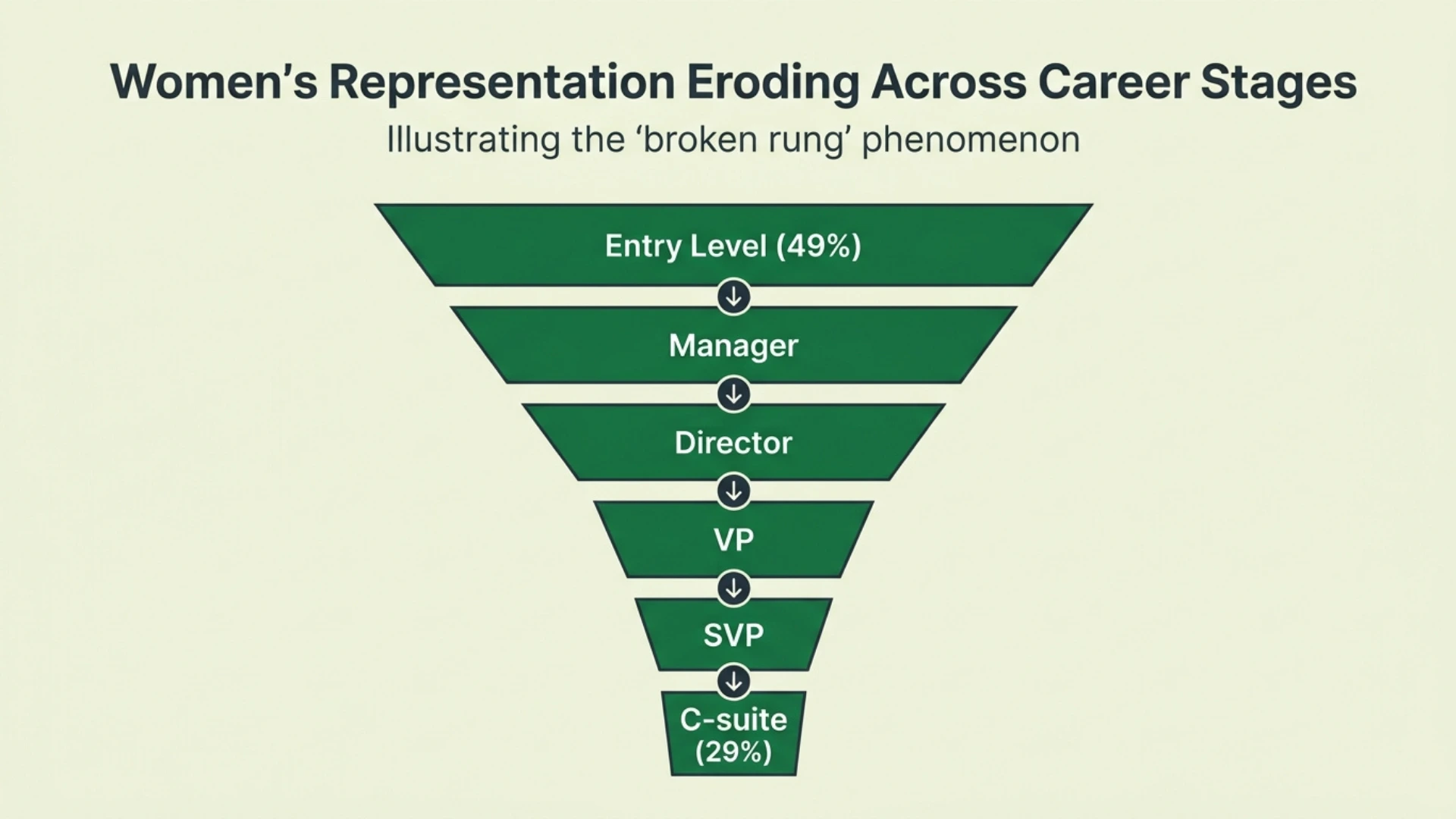
- Women hold just 29% of C-suite roles, unchanged from 2024, and remain underrepresented at every level of the corporate pipeline for the 11th consecutive year.
Source: McKinsey & LeanIn.org, Women in the Workplace 2025 (124 organizations, ~3M employees, ~9,500 employees surveyed) - Women represent 49% of entry-level employees, but that share erodes at every step up (manager, director, VP, SVP) until fewer than 1 in 3 C-suite seats belongs to a woman. For every 100 men promoted to their first manager role, only 81 women make the same leap, the "broken rung."
Source: McKinsey & LeanIn.org, Women in the Workplace 2025 - For the first time in the study's 11-year history, a measurable "ambition gap" has emerged: 80% of women want to be promoted to the next level, compared with 86% of men, a gap that widens further at entry and senior levels.
Source: McKinsey & LeanIn.org, Women in the Workplace 2025 - Only 31% of entry-level women have a workplace sponsor, compared with 45% of men at the same level, one of the strongest predictors of career acceleration missing disproportionately for women.
Source: McKinsey & LeanIn.org, Women in the Workplace 2025 - 6 in 10 senior-level women report frequent burnout, the highest level ever recorded in the study's history, compared with about half of senior men and roughly 4 in 10 employees overall.
Source: McKinsey & LeanIn.org, Women in the Workplace 2025
- Companies in the top quartile for gender diversity on their leadership team are 27% more likely to outperform financially than those in the bottom quartile.
Source: McKinsey & LeanIn.org, Women in the Workplace 2025 / Careerminds analysis - Organizations with robust DEI programs average 35% women in leadership, compared with 25% at companies with weak or absent DEI initiatives.
Source: McKinsey & LeanIn.org, Women in the Workplace 2025 - Despite the ambition gap, 88% of employers say they prioritize inclusivity and 67% prioritize diversity in their business, but only 54% say that includes actively promoting women, and just 46% say it includes advancing women of color specifically.
Source: McKinsey & LeanIn.org, Women in the Workplace 2025 - Investment in DEI programs is showing real retrenchment: 13-17% of organizations report scaling back or discontinuing inclusion and diversity resources in the past year, versus only 6-9% scaling up.
Source: McKinsey & LeanIn.org, Women in the Workplace 2025 - 60% of women in high-level roles report burnout, compared with 50% of men in equivalent positions, a gap researchers link partly to unequal access to AI tools and productivity support at senior levels.
Source: McKinsey & LeanIn.org, Women in the Workplace 2025
8. Gen Z & the Future of Work
Gen Z is fast becoming the largest generation in the workforce, and the data shows their priorities, stability, recognition, and sustainable ambition, are quietly resetting what "career growth" means for everyone else too.
- Gen Z makes up roughly 26–30% of the global workforce in 2026 and is projected to reach 35–40% by 2030.
Source: McKinsey / World Economic Forum workforce projections - In the U.S., Gen Z has already surpassed Baby Boomers in workforce share.
Source: U.S. Bureau of Labor Statistics (2026) - 72% of Gen Z employees have either left or seriously considered leaving a job because it lacked flexible work options.
Source: LinkedIn workforce survey - Work-life balance (76–77%) outranks salary as Gen Z's top priority when evaluating a job offer, according to multiple independent surveys.
Source: McKinsey, American Opportunity Survey - Deloitte's 2026 Global Gen Z and Millennial Survey, 22,500+ respondents across 44 countries, found these generations are prioritizing stability, skills, and wellbeing over fast-paced career advancement; more than half of Gen Z (55%) and millennials (52%) say they've delayed major life decisions, such as marriage or homebuying, due to their financial situation.
Source: Deloitte Global, 2026 Gen Z and Millennial Survey - 76% of Gen Z and 67% of millennials say they're interested in eventually pursuing executive leadership, but only 6% cite leadership as their primary career goal; ambition is present but conditional on sustainable workload and wellbeing.
Source: Deloitte Global, 2026 Gen Z and Millennial Survey - Gen Z's average early-career job tenure is just 1.1 years, the shortest of any generation, and roughly 1 in 3 plan to change jobs within the next year.
Source: Randstad, Gen Z Workplace Blueprint (2025) - When Gen Z employees are satisfied with the recognition they receive at work, 61% report good mental wellbeing; when dissatisfied, that drops to 41%, a 20-point swing tied to a single, controllable factor.
Source: Deloitte Global, 2025 Gen Z and Millennial Survey - Gen Z is the most ethnically diverse generation entering the workforce to date.
Source: Pew Research Center - Nearly 40% of workers report their employer has provided practical, day-to-day AI-skills workshops as part of workplace AI rollout.
Source: SHRM, Navigating AI in the Workplace (2026, n=5,875 U.S. workers)
9. Compliance & Data Privacy (Global)
Regulation is finally catching up with how HR actually uses data and AI, from India's DPDP timeline to the EU AI Act, and most organizations still have real ground to cover before enforcement dates hit.
- India's DPDP Rules were notified on November 13, 2025, with a phased rollout, Consent Manager provisions become mandatory November 13, 2026, and full substantive compliance obligations, including HR/employee-data handling, are enforceable by May 13, 2027. Penalties for non-compliance can reach ₹250 crore.
Source: DPDP Act, 2023 / DPDP Rules, 2025 (Government of India, MeitY) - Despite the runway, readiness is uneven: an EY survey of 150+ professionals across sectors found close to 70% are not very familiar with the DPDP Act and Rules, and more than 83% of organizations have not begun comprehensive implementation.
Source: EY India, "India's Digital Privacy Crossroads" (2026) - The EU AI Act's employment-related obligations (Annex III, high-risk systems) become enforceable August 2, 2026, requiring documented risk assessments for any AI used in hiring or HR decisions.
Source: EU AI Act enforcement schedule (2026) - Organizations with an existing GDPR compliance program are estimated to be roughly 60-70% of the way toward DPDP compliance, since data mapping, privacy-by-design practices, and breach-response protocols largely transfer, though DPDP's consent-first model and India-specific obligations still require a dedicated build-out.
Source: DPDP/GDPR compliance comparison analysis (2026)
Key Takeaways
Identity is the new frontier of hiring risk. Nearly 3 in 4 recruiters have already run into AI-fabricated resumes or credentials, but fewer than 1 in 5 hiring managers feel confident they can catch it.
- AI adoption in HR has outpaced AI value. 92% of CHROs expect more AI in 2026, yet 88% of HR leaders say they haven't seen real business value from it yet.
- Engagement, not just pay, is driving attrition. Toxic culture is over 10x more predictive of attrition than compensation, and 42% of departures were preventable.
- Flexibility is now table stakes, not a perk. From hybrid work to pay transparency, employees, especially Gen Z, treat these as baseline expectations.
- Regulation is catching up fast. Between the EU AI Act, India's DPDP Act, and GDPR, 2026 is the year HR compliance and AI governance stop being separate conversations.
