

 8 mins read
When professionals begin looking for a new job, preparing a strong application is an important first step. Along with a well-structured resume, a cover letter can help explain a candidate's relevant experience, skills, and interest in the role. Before applying, candidates should also ensure that their resume clearly presents their education, skills, experience, and other relevant qualifications.
But sending a resume or CV is not enough. A supporting document along with the resume/CV that explains the skills, experiences, relevancy to the role and interest in the company etc is also necessary. This document is the cover letter.
When someone sends a cover letter, they are directly introducing themselves personally to the HR of a company. A properly written cover letter creates a strong first impression. A cover letter explains why the applicant is interested in the position.
Therefore, it is important to know how to write a cover letter. We will start by writing what a cover letter is and then we will move forward to points.
What is a Cover Letter?
A cover letter is typically a concise professional document submitted alongside a resume or CV. It gives candidates an opportunity to introduce themselves, highlight relevant qualifications and experience, and explain why they are interested in a particular position and organization.
Write a Compelling Cover Letter :
A well-written cover letter follows a clear structure and should be tailored to the position you are applying for. The following steps can help candidates create a professional and effective cover letter.
Format the Header
Write the name, phone number and email address in the header section of the cover letter. Also write the date and company’s details. Including these details makes it easy for the hiring manager or recruiter to identify the candidate and contact them if needed.The header template is given below:
Your name
City & state
Phone number
Email Address
Date
Recipient’s Name
Recipient’s Title
Company’s Name
Company’s Address
Let’s fill these out to help you understand it:
Charlotte Richmond
Houston, Texas
713-837-0311
September 7, 2026
Sarah Jenkins
Senior Marketing Manager
BMC Software
Houston, Texas
Use a Professional Greeting
Start with a polite and professional greeting. If you know the person reviewing your application, then mention the name. Address them directly. If you don't then simply write them as Hiring Manager. Let’s understand it with an example.
If the hiring manager's name is Sarah Jenkins, you could write “Dear Ms. Jenkins.” If you cannot identify the appropriate contact, “Dear Hiring Manager” is a suitable alternative.
Write a Strong Introduction
Now write a strong introduction. Mention the position you are applying for. For example, "Marketing position". You can also mention the platform where you saw the job description. You can write "Indeed", "Glassdoor", "LinkedIn" or wherever you see the job.
Briefly explain why you are interested in the role. Also explain why you are specifically interested in joining their company. You can mention any specific detail about the company which increases your interest.
This will show that you have researched the company. The opening paragraph is an important part of your first impression on the hiring team. A strong introduction encourages HR to continue reading.
For Example:
“I am excited to apply for the Marketing position at BMC Software. My experience in digital marketing and content creation has helped me develop campaigns that improve audience engagement and strengthen online visibility. I’m particularly interested in this opportunity because it would allow me to apply my marketing skills while contributing to a technology-focused organization.”
Write Body Paragraph
The next important part is to write about your relevant skills and experiences. Add your achievements, skills and specialities which make you well suited for the position. Write down one or two examples which highlight your success on any project.
Analyze the keywords added in the job description. Add these keywords in your cover letter as well. If an employer uses an applicant tracking system (ATS), reviewing the job description and naturally incorporating relevant skills and terminology into your resume and cover letter can help ensure your application clearly reflects the requirements of the role. Avoid adding keywords unnaturally or simply repeating terms from the job description.
Example:
“In my previous position as a Marketing Assistant at Smarter IT, I ran social media campaigns, made engaging content and provided promotional strategies. These strategies increased the company’s online visibility.
I also worked with Greenfield Retail. I was assigned to increase social media engagement and do promotions through email. My strategies helped increase social media engagement and contributed to stronger online sales.”
Explain Why You Want the Job
Show your interest in the position and the company. But you can't just type it simply. You need to prove it with your words. Explain what really attracts you or what motivates you to join the organisation. Also mention how the opportunity fits your career goals.
Take some time and search for the company. This signifies that you are genuinely interested in joining the company. An example to demonstrate in your writing:
“This position would allow me to apply my marketing skills and creativity while continuing to grow professionally. After researching your organization, I was particularly interested in its collaborative work environment and focus on employee development. I believe my experience and skills could contribute to the company's goals while allowing me to develop further in my career.”
End with a Strong Closing
End your cover letter with a paragraph that summarises the whole letter. Keep the conclusion precise and state that you are considering a reply from the employer where they may explain the next steps.
End the cover letter with a professional closing text like ‘Sincerely’ or ‘Kind Regards’. After this you need to write your name or signature. Closing Example:
“Thank you for your time and consideration. I look forward to discussing how my marketing experience and skills could contribute to your team. I would welcome the opportunity to learn more about the position and discuss the next steps.”
Kind Regards,
Charlotte Richmond”
Review Your Cover Letter Thoroughly
Before submitting your cover letter, review it carefully for spelling, grammar, clarity, and overly generic language. Make sure the letter reflects your actual experience and is tailored to the specific position and organization.
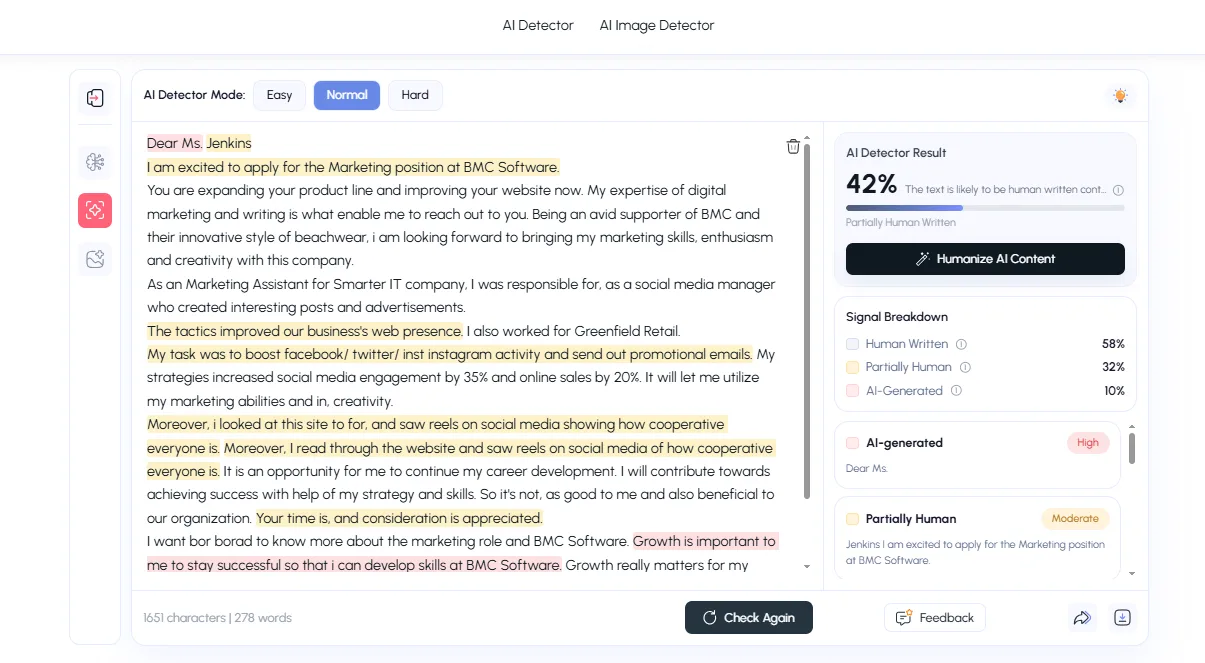
Candidates who use AI-assisted writing tools should also review the final draft carefully to ensure that the content accurately represents their experience and maintains a natural, personal tone. An AI detector can be used as an additional reference when reviewing AI-assisted content, but it should not be treated as a definitive measure of whether writing is human- or AI-generated.
The example below shows how an AI detection tool can analyze individual sentences and provide an assessment of the content.
In this example, the tool highlights individual sentences and indicates its assessment of the content. This can help users identify sections they may want to review and rewrite in their own words.
Regardless of whether an AI detection tool is used, the final cover letter should be specific to the job, accurately reflect the candidate's experience, and sound natural and authentic.
Tips to Write a Good Cover Letter:
There are a few tips for a good cover letter. A good cover letter should be clear, precise and professional. Aim to keep your cover letter concise and, in most cases, to around one page. Focus on the experience and qualifications most relevant to the position. Use a clean, professional font that is easy to read, such as Arial, Calibri, Helvetica, or another standard sans-serif font. A font size around 10–12 points is generally appropriate.
Use left alignment, single spacing, and standard one-inch margins to maintain a clean and professional layout. Customise your cover letter for each company or role. Don’t use the same cover letter for all the jobs.
What are the Best Practices to Write a Cover Letter?
Before writing your cover letter, gather the important details you want to include. This may include your current or previous employer, relevant responsibilities, key accomplishments, skills, and other qualifications. Having these details ready can make the writing process more efficient.
- Highlight relevant experience: Focus on experience, skills, and achievements that relate directly to the position.
- Mention how you found the opportunity: If someone referred you, mention their name and title where appropriate. If you found the position through a job platform, mention the platform.
- Research the company: Review the company's website, mission, values, and other relevant information to understand whether the organization aligns withyour professional goals.
- Show genuine interest: Mention specific aspects of the company or role that genuinely appeal to you rather than relying on generic statements.
Conclusion
A cover letter is more than just an additional document. It is an opportunity to introduce yourself. You can explain your qualifications and skills. Then relate these to the role. You can also explain why you are a perfect fit for the role.
A clear and professional cover letter can help employers understand your motivation, relevant qualifications, and interest in the role. While it cannot guarantee an interview, a well-tailored application can present your experience more effectively and complement your resume.