

 11 mins read
An HR job description is a structured document that explains an HR role’s purpose, key responsibilities, required and preferred qualifications, reporting line, and success metrics. It helps candidates understand what the position involves while giving hiring teams a consistent framework for evaluating applicants and measuring performance after hiring.
A clear HR job description can help suitable candidates assess their fit, reduce avoidable application mismatches, and communicate the organization’s expectations from the beginning. This guide explains how to structure, optimize, and evaluate one effectively.
TL;DR
- Write a clear, concise HR job description focused on outcomes and culture
- Lead with a compelling summary and a precise job title
- List core responsibilities, required skills, and measurable success indicators
- Use inclusive language and highlight benefits, growth, and remote options
- Optimize for ATS with keywords and structured formatting
- Test and iterate listings using hiring metrics and candidate feedback
- Use AI and recruitment tech to shorten time to hire and improve quality
Why an HR Job Description Is Important for Hiring Success
An HR job description is the first real introduction between your team and potential hires. It sets expectations, signals company culture, and filters applicants. A clear description can help suitable candidates understand the role, reduce avoidable mismatches, and support a more efficient screening process. When recruiting for HR roles, clarity matters more than ever because your new hire will shape employee experience, talent programs, and compliance.
Common HR Job Description Mistakes to Avoid
Many hiring teams treat the job description as a checklist. They copy and paste from old postings, list every possible task, and forget to state measurable impact. When reusing content from previous job postings, HR teams can use a plagiarism remover to rewrite duplicated wording and create a more original job description while keeping the intended meaning intact. That approach can make it harder for candidates to assess their fit and may create additional screening work for the hiring team.
Instead, treat the job description as a marketing asset. Write to the candidate you want not just the applicant you can handle. Be specific about impact, avoid overloading responsibilities, and include measurable goals so applicants can self-select.
HR Job Description vs. HR Job Posting: What Is the Difference?
An HR job description and an HR job posting are related, but they serve different purposes.
An HR job description is usually an internal role document. It defines the position’s purpose, reporting line, responsibilities, required qualifications, decision-making authority, and success metrics. Hiring managers and HR teams can use it for recruitment, onboarding, performance management, and workforce planning.
An HR job posting is the candidate-facing version of that document. It presents the most relevant information in a clear and persuasive format to attract suitable applicants. It usually includes the job title, role summary, key responsibilities, qualifications, salary range, benefits, work arrangement, company culture, and application instructions.
The job description should provide the factual foundation for the role, while the job posting should communicate that information in a concise and candidate-friendly way. The two documents should remain consistent, but the job posting does not need to include every internal detail.
How to Structure an HR Job Description that Converts
A well-structured HR job description follows a predictable and scannable layout. Recruiters, hiring managers, and applicant tracking systems prefer consistency. Use short paragraphs, clear headings, and bullet lists. Below is a practical template you can adapt.
1. Write a Clear Job Title and Location
Start with a precise title. Avoid vague labels like HR Ninja. Use titles candidates search for, such as HR Generalist, HR Business Partner, or Talent Acquisition Manager. Add location and remote options.
Example: HR Business Partner, Remote with occasional travel.
2. Add a Compelling Job Summary
Open with a two to three sentence summary that answers why the role exists and the impact the hire will make. Mention team size, reporting line, and one outcome.
Example: "We seek an HR Business Partner to support our product and engineering teams. You will shape people strategy, improve retention, and partner with leadership to scale our people practices."
3. Define Key Responsibilities
List five to eight core responsibilities using action verbs. Focus on outcomes, not tasks.
Good items include:
- Partner with leaders to define people priorities and talent plans
- Drive performance management cycles and manager coaching
- Design and implement employee engagement and retention programs
- Manage HR policy, compliance, and onboarding processes
4. List Required Qualifications and Skills
Separate must-haves from nice-to-haves. Keep the must-haves short and realistic.
Example must-haves:
- Three to five years of HR experience supporting technical teams
- Proven experience with performance management and employee relations
- Strong interpersonal and communication skills
Optional skills can include experience with HRIS, ATS platforms, and talent analytics.
5. Include Success Metrics
Tell candidates how success will be measured in the first six to twelve months. Examples include improving new hire retention by a measurable percent, reducing time to fill for priority roles, or raising engagement scores. Adding measurable goals helps candidates understand what the organization expects and allows them to assess whether the role matches their experience and career goals.
When possible, list a target or baseline so applicants know the scale of the challenge and the opportunity for impact.
6. Highlight Compensation and Benefits
Show a salary range and key benefits when possible. Providing an accurate salary range helps candidates evaluate whether the role meets their expectations before applying. It can also make the hiring process more transparent. Highlight relevant benefits such as remote-work policies, learning budgets, healthcare, and equity where applicable.
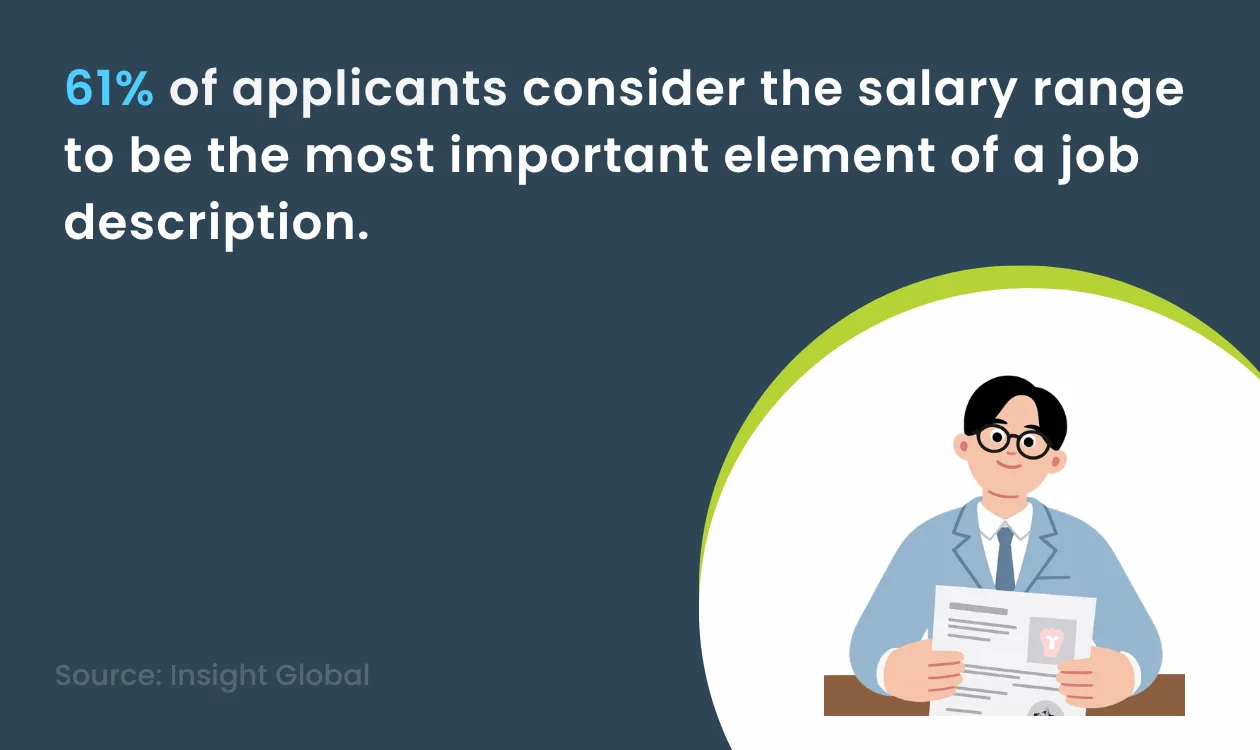
Compensation is one of the most important factors candidates evaluate, 61% of job seekers consider salary range the most important part of a job description, according to a hiring trends report by Insight Global.
Example: "Competitive salary range, flexible remote policy, professional development stipend, and equity grant."
7. Describe Culture and Growth Opportunities
Use a short paragraph to describe team culture and growth opportunities. Candidates for HR roles care deeply about company values and leadership philosophy. Mention mentoring, career paths, and any people-focused initiatives.
For roles such as an HRBP, an HR manager job posting, or an HR recruiter job description, call out specific development pathways. For example, describe how an HRBP might progress to a senior people leader role or how a recruiter can grow into talent strategy.
8. Explain How to Apply
End with clear application steps. Let candidates know what to include in their application and expected timelines.
Example: "Apply with a resume and a brief note about a people program you built. We aim to respond within two weeks."
How to Optimize an HR Job Description for ATS and Candidates
Both humans and systems read your HR job description. Clear keywords and consistent formatting can improve how easily candidates and applicant tracking systems interpret the description.
Use the Right Keywords in Your Job Description
Run simple keyword checks in your ATS or job boards to find terms candidates use. Include role-based keywords such as "HR generalist," "talent acquisition," "employee relations," and relevant software like "iSmartRecruit," "Greenhouse," or "BambooHR." Do not keyword stuff. Place keywords naturally in responsibilities and skills lists. Also include role-specific phrases like HRBP job description, HR manager job posting, and HR recruiter job description to improve match and discoverability.
Format Your Job Description for Easy Scanning
Candidates skim job posts. Use bullets, bold key phrases, and short paragraphs. Lead with the most attractive information. Use concise sentences, short paragraphs, and descriptive headings to make the job description easier to scan and understand.
Make Your Job Description Mobile-Friendly
Candidates may view job postings on phones, tablets, and desktop devices. Use short headings, concise paragraphs, readable text, and simple application steps so the experience works across screen sizes. Track application completion and abandonment rates to evaluate whether mobile usability needs improvement.
How to Write an Inclusive HR Job Description
Use inclusive language to make the role understandable and welcoming to a broader range of qualified candidates. Avoid gendered terms and jargon that deter qualified candidates. Tools that flag biased wording can help. Also highlight flexible work, caregiver policies, and accommodations to signal inclusion.
Include concrete accessibility details such as whether interviews can be scheduled outside core hours or if documents are available in accessible formats. These details help candidates understand what support is available and may encourage qualified applicants who require flexibility or accommodations to continue with the application.
Tip: Replace "must be comfortable working late" with "flexible hours may be required during peak periods." The second phrasing describes reality without alienating candidates.
Examples of Effective HR Job Description Openings: HRBP, HR Manager, HR Recruiter
Examples help hiring teams visualize tone and structure. Below are three brief openings for different HR roles.
HR Generalist
"We are hiring an HR Generalist to support our fast-growing operations team. You will manage onboarding, benefits administration, and employee relations. If you enjoy solving people challenges and building processes that scale, join our team."
Talent Acquisition Manager
"We need a Talent Acquisition Manager to lead hiring for engineering and design. You will build pipelines, coach hiring managers on interviewing, and improve our ATS processes. Success will be measured by quality of hire and reduced time to fill."
This example can be adapted into an HR recruiter job description by emphasizing sourcing strategies, employer branding, and recruiting metrics.
People Operations Partner
"As a People Operations Partner, you will design people programs, manage HRIS enhancements, and support leadership on organizational design. You should be data driven and passionate about employee experience."
Using AI and Tools to Improve Job Description Performance
Hiring teams can use AI tools and ATS features to draft, review, publish, and evaluate job descriptions. AI can draft first versions and suggest inclusive language. Depending on the platform and its tracking configuration, ATS analytics may provide information about application abandonment, completion time, applicant sources, and conversion rates. Combine automation with human review to maintain accuracy and employer brand.
Establish guardrails for AI outputs such as reviewing role-specific accuracy, legal compliance, and compensation language before publishing. Protect candidate data and avoid overreliance on automated decisions.
Practical Workflow
- Draft the HR job description using a template
- Run an inclusive language check and ATS keyword audit
- Publish to job boards and track metrics
- Iterate based on application quality and candidate feedback
Measuring success of your HR job description
Track these metrics to evaluate and improve performance: application rate, qualified candidate rate, time to fill, and offer acceptance rate. Use candidate surveys to learn why applicants applied or declined. Changes to wording, compensation, benefits, formatting, or application steps may affect performance. Compare results against a historical baseline and avoid attributing changes to one edit when other hiring conditions have also changed.
Benchmark against your historical performance and industry norms where possible. Use cohorts to test wording changes so you can attribute impact to specific edits.
Hypothetical Examples of HR Job Description Improvements
The following hypothetical examples show how hiring teams can test and improve an HR job description. Results will vary depending on the role, employer brand, labor market, compensation, and application process.
Example 1: Improving Candidate Quality
A staffing company receives many applications for an HR recruiter role, but only a small percentage of applicants meet the essential requirements.
The hiring team shortens the job description, separates required qualifications from preferred qualifications, and adds clear success metrics for the first six months. After publishing the revised version, the team compares the qualified applicant rate, screening time, and interview conversion rate with the previous posting.
This test can help determine whether clearer requirements attract candidates who are better aligned with the role.
Example 2: Expanding the Candidate Pool
A growing company wants to attract candidates from a wider range of locations for a People Operations role.
The hiring team adds clear remote-work information, flexible scheduling details, accessibility accommodations, and location requirements. It then compares application volume, application completion rate, candidate locations, and qualified applicant rate before and after the update.
This approach can help the company understand whether clearer flexibility and accessibility information broadens its candidate pool.
These examples are illustrative rather than guaranteed outcomes. Hiring teams should test changes against their own historical data and consider other factors that may influence performance, including salary, employer reputation, job-board reach, and labor-market conditions.
Common mistakes to avoid
- Listing every possible responsibility rather than core priorities
- Using vague language that creates confusion about expectations
- Failing to include salary range or remote policy
- Not optimizing for ATS keywords or mobile viewing
- Overusing internal jargon that external candidates do not understand
Final checklist before posting
- Clear and searchable job title
- Two to three sentence compelling summary
- Five to eight outcome-focused responsibilities
- Separate must-have and nice-to-have qualifications
- Salary range and top benefits called out
- Inclusive language and mobile friendly layout
- ATS keyword optimization and tracking enabled
Conclusion
Writing an effective HR job description is a repeatable skill. Leading with clarity, measurable outcomes, and candidate experience can help suitable applicants evaluate the role and support a more focused hiring process. Use the templates and tips here to improve one posting at a time and measure impact.
Start by rewriting one job description using this framework, establish a baseline, and track whether qualified applicant rate, application completion, and screening efficiency change after publication. Stay ahead of the curve - explore more HR insights on NextInHR.