
 11 mins read
When a confidential CEO assignment arrives, a firm may need to identify experienced leaders within weeks. A leadership talent pipeline developed in advance preserves market intelligence, relationships and career context, reducing duplicated research. Executive search software can connect this knowledge with talent mapping and assignment workflows. See our executive search guide and compare six platforms.
TL;DR
- Build leadership talent pipelines before assignments arrive to reduce duplicated research and preserve market knowledge.
- Map target organisations and define leadership profiles based on industry, experience, geography, and business needs.
- Research and verify executives using credible sources, advanced search, and AI-assisted discovery.
- Organise executives into relevant talent pools and maintain professional relationships through meaningful follow-ups.
- Keep executive records accurate, protect confidential information, and review profiles regularly.
- Use executive search software to connect databases, relationship management, talent mapping, and assignment workflows.
- Measure pipeline quality through data accuracy, market coverage, follow-up completion, and the relevance of researched profiles.
What is a leadership talent pipeline in executive search?
A leadership talent pipeline is a maintained pool of relevant senior professionals supported by market intelligence and relationship history. Unlike an assignment-specific shortlist, it exists before a particular role needs to be filled.
A firm might maintain pools for CFOs with private equity experience, CTOs who have scaled SaaS businesses and board directors from regulated industries. Record career context and follow-ups, but verify details for each assignment. External pipelines map the wider market; succession plans focus on internal successors.
Why build leadership pipelines proactively?
- Reduce duplicated research: Reuse maps and profiles, checking them against each new brief.
- Improve market visibility: Understand target organisations and leadership structures.
- Build relationships early: Maintain relevant conversations before vacancies arise.
- Preserve knowledge: Shared records reduce reliance on personal inboxes.
- Broaden discovery: Find leaders beyond familiar networks.
- Prepare for assignments: Identify existing knowledge and research gaps.
A pipeline's value depends on research quality and maintenance.
How to build a leadership talent pipeline with executive search
A repeatable executive search process builds knowledge and relationships, not profile volume.
1. Define leadership profiles and target markets
Define relevant experience, sector, geography and organisational context. A private equity-backed technology firm may need a CFO with acquisition experience, while a manufacturer may prioritise international operations. Clear criteria keep leadership talent sourcing focused on evidence, not titles.
2. Map organisations and leadership teams
Identify target companies, leadership structures and career paths. Executive talent mapping must be refreshed as organisations and leaders change.
3. Research and verify potential leaders
Use credible professional and company sources. Boolean search supports precise queries; semantic search may find differently worded experience. AI-assisted matching can narrow research, but consultants must verify details and prioritise relevance.
4. Segment executives into talent pools
Group profiles by function, sector and experience. Consistent tags make records easier to retrieve and reduce duplicates.
5. Build relationships before assignments
Maintain relevant conversations, respect communication preferences and record meaningful interactions. Reminders support follow-through but should not replace genuine engagement.
6. Maintain accurate records
Keep career histories, contact details, notes and follow-ups current. Correct duplicates and outdated details, and apply access controls. An executive search CRM preserves relationship context across the team.
7. Activate the pipeline for a new assignment
Revisit relevant pools and verify that executives and information still fit the brief. Existing intelligence guides, but never replaces, fresh assessment.
8. Measure pipeline quality
Database size alone is a poor measure. A smaller, accurate pool can be more useful than thousands of outdated records.
Metric | What it helps assess |
Profile verification rate | Priority profiles with recently checked information |
Market coverage | Representation of target companies, sectors and leadership groups |
Follow-up completion | Planned relationship activities completed appropriately |
Data quality | Duplicates, missing information and outdated records |
Initial longlist preparation time | How quickly existing research supports an assignment |
Research relevance | Profiles relevant to a real brief |
Pipeline conversion | Progression to qualified longlists and placements |
These metrics should help identify weaknesses in the process rather than encourage unnecessary outreach or inflated profile counts.
How executive search software supports leadership talent pipelines
Capability | Practical use |
Executive database management | Preserves professional profiles, career histories and interaction records. |
Advanced search and filtering | Retrieves relevant executives using keywords, filters and experience criteria. |
Talent mapping | Organises target companies, leadership teams and market research. |
Relationship management | Maintains interaction history, referrals, relationship ownership and follow-up activities. |
Talent pool management | Groups executives by function, industry, geography and future relevance. |
AI-assisted matching | Helps identify potentially relevant profiles for human review. |
Assignment management | Connects existing research to active search requirements. |
Collaboration and reporting | Helps researchers and consultants share information and prepare client updates. |
Security and access controls | Supports confidentiality through appropriate permissions and controlled information sharing. |
Sourcing-focused tools may offer less assignment management; project-focused platforms may offer less research depth. Choose for your workflow.
Top 6 executive search software tools for building leadership talent pipelines
This comparison uses published vendor information, not independent hands-on testing. Confirm current features, pricing and configuration with providers.
Quick comparison
Software | Potential use case | Relevant pipeline capabilities | Key consideration |
iSmartRecruit | Connected executive search and recruitment CRM workflows | Advanced search, executive database management, AI-assisted research, talent pools and assignment workflows | Verify configuration, AI feature availability and data migration. |
Talentis Global | Research-led executive search | External profile discovery, company mapping, relationship intelligence and assignment management | Validate data coverage in your target markets. |
Crelate | Relationship-led recruitment and executive search | ATS, CRM, AI-assisted discovery, contact enrichment and workflow automation | Assess suitability for confidential retained searches. |
Invenias | Structured executive research and assignment management | People and company records, advanced search, target-company research and assignment tracking | Confirm current product arrangements and implementation requirements. |
Cluen Encore | Specialist executive search database and relationship management | Relationship intelligence and search-focused workflows | Verify the current offering and precise feature set. |
Clockwork Recruiting | Retained-search projects and client collaboration | Client portal, longlists, status reporting and collaborative search workflows | Assess long-term pipeline management alongside project capabilities. |
1. iSmartRecruit — connected search and talent pipeline workflows
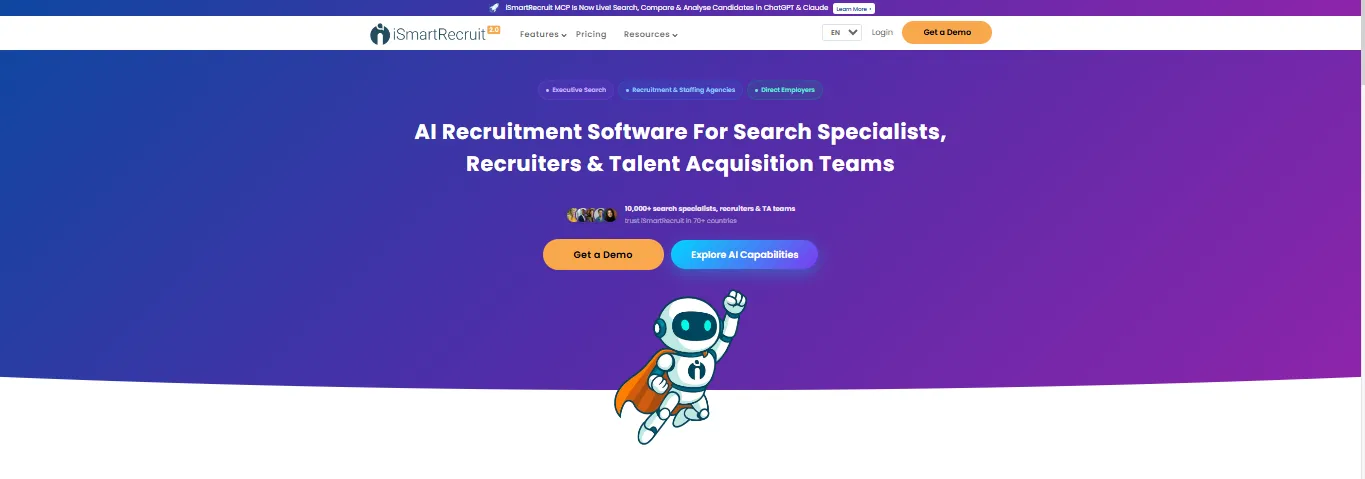
iSmartRecruit combines executive search workflows with recruiting CRM, database management and AI-assisted research. Its official product page describes advanced search, semantic matching, AI agents for executive research and sourcing, natural-language database queries through AI integrations, and branded client presentations.
Key capabilities relevant to leadership pipelines include:
- Executive database and profile management.
- Boolean and semantic search.
- AI-assisted research, sourcing and matching.
- Talent pool management and relationship history.
- Assignment workflows and client-ready presentations.
Pipeline fit: Organise profiles and relationships for future assignments; verify AI-assisted results.
Evaluate: Test search relevance, included features, confidentiality and migration.
Verdict: Worth assessing for connected search, CRM and assignment workflows.
2. Talentis Global — external research and market mapping
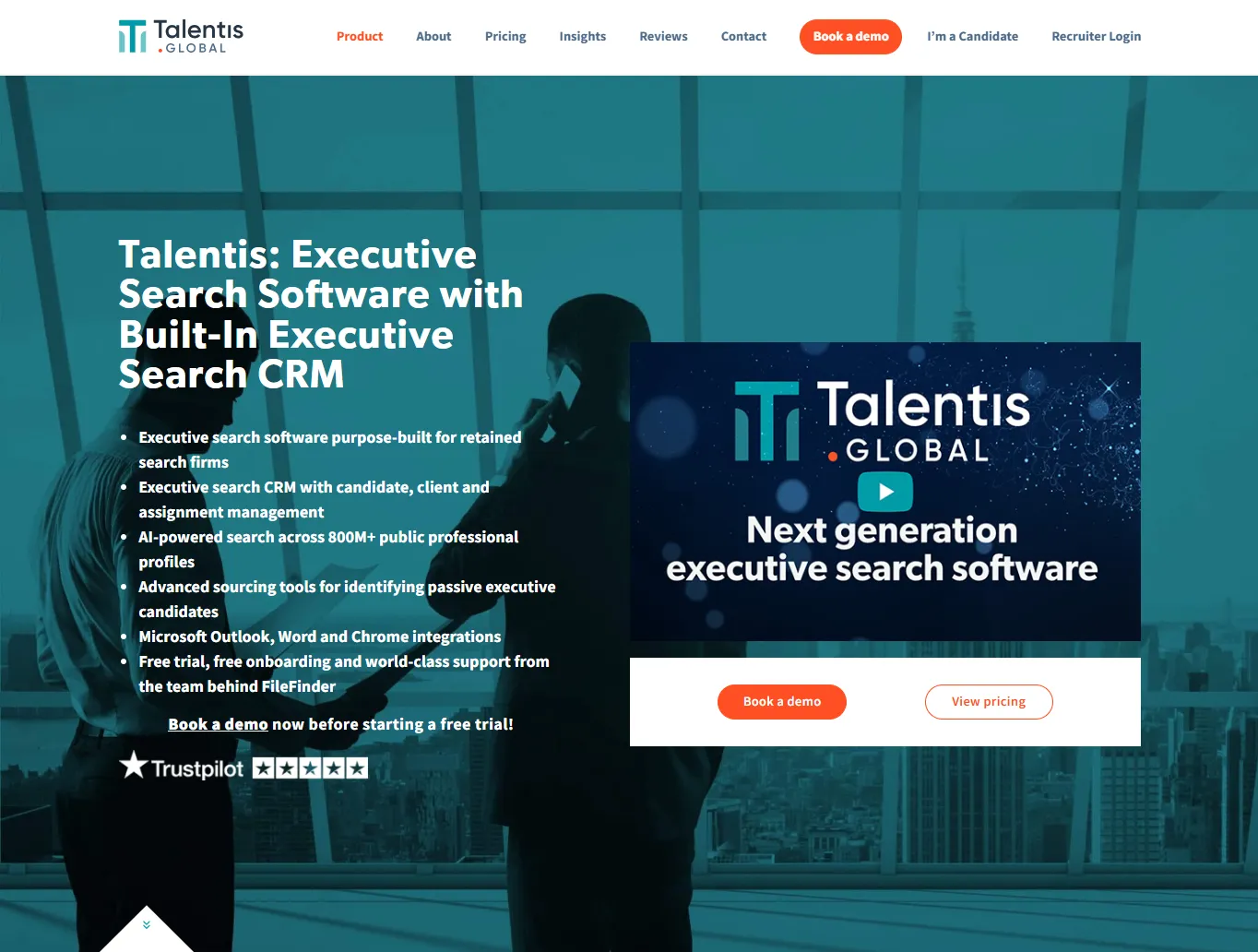
Talentis Global combines executive search CRM functionality with external professional profile research, company mapping, relationship intelligence and assignment management. Its official feature page describes access to more than 800 million public professional profiles, alongside tools for building longlists, managing assignments and conducting AI-assisted research.
Key capabilities relevant to leadership pipelines include:
- External professional profile discovery.
- Advanced search across internal records.
- Company and market mapping.
- Relationship and network mapping.
- Longlist, shortlist and assignment management.
- AI-assisted research and reporting.
- Off-limits management.
Pipeline fit: Discover executives beyond the database and retain research for future searches.
Evaluate: Check regional coverage, data freshness and included features.
Verdict: Relevant for research-led firms.
3. Crelate — connected recruiting CRM and talent discovery
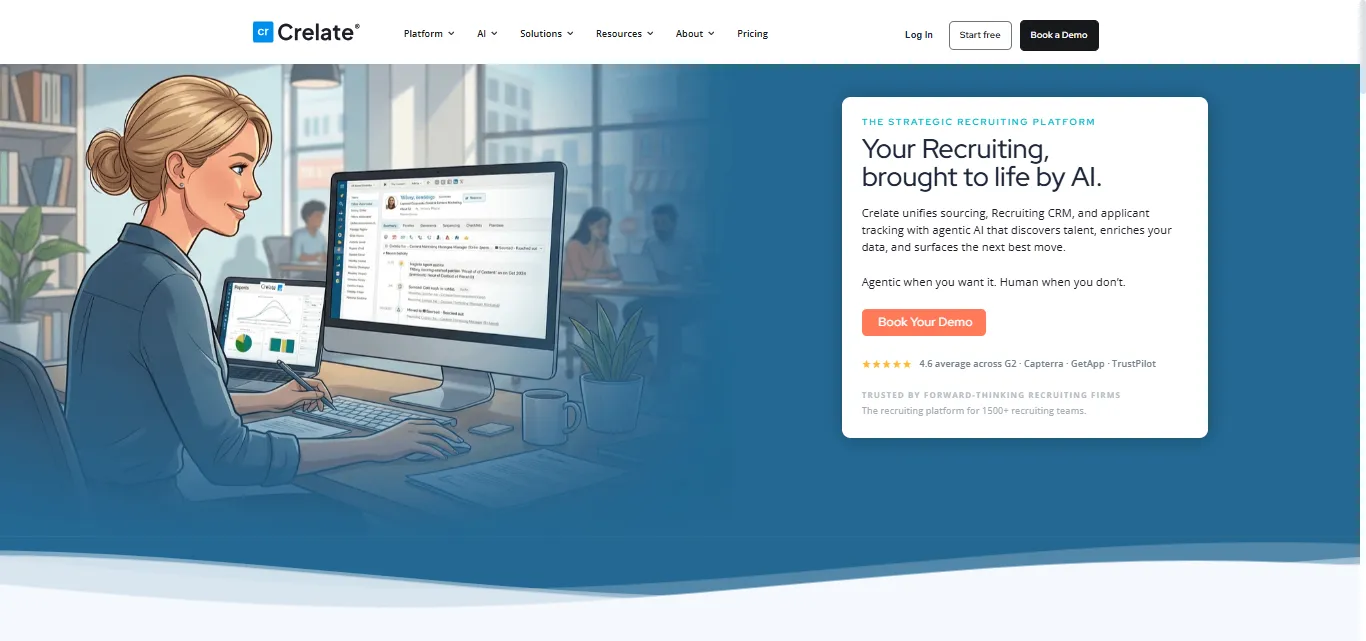
Crelate offers a recruiting platform combining applicant tracking, recruiting CRM, contact enrichment, talent discovery and workflow automation. Its current product information includes executive search use cases and relationship-led recruitment workflows.
Key capabilities relevant to leadership pipelines include:
- Recruiting ATS and CRM.
- AI-assisted talent discovery.
- Contact enrichment and data maintenance.
- Relationship and activity tracking.
- Configurable workflows and outreach sequences.
- Client portals, reporting and integrations.
Pipeline fit: Shared records support discovery and follow-ups.
Evaluate: Test confidential assignments and relationship continuity.
Verdict: Relevant for configurable recruiting CRM workflows.
4. Invenias — structured executive research and assignment management
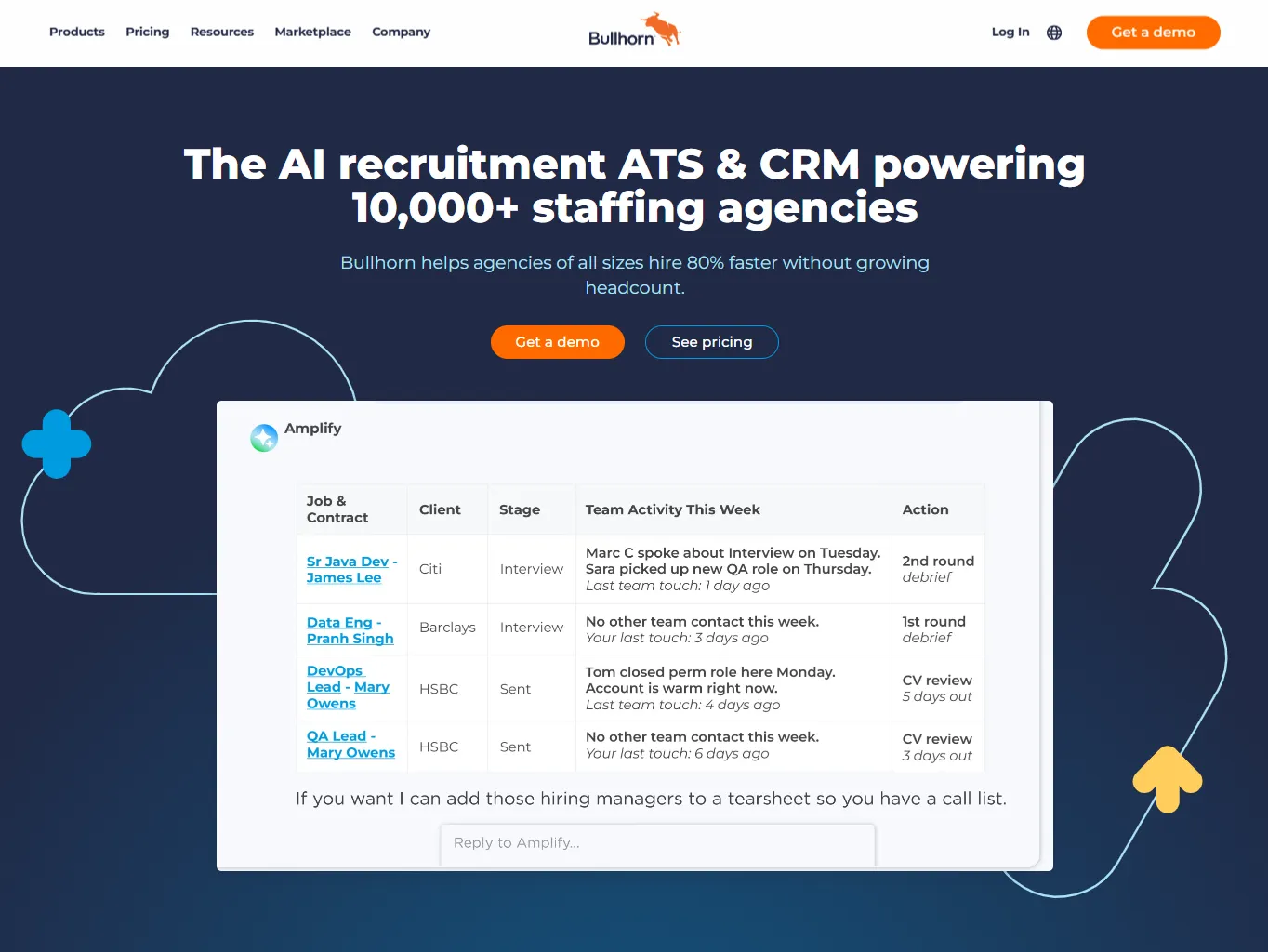
Invenias, offered by Bullhorn, supports structured people, company and assignment records. Its official product information describes executive research, assignment workflows, client collaboration and reporting.
Key capabilities to evaluate include:
- Searchable people and company records.
- Advanced search and research workflows.
- Target-company and referral-partner research.
- Assignment tracking and status management.
- Research notes and supporting records.
- Client collaboration and deliverables.
Pipeline fit: Connect target organisations and leaders to assignments.
Evaluate: Confirm current arrangements, integrations and historical-data migration.
Verdict: Relevant for structured research and assignments.
5. Cluen Encore — relationship-driven executive search
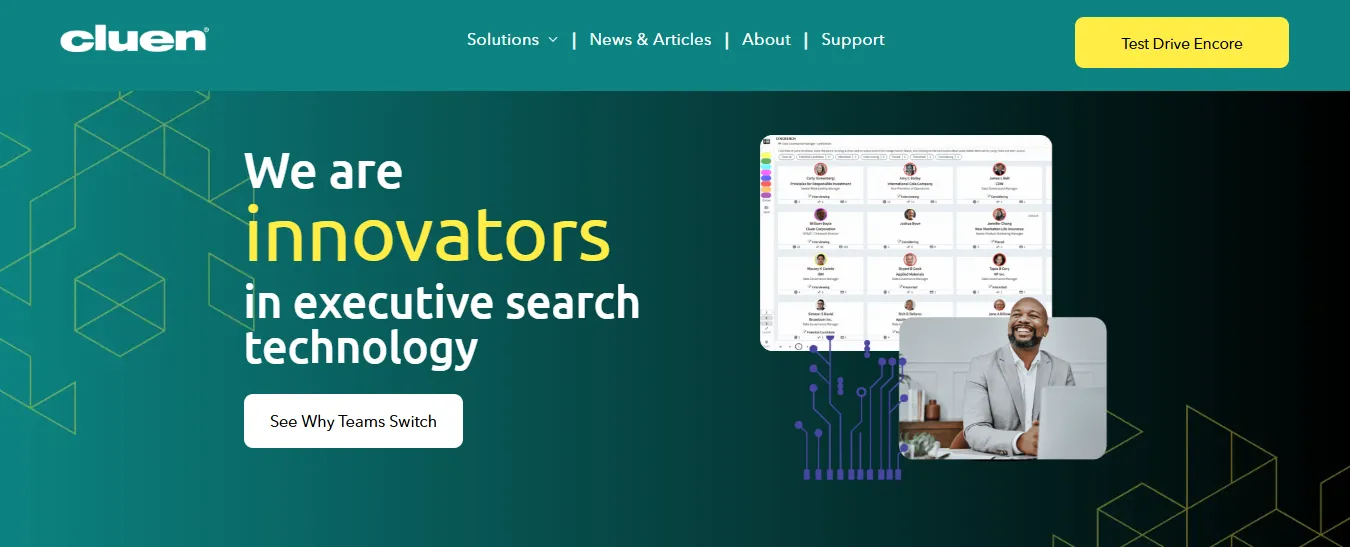
Cluen Encore’s offering is positioned around executive search, relationship intelligence and business development. Its current official website describes AI-supported insights, relationship discovery and client-ready reporting.
Key areas to evaluate include:
- Executive search CRM and database management.
- Relationship and interaction history.
- Relationship intelligence and network insights.
- Search and assignment workflows.
- Reporting and collaboration.
- Data migration and record continuity.
Pipeline fit: Interaction history helps firms use established relationships.
Evaluate: Verify availability, features and support.
Verdict: Consider it for specialist executive search CRM.
6. Clockwork Recruiting — retained-search projects and client collaboration
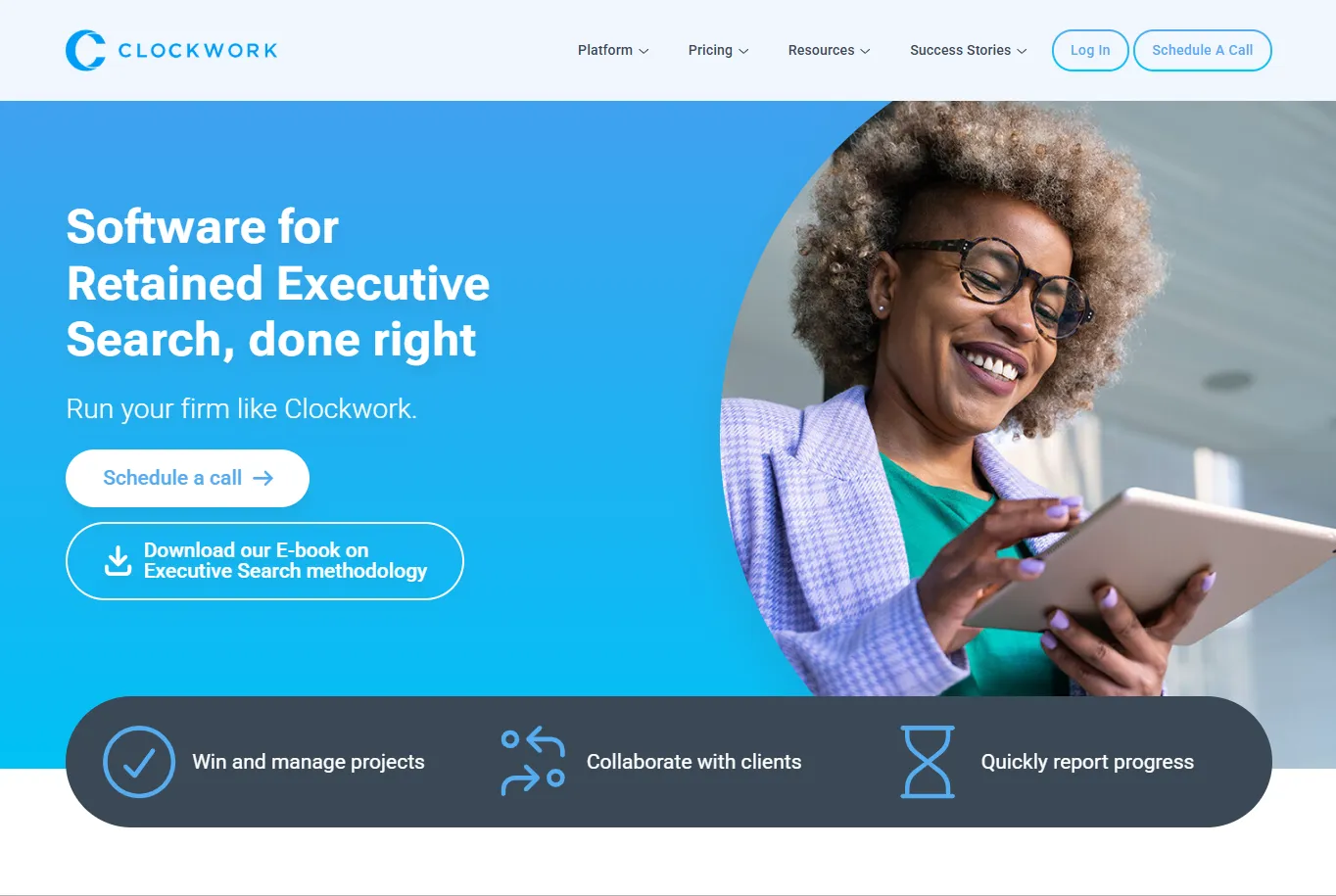
Clockwork Recruiting focuses on executive search project execution, team coordination and client collaboration. Its published feature page describes client portals, online longlists, real-time status reports, research strategy tools, branded communications and custom reporting.
Key capabilities relevant to leadership pipelines include:
- Client portal and online longlist review.
- Research strategy tools.
- Search project and status tracking.
- Candidate scoring and ranking.
- Team notes and activity tracking.
- Contact and company records.
- Custom reporting and client collaboration.
Pipeline fit: Teams can organise search activity and revisit contact records.
Evaluate: Check reusable pools and relationship management beyond project delivery.
Verdict: Relevant for project and client collaboration.
Comparing the six platforms for leadership pipeline management
“Not verified” means sufficient current evidence was not established; it does not mean the capability is absent.
Software | Talent discovery | Relationship management | Pipeline management | Assignment workflows | AI and automation |
iSmartRecruit | Advanced search and AI-assisted discovery | Recruiting CRM and executive database | Talent pool management | Search workflows | AI agents and matching documented |
Talentis Global | External profile search | Executive search CRM and relationship mapping | Assignment and pipeline management | Longlists and shortlists | AI research and automation documented |
Crelate | AI-assisted discovery | Recruiting CRM and contact enrichment | Recruiting pipeline workflows | Configurable recruitment workflows | AI discovery and automation documented |
Invenias | Advanced and saved searches | People and company records | Saved research and search records | Assignment tracking | Current AI availability requires confirmation |
Cluen Encore | Current details to verify | Executive search CRM positioning | Current details to verify | Current details to verify | Current details to verify |
Clockwork Recruiting | Search capabilities to evaluate | Contact database and client collaboration | Long-term pool depth to verify | Search project management | Confirm current feature availability |
The comparison should be used to narrow the shortlist, not to declare a universal winner. The products have different strengths, and the most appropriate choice depends on how your firm conducts research, manages relationships and delivers assignments.
How to choose executive search software for pipeline development
- Search and talent mapping: Can researchers identify leaders and target organisations?
- Database and relationships: Are histories, conversations and referrals easy to retrieve?
- Talent pools: Can profiles be segmented by sector, function and geography?
- Assignment visibility: Can research inform a mandate without confusing a pool with a shortlist?
- Confidentiality: Are sensitive assignments access-restricted?
- AI, integrations and cost: Do features solve real problems, integrate with existing tools and justify migration, training and subscription costs?
Practical software evaluation checklist
During demonstrations:
- Run a real assignment from research to shortlist.
- Search by sector, experience and career history.
- Show relationship records and talent-pool segmentation.
- Demonstrate confidential permissions and audit trails.
- Review reporting, integrations, migration, pricing and support.
Ask each vendor to demonstrate the same assignment to expose gaps.
Best practices for maintaining a leadership talent pipeline
- Review profiles: Verify career information before using it for an assignment.
- Maintain relationships: Follow up according to context and preferences.
- Record useful interactions: Capture meaningful context, not generic notes.
- Refresh pools: Remove duplicates and reassess relevance.
- Separate pipelines from shortlists: Future interest does not establish suitability for a specific assignment.
- Respect privacy: Apply appropriate access, retention and data-protection practices.
- Measure quality: Track accuracy and research relevance, not contact volume.
These practices help keep talent intelligence current.
Conclusion
A strong leadership talent pipeline develops through research, accurate records, relationships and follow-through. Software can connect databases, search and assignment workflows, but cannot replace judgement or trust. Evaluate iSmartRecruit for executive search, recruiting CRM and AI-assisted research.
Looking to organise your executive talent pipeline?
Explore iSmartRecruit Executive Search Software to review the platform and request a personalised demonstration.