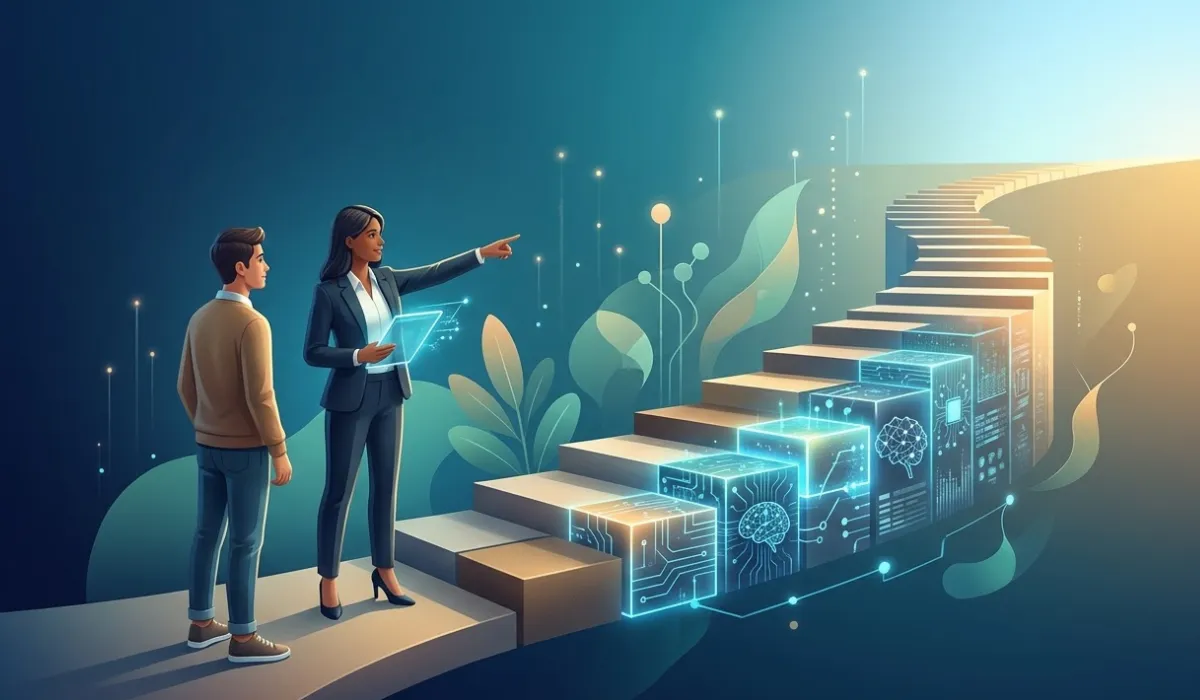
Artificial intelligence is helping younger professionals take on tasks that once required years of experience. But as AI automates routine work, HR leaders face a difficult question: how will early-career employees develop the judgement, critical thinking and practical knowledge they need to progress?
Research from International Workplace Group (IWG), published in The Z-Suite Report: How a New Generation Is Evolving the Boardroom, found that 82% of senior leaders believe AI is accelerating the rise of younger leaders. The survey of 1,000 company leaders in the UK and US also found that 92% would consider appointing a Gen Z candidate to a senior leadership role (read the report findings).
Among young leaders surveyed, 80% said AI gives them access to knowledge they would previously have needed years of experience to gain, while 79% said AI helps them perform tasks beyond their current seniority.
These findings point to the potential of AI to expand what younger professionals can do. However, they also raise questions about how organisations will prepare employees for greater responsibility when some of the traditional learning experiences of early careers are disappearing.
AI Is Changing How Younger Professionals Build Experience
AI tools can help employees research unfamiliar topics, analyse information, draft documents and complete tasks more quickly. For junior employees, this can shorten the time needed to understand certain concepts and contribute to complex projects.
IWG CEO Christian Schmitz said the shift is about more than promoting younger employees sooner. He emphasised giving people the tools, flexibility and support to make better decisions and create value.
However, being able to complete a task with AI assistance is not necessarily the same as having the experience to judge whether the result is accurate, appropriate or commercially sound.
That distinction matters when employees begin taking on work with greater consequences. HR leaders need to consider not only what junior employees can produce with AI, but also whether they can explain their decisions, recognise errors and know when to seek guidance.
The Entry-Level Talent Pipeline Faces a New Challenge
For many professions, early-career employees have traditionally developed their skills through routine assignments, document reviews, research and supporting more experienced colleagues. These tasks may appear repetitive, but they can also expose employees to how decisions are made and how professional standards are applied.
Anna Crow, head of people and culture at accounting network Plus More Group, said workforce planning is increasingly focused on the capabilities organisations will need rather than simply the number of people they employ.
She highlighted the challenge of giving junior employees a strong grounding while preparing them to operate at a more senior level sooner.
The concern is not that routine work must remain unchanged. It is that, when AI takes over parts of that work, organisations need to deliberately replace the learning opportunities it provided.
Without that planning, businesses could find themselves with employees who can complete tasks quickly but have had fewer opportunities to develop independent judgement, problem-solving skills and professional confidence.
AI and Remote Work Can Complicate Knowledge Transfer
Learning early in a career involves more than completing assigned tasks. Employees also gain experience by observing colleagues, listening to discussions, asking questions and seeing how experienced professionals handle difficult situations.
Sam Kidd, co-founder and CEO of legal operations platform LawVu, questioned how much learning came from routine research tasks themselves. He argued that being around experienced colleagues and hearing how deals were structured could be more valuable than the repetitive work alone.
He also highlighted the challenge of transferring knowledge when AI adoption coincides with more distributed ways of working.
For HR, this means that automating routine tasks should be accompanied by deliberate opportunities for employees to learn from experienced colleagues. Mentoring, project shadowing, case discussions and regular feedback can help junior employees understand the reasoning behind decisions, rather than simply receiving the final answer.
Shadow AI Adds to the Need for Training
The transition also creates an immediate skills and governance challenge. At Plus More Group, an internal audit found employees using unregistered AI tools on work devices despite an existing policy.
Crow said the findings gave leaders concrete evidence that written policies alone were not enough. The organisation introduced additional training on critical thinking and recognising when AI output cannot be trusted, alongside training on tools such as Microsoft Copilot.
This highlights a broader lesson for HR: employees need practical guidance on how to use AI safely, assess its output and understand when human review is necessary.
However, governance should not be the only focus. Training should also help employees build the professional capabilities that AI cannot reliably replace, including contextual judgement, communication, ethical reasoning and decision-making under uncertainty.
What HR Leaders Can Do to Protect Early-Career Development
HR teams can respond to these changes by redesigning early-career development rather than simply removing tasks that AI can automate.
1. Map the skills junior employees need to develop. Identify the technical knowledge, judgement and interpersonal capabilities required at each career stage. Review which tasks currently help employees build those skills.
2. Replace routine work with structured learning. When AI takes over repetitive assignments, provide supervised projects, realistic case studies and opportunities to work through complex problems.
3. Build mentoring into everyday work. Give junior employees regular access to experienced colleagues who can explain decisions, review AI-assisted work and provide feedback on their reasoning.
4. Teach employees to challenge AI output. Training should cover verification, source checking, confidentiality, bias and the limits of AI-generated recommendations, not just how to operate the tools.
5. Review graduate and entry-level roles. Assess whether job design still gives new employees enough opportunities to learn the fundamentals before they take on greater responsibility.
6. Measure capability, not just productivity. Faster completion times do not necessarily mean employees are developing the skills needed for progression. Include quality, judgement, problem-solving and learning progress in development reviews.
Preparing the Next Generation of Leaders
AI can give younger professionals access to information and capabilities that were once harder to acquire early in a career. But access to knowledge alone does not guarantee professional maturity or sound judgement.
For HR leaders, the challenge is to ensure that automation does not remove the very experiences employees need to grow. That means redesigning junior roles, strengthening mentoring and making critical thinking part of AI training.
The goal is not to preserve every traditional entry-level task. It is to preserve the learning behind it, so employees can build the judgement and experience required for future leadership.