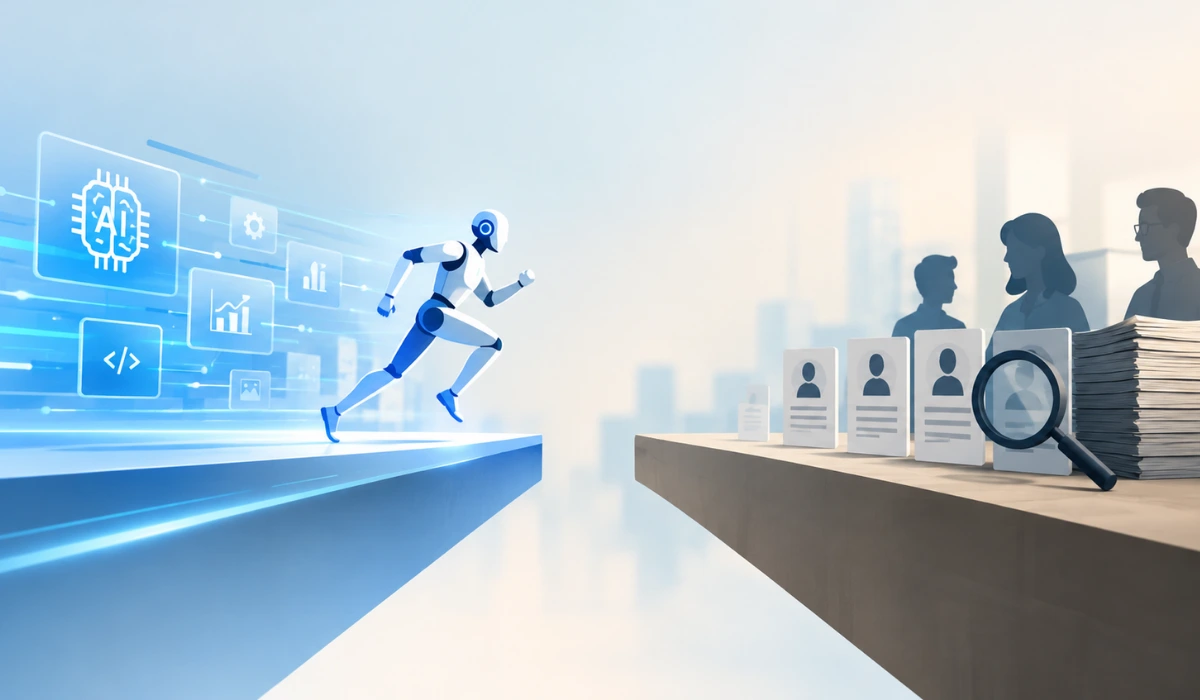
AI is changing how work gets done, but many organisations are still hiring for jobs designed around yesterday's workflows.
As employers introduce AI into recruitment and everyday tasks, job descriptions are increasingly becoming a problem. Instead of defining a role only by its traditional responsibilities, employers may need to break jobs down into tasks, identify what AI can handle and focus hiring decisions on the human skills that remain.
That shift is becoming increasingly important as organisations rethink how work is designed.
Job redesign is moving faster than job descriptions
Betul Genc, SVP and country head for Australia and New Zealand at the Adecco Group, said employers need to reconsider how roles are structured as AI takes on more tasks.
The company's research, The Human Premium: Leadership Beyond the Algorithm, surveyed 2,000 executives across 13 countries between December 2025 and January 2026.
Only 36% of C-suite leaders said their talent strategy shows that AI creates opportunities rather than simply replacing work.
The gap matters because AI does not necessarily eliminate an entire job. In many cases, it changes which parts of the job require human judgement, communication, creativity and decision-making.
That means employers may need to rethink the job itself before deciding what candidate to hire.
What should employers change?
Rather than starting with an existing job description, organisations can begin by breaking a role into its individual tasks.
The next step is to determine which tasks can be automated or supported by AI and which still require human expertise.
This can help employers identify the capabilities they actually need when recruiting.
For recruiters, the change is already visible. AI is increasingly being used for tasks such as sourcing and screening candidates. That means recruiters may spend more time understanding business needs, challenging hiring managers and assessing the human capabilities required for a role.
But many job descriptions have not caught up with that shift.
Skills are changing too
The World Economic Forum's Future of Jobs 2025 report estimated that 39% of workers' existing skill sets could be transformed or become outdated by 2030.
That creates another challenge for employers: hiring for today's requirements while also considering how a role could change over the next few years.
Adecco's research found that only 22% of executives were highly confident in their organisation's ability to develop future-ready capabilities. Just 31% said their leadership team had sufficient knowledge of AI.
The issue is therefore not simply whether companies are adopting AI. It is whether they understand how AI changes the work people are expected to perform.
Hiring is becoming more cautious
Hiring conditions are also making the problem more complicated.
In Australia, recruiting employers reported continued difficulty finding suitable candidates in early 2026, while hiring activity remained cautious.
Adecco says its typical time to fill roles, previously around 14–28 days, has stretched to roughly six to eight weeks in some cases.
When hiring takes longer and employers are more cautious about adding headcount, getting the role definition right becomes even more important.
A poorly designed job description can attract candidates who match an outdated version of the role while missing people with the skills needed for the future version of the job.
Workforce planning needs to catch up
Some organisations are already moving towards a more flexible approach.
Future-ready organisations identified in Adecco's research were more likely to report adaptability in their workforce and business models.
The underlying lesson for HR is straightforward: AI adoption should not happen separately from workforce planning.
Before opening a vacancy, employers should consider:
- Which parts of the role can be automated?
- Which tasks require human judgement?
- Which skills will become more important as AI adoption increases?
- Can the role be redesigned instead of simply replaced?
- Does the job description reflect the work the person will actually perform?
As AI continues to change how work is organised, job descriptions need to evolve with it.
The challenge for HR is no longer simply writing a better description of an existing job. It is understanding what the job should look like in the first place.