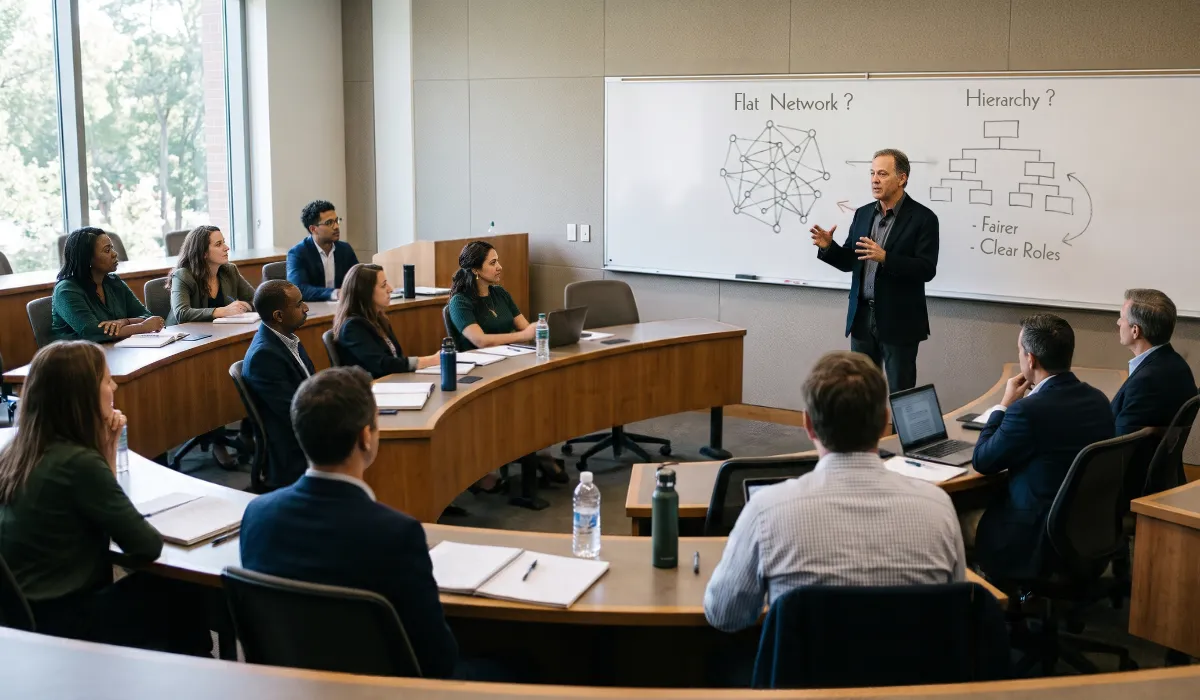
As organisations remove management layers and adopt flatter structures, questions are emerging about how these changes affect employees, leadership and workplace performance.
Nir Halevy, professor of organisational behaviour at Stanford Graduate School of Business, argues in his book Level Up: Why Hierarchies Are Broken and How to Fix Them that the solution is not necessarily eliminating workplace hierarchies, but making them fairer, more stable and supportive.
Three Signs of a Broken Workplace Hierarchy
Halevy identifies three characteristics of dysfunctional organisational hierarchies:
- Excessive competition: Employees compete aggressively, with behaviours such as withholding information or undermining colleagues.
- Unfairness: Employees struggle to understand promotion, compensation and decision-making processes because the criteria are unclear or inconsistent.
- Instability: Unexpected changes in responsibilities, promotions and demotions create uncertainty among employees.
Based on his May 2026 research using UK and US samples designed to mirror census data, Halevy estimated that approximately one in four employees works within a broken hierarchy.
These conditions can affect employee wellbeing, retention and organisational performance.
Why Simply Removing Management Layers May Not Work
Organisations increasingly consider flatter structures as a way to reduce bureaucracy and improve decision-making.
However, removing formal management positions does not necessarily eliminate workplace hierarchies. Informal power structures and differences in compensation and influence can still develop.
Gallup's 2026 State of the Global Workplace report found that global manager engagement declined from 31% in 2022 to 22% in 2025.
These findings highlight the importance of supporting managers and reviewing how organisational changes affect leadership responsibilities.
A Three-Part Framework for Healthier Hierarchies
Halevy proposes a framework called CPR, consisting of three principles:
Common Value: Organisational structures should create value for employees and the wider business, rather than primarily benefiting senior leadership.
Pluralism: Employees should have different opportunities to develop, contribute and advance without relying on a single traditional promotion ladder.
Relatedness: Organisations should encourage cooperation and shared success rather than unnecessary competition between colleagues.
Together, these principles aim to create workplace structures that support fairness, collaboration and professional development.
What HR Leaders Can Do
Halevy highlights several areas where HR can influence organisational effectiveness.
HR teams can introduce clearer promotion and reward criteria, recognise employees in roles that carry responsibility but receive limited organisational status, and develop career pathways that recognise different types of contribution.
They should also review how organisational changes affect employee wellbeing, retention and relationships between teams.
Building Healthier Organisational Structures
Workplace hierarchies are not automatically harmful. Their effectiveness depends on how authority, recognition, opportunities and responsibilities are distributed.
For HR professionals, the focus should be on creating transparent structures that support collaboration, employee development and fair career progression.
Rather than removing management layers without examining their purpose, organisations should identify what is working, address structural problems and build healthier ways for employees to grow.