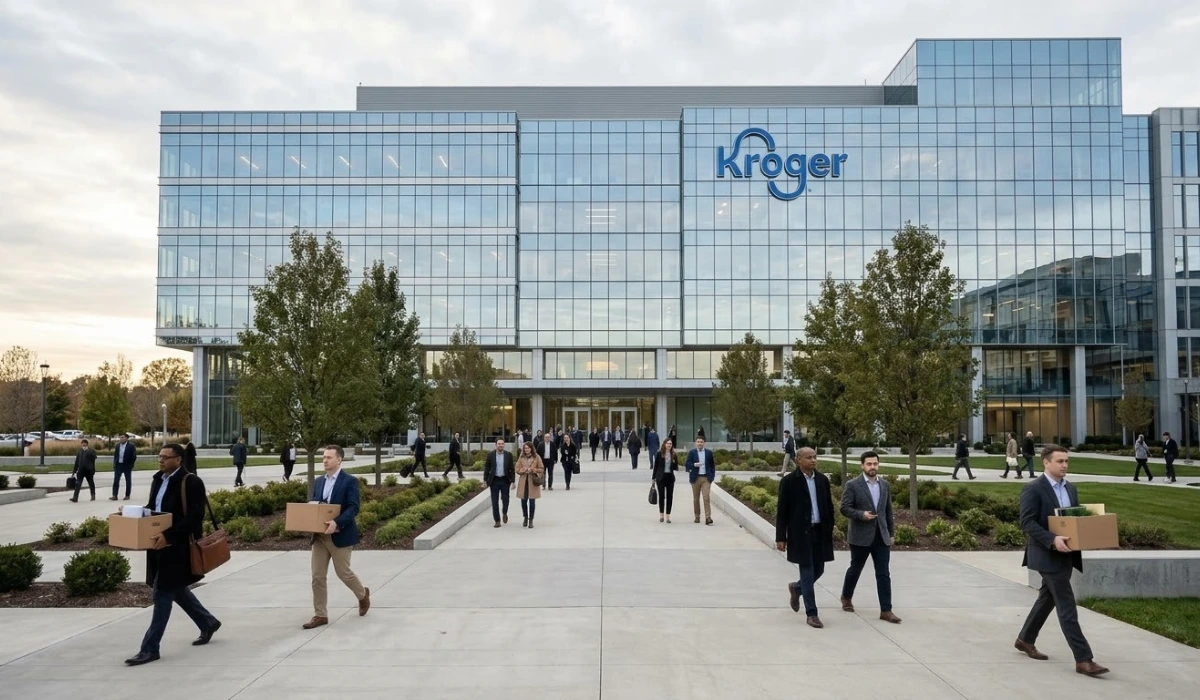
Kroger Co. plans to eliminate approximately 3,000 corporate jobs, representing about 37% of its corporate workforce, as the US grocery retailer looks to reduce overlapping responsibilities and simplify its operations.
The cuts were announced by chief executive Greg Foran in a memo reported by Bloomberg. Foran said the company had accumulated more organisational layers and overhead than necessary, slowing decision-making and diverting resources from other priorities.
“Simplifying means making faster decisions and deploying more resources where they matter most,” Foran said in the memo, as quoted by Bloomberg.
Kroger has approximately 8,200 corporate employees. The company had not provided a detailed breakdown of the affected roles in the reporting, with further details expected in the coming months.
Kroger looks to simplify operations
The planned reductions are part of a broader effort to streamline the retailer’s operations under Foran, who became CEO in February 2026.
According to Bloomberg, Kroger is facing slowing growth, strong competition and persistent inflation concerns. The company expects the restructuring to free up resources for frontline employees, lower prices and improvements to the customer shopping experience.
The scale of the proposed cuts highlights the workforce implications of restructuring in a competitive retail market. For HR teams, reductions of this size can involve more than eliminating positions: they can also require careful workforce planning, clear communication and support for affected employees and the teams that remain.
The company’s stated aim is to reduce duplication and redirect resources. The reporting does not establish how the proposed reductions will be distributed across corporate departments.
AI is part of Kroger’s wider efficiency strategy
Kroger has also been expanding its use of artificial intelligence to improve workflows. However, the available reporting does not establish that AI is the direct cause of the planned corporate job cuts.
In September, executive vice president and chief digital officer Yael Cosset described the company’s approach to AI in three stages: assisted, augmented and autonomous. He said the appropriate level of automation depends on factors such as risk, repeatability and the need for human judgement.
“The goal is not autonomy everywhere,” Cosset said in an announcement reported by Retail Brew, adding that governance remains central to the approach.
The distinction is important as employers introduce automation while restructuring their workforces. Technology investment, operational simplification and workforce reductions can occur at the same time, but they should not automatically be treated as having a direct causal relationship.
Implications for workforce planning
Kroger’s planned reductions put the focus on how large employers assess corporate structures and decide where resources are most needed.
For HR leaders, the case raises questions about how organisations identify overlapping responsibilities, communicate changes and maintain operational effectiveness after restructuring. It also illustrates the importance of distinguishing between a company’s stated reasons for job cuts and broader industry trends involving automation.
Kroger’s next steps, including details about the positions affected, will provide a clearer picture of how the restructuring will reshape its corporate workforce.
Sources:
Bloomberg — Kroger Plans to Slash 37% of Corporate Jobs in Next Three Years