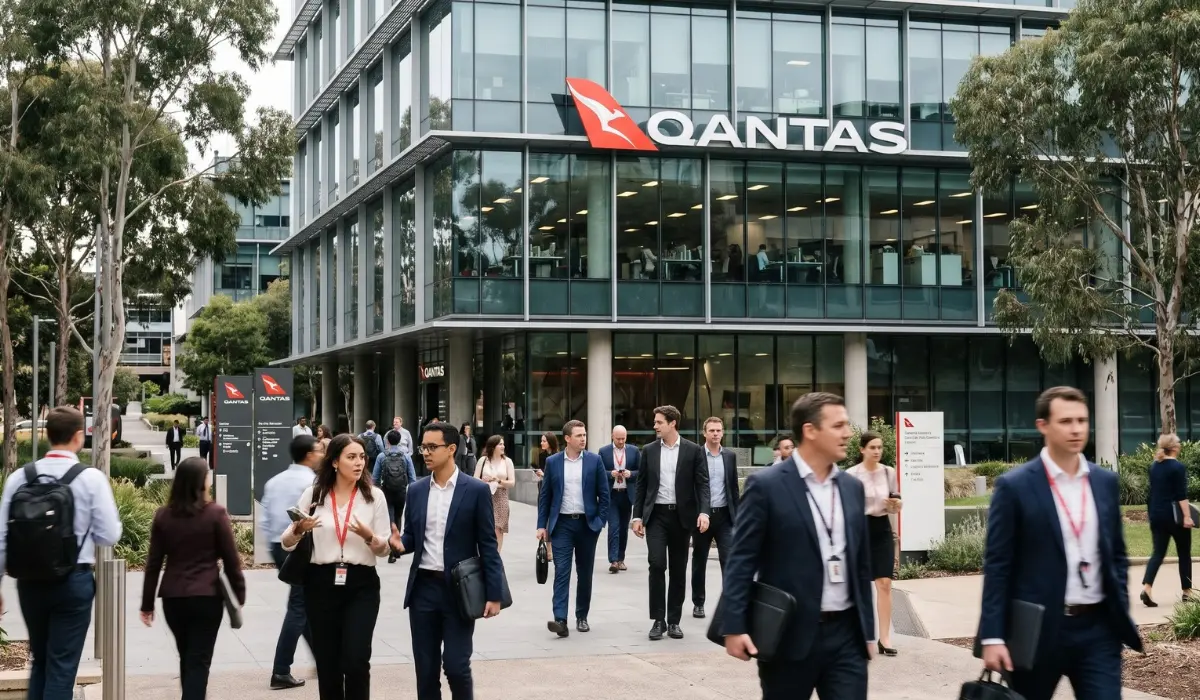
Australian airline Qantas plans to restructure parts of its corporate workforce, with around 850 roles expected to be affected under a new multi-year partnership with consulting firm Accenture. Much of the work currently handled by Australian teams will move to Accenture operations, primarily in India.
Announced on November 10, 2026, the agreement is part of Qantas' plan to modernise its internal technology systems, simplify business processes and expand its use of automation and artificial intelligence (AI). The affected positions represent approximately 3% of the airline's 28,000-strong Australian workforce.
HR, Finance and Procurement Among the Functions Affected
The initial phase of the restructuring will cover finance, procurement, human resources and marketing. Some services currently managed by these departments will transfer to Accenture, with most of the work expected to be delivered by its teams in India and some in Australia.
The changes will be introduced over several years, with the first phase expected to be in place by mid-2027. Qantas has said individual employee outcomes have not yet been determined and that it will consult affected employees and their unions before final decisions are made.
Qantas Plans Reskilling and Redeployment for Affected Employees
Qantas CEO Vanessa Hudson has acknowledged the uncertainty the announcement creates for employees. She said the restructuring does not reflect the contribution or commitment of the affected teams.
The airline has said it will explore opportunities to redeploy employees into other positions across the group, including newly created roles in Australia. Reskilling, retraining and additional support are also part of its approach to managing the transition.
Australian Union Raises Concerns Over Offshore Outsourcing
The announcement has drawn criticism from the Australian Services Union (ASU), which represents employees affected by the changes.
The union said Qantas had previously indicated that the Accenture partnership would not involve moving Australian jobs offshore. It has called on the airline to explain the change and provide greater clarity about affected positions, retraining opportunities and redundancy arrangements.
Qantas has disputed the union's account, saying it had not given assurances that jobs would remain in Australia. The airline also said it had discussed the possibility of some work moving to Accenture teams in India and Australia during earlier discussions with the union.
Technology Modernisation Behind the Restructuring
Qantas operates more than 1,000 legacy applications, many of which were developed independently and were not designed to work together. The partnership with Accenture is intended to simplify this infrastructure, connect business data and support the airline's wider technology and AI strategy.
Qantas says the arrangement will help it access specialist technology and data expertise while accelerating the modernisation of its internal systems. Automation and AI are expected to play a growing role in how some corporate services operate.
What the Changes Mean for HR Teams
The restructuring places workforce planning, employee consultation and redeployment at the centre of a significant technology transformation.
For HR professionals, the development raises important questions about how organisations manage roles affected by outsourcing, communicate restructuring decisions and provide employees with realistic opportunities to transition into new positions.
The Qantas announcement also highlights the importance of balancing operational efficiency with employee interests when technology and outsourcing change how work is organised.
With the first changes expected by mid-2027, the impact on individual employees will become clearer as consultation progresses.