The Truth About AI in Hiring: Real Risks, Bias, and Fixes
Written by Amit G.
Jan 07, 2026
10 mins read
AI in Hiring is reshaping how talent teams find, screen, and engage candidates. The promise is faster time to hire, lower cost per hire, and better matches. The risk is that these tools can amplify existing process problems while appearing neutral. If you are a recruiter, hiring manager, or HR leader, you need clear, practical guidance on the operational, legal, and ethical tradeoffs before you deploy automation at scale.
TL;DR
AI in hiring speeds processes but can embed hidden bias and compliance risks.
Data quality and training sets shape outcomes more than the model itself.
Tools that claim objectivity often recycle historic hiring patterns.
Regulation is increasing; proactive audits reduce legal exposure.
Human oversight, transparency, and skills-based design cut risk and improve outcomes.
Small fixes like feature selection, benchmarking, and continuous monitoring help a lot.
Treat AI in hiring as augmentation, not replacement, of recruiter judgment.
What Is AI in Hiring?
AI in hiring is the use of artificial intelligence, algorithms, or automation to support recruitment tasks such as screening resumes, matching candidates to roles, ranking applicants, scheduling interviews, and analyzing hiring data. It can help talent teams work faster, but it also requires human oversight, bias mitigation, explainable AI, and regular model monitoring to protect hiring fairness and candidate experience.
What readers will learn
This article explains the real operational and ethical tradeoffs of using AI in hiring, gives practical steps to evaluate and audit tools, and shows how to deploy AI in a way that improves fairness, compliance, and candidate experience. Real world examples and recent developments are included so you can translate this into actions for your staffing or talent acquisition team.
How AI in Hiring actually works, and why that matters
At its core, AI in hiring is usually a pattern matching engine. It looks for correlations between input data like resumes, assessments, or video responses and outcomes such as interview scores, job offers, or performance on the job. The simplest systems use keyword matching inside an applicant tracking system. More advanced systems use machine learning models trained on historical hires and performance reviews.
The model does not know what you intend. It learns what the training data says. If your past hiring favored a certain school, gender, or work history, the model will pick up those signals. That is why understanding the data and the labels used for training is the first step to getting honest outcomes with AI in Hiring. Understanding algorithmic bias in hiring and how labels were defined is essential to prevent repeating past mistakes.
Real examples that drove conversations
Some high profile examples illustrate the danger. Amazon shelved an AI recruiting project after the model learned to prefer resumes that followed patterns common to past male hires. A number of vendors offering facial analysis for video interviews drew blowback because their features relied on contested links between facial movement and traits like trustworthiness or fit. The vendor stories made the industry confront the difference between useful automation and pseudoscience.
The hidden costs and AI hiring risks
When talent teams adopt AI in hiring without guardrails, they face operational, legal, and cultural risks. Below are the most common ones I see in staffing and corporate talent teams.
1. Bias amplification
Machine learning models will amplify bias present in historical data. If your past hiring excluded certain groups, the model learns to replicate that. Bias can be subtle. For example, a model might penalize candidates who have gaps in their resume for caregiving reasons or favor applicants from specific universities. This is a common form of algorithmic bias in hiring. Surface level fairness checks are not enough; you need disaggregated analysis by gender, race, age, veteran status, and other protected classes where allowed by law.
2. Data quality and label problems
AI in hiring depends on labels. Did you train the model on 'hire vs no hire'? On 'performance rating after one year'? On 'retention'? Each choice changes what the model optimizes for. Poor quality labels, inconsistent performance metrics, or incomplete outcome data lead to unreliable predictions.
3. Overfitting to convenience signals
Recruiting data often contains strong convenience signals. For example, candidates who responded quickly to an outreach message might be scored higher because response time correlates with eventual acceptance. This rewards candidates who have time to monitor job boards and penalizes those actively employed or with caregiving responsibilities.
4. Explainability and auditability gaps
Many machine learning models are not easily explainable. Vendors sometimes provide opaque scores without clear feature importance. If a regulator or internal audit asks how a score was calculated, you might be unable to provide a clear answer. The European AI Act and other regulatory moves are increasing expectations for explainability in high risk domains like hiring.
5. Candidate experience and trust
A poorly configured AI in hiring workflow can frustrate candidates. Generic rejection messages, false positive mismatches, or assessments that feel invasive reduce your employer brand. Candidates talk, and bad experiences show up in employer review sites and social media.
Recent regulatory context for AI in Hiring and market reality
Regulation is not theoretical. The European AI Act classifies certain algorithmic hiring supports as high risk. Regulators in multiple countries are scrutinizing algorithmic decision-making in employment. In the United States, agencies and state legislatures have examined rules around the use of automated decision systems. That means vendors, staffing firms, and employers must prepare to explain their systems, measure for disparate impact, and document mitigation steps.
A 2023 McKinsey Global Survey reported that a majority of organizations have adopted at least one AI capability in their business operations, showing rapid adoption alongside rising governance expectations.
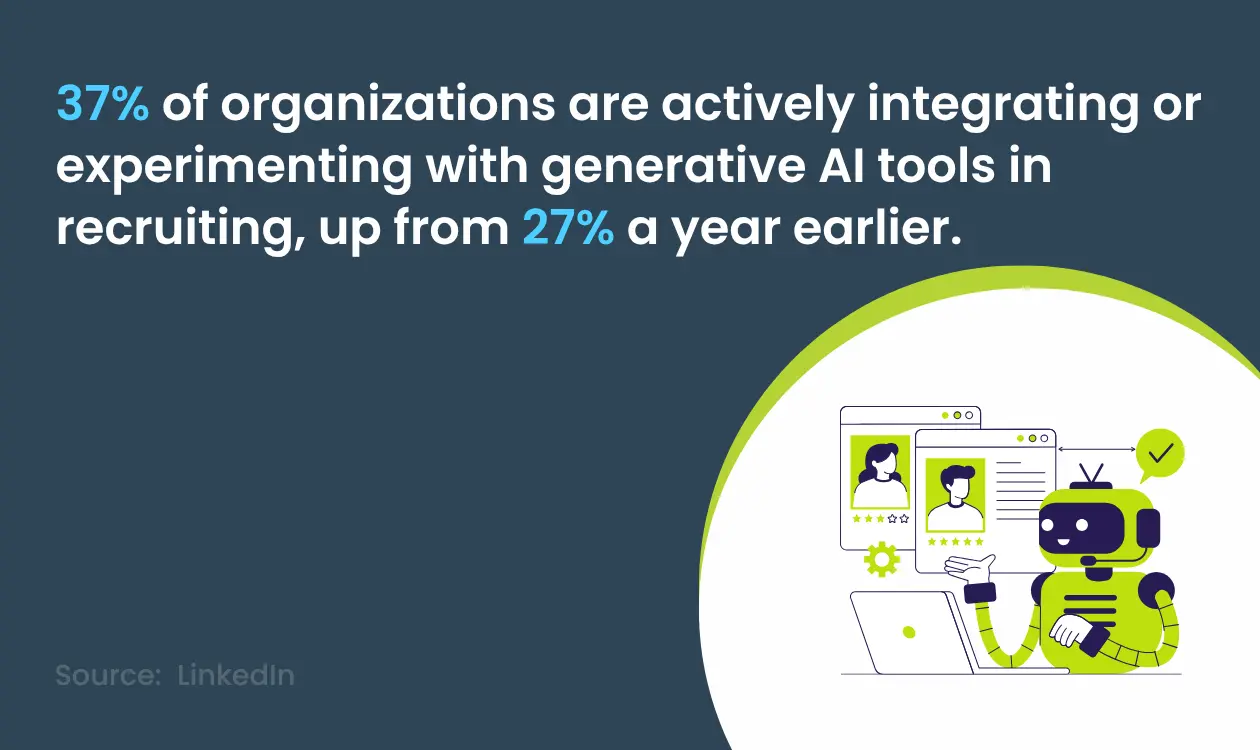
AI in hiring is no longer experimental for many talent teams. LinkedIn’s Future of Recruiting 2025 report found that 37% of organizations are actively integrating or experimenting with generative AI tools in recruiting, up from 27% a year earlier. This growth makes hiring fairness, bias mitigation, model monitoring, and human oversight more important as AI recruiting becomes part of everyday talent acquisition workflows.
Adoption is fast. But adoption without governance multiplies risk as much as value.
How to evaluate AI vendors and tools effectively
When you assess vendors, do not treat features and marketing claims as substitutes for evidence. Ask for measurable benchmarks, reproducible audits, and the ability to access raw signals for your own analysis. Be explicit about AI screening risks and require tests that expose those risks. Below are practical checks I recommend.
Vendor due diligence checklist
Request documentation on training data and label definitions.
Ask for bias audits with disaggregated results across key demographics.
Understand which features the model uses. Avoid vendors that include unexplainable or invasive biometric signals.
Confirm the vendor supports model governance: versioning, logging, and rollback.
Validate model performance on your own historical data where possible.
Negotiate contractual protections for explainability and the right to audit.
ATS Integration, Explainability, and Model Monitoring
When evaluating AI in hiring tools, check whether the system integrates with your ATS, explains why candidates are ranked or filtered, and supports ongoing model monitoring. A responsible vendor should provide audit logs, fairness metrics, and clear documentation so hiring teams can review decisions, detect AI hiring bias, and protect candidate experience over time.
Measurement you should require
At minimum, measure: accuracy by role and department, false positive and false negative rates by protected group where permitted, time to hire impact, and candidate drop off at each funnel stage. Benchmark against a human-only baseline to know if the model adds value in your context.
Practical steps to mitigate risks when deploying AI in hiring
Here is a step by step approach that staffing leaders and TA teams can implement in weeks, not months.
1. Start with the problem, not the tool
Define the hiring problem you want to solve. Is it reducing screening time, improving quality of interview slates, or boosting diversity? Choose metrics aligned to business outcomes and plan how AI in hiring will affect them.
2. Use data audits before modeling
Profile your historical hiring dataset. Look for representation gaps, label drift, and proxy variables that correlate with protected attributes. For example, postal codes or names may serve as proxies for race or socioeconomic status. Either remove or control for those variables.
3. Prefer skills-based outcomes
If you can label training examples with objective skills assessments or work sample scores, models learn to optimize for job-relevant behaviors rather than pedigree. Several successful firms moved to skills-based hiring and saw improved diversity without sacrificing performance.
4. Keep humans in the loop
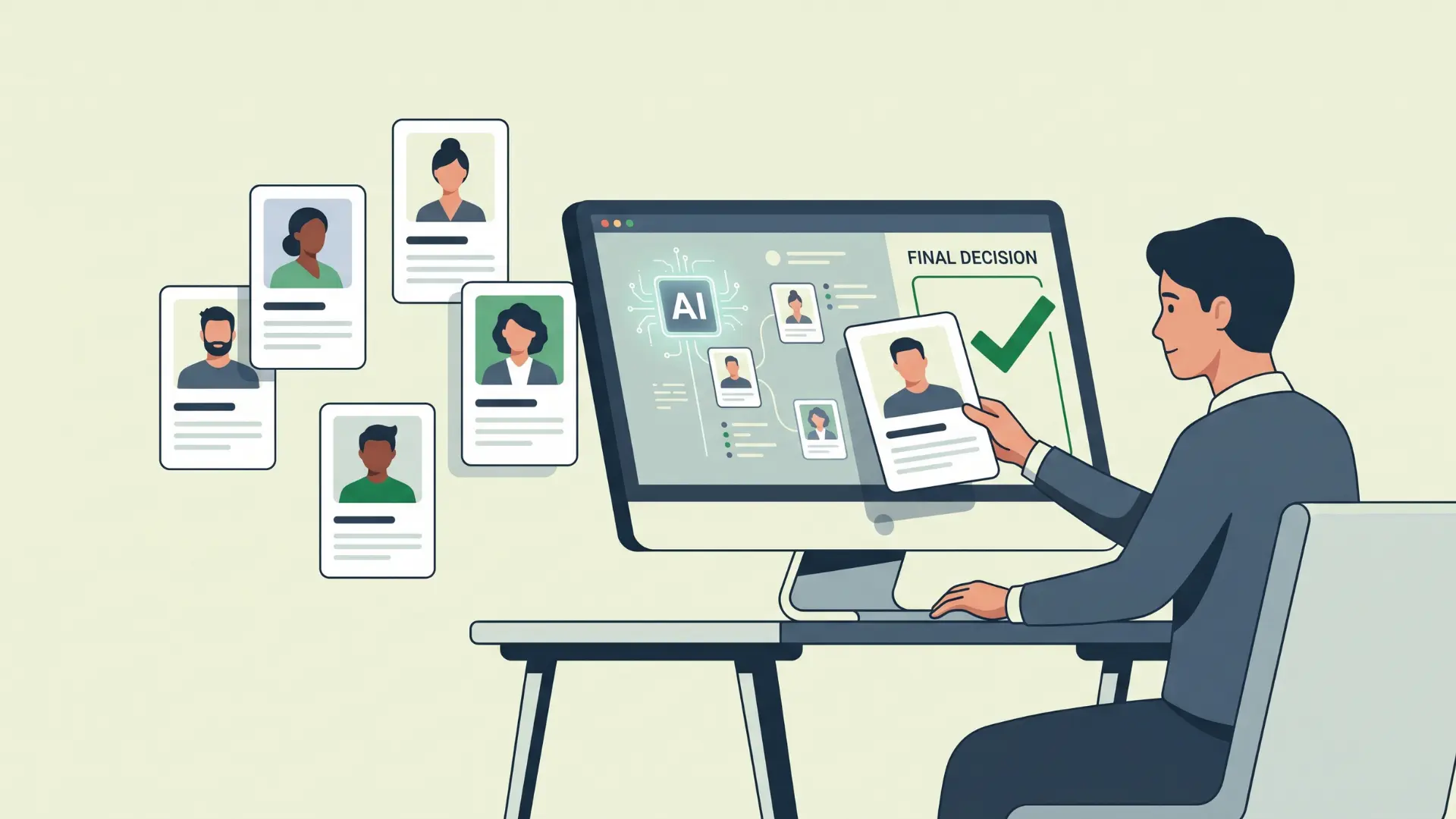
Use AI in hiring for augmentation tasks such as prioritizing a shortlist, suggesting interview questions, or highlighting risky patterns. Final decisions should remain with trained recruiters and hiring managers. Design for easy overrides and require human justification for automated rejections.
5. Monitor continuously
Run live fairness monitoring. Check pipeline metrics weekly for anomalous changes. If disparate impact appears, pause and investigate. Implement automated alerts for sudden shifts in model behavior.
6. Transparent candidate communication
Tell candidates when automation is used and what it assesses. Clear, concise transparency improves trust. For roles that require assessments, provide feedback or next steps so candidates feel respected.
As AI-generated resumes, cover letters, and application responses become more common, employers should also consider using an AI text detector to better understand how candidate-submitted content was created and maintain transparency throughout the hiring process.
Organizational practices that make AI in hiring work
Technology is only part of the equation. Governance, training, and culture matter. Below are organizational practices I recommend.
Create a cross functional governance body
Include HR, legal, data science, diversity and inclusion, and a recruiter representative. This body reviews vendor risk, approves models, and owns the monitoring plan. Strong governance is central to AI recruitment ethics.
Train recruiters and hiring managers
Equip your teams to understand model outputs, limitations, and how to probe candidate recommendations. Training should include practical exercises and examples from your own data.
Document decisions and rationale
Maintain a record of model selection, training datasets, evaluation metrics, and mitigation steps. If regulatory or litigation questions arise, documentation shortens resolution time and reduces exposure.
Real world wins when AI in hiring is used responsibly
Used correctly, AI in Hiring can deliver measurable benefits. One international retailer reduced preliminary screening time by 60 percent after introducing a rules-based resume triage followed by a skills-focused assessment. Another staffing firm improved diversity in their candidate slates by combining blind screening with structured interviews and ongoing bias monitoring. These wins share common traits: focus on skills, transparent processes, and human oversight.
Vendor negotiation tips
When you buy, contract for audit rights, access to feature sets, and performance guarantees. Avoid opaque subscription models that do not permit any testing on your data. Insist on service level agreements for model drift and on-boarding support for ethical use guidance.
Checklist to launch AI in hiring in 90 days
Define the problem and metrics.
Audit historical data for representation and label quality.
Run a small pilot with a control group.
Measure impact on accuracy, time to hire, and diversity metrics.
Document governance and candidate communication plan.
Scale only after reaching agreed thresholds and establishing monitoring.
Conclusion: The truth stated plainly
AI in Hiring can drive productivity and help teams reach candidates they would otherwise miss. The truth no one talks about is that it will also mirror your existing processes and biases unless you intentionally design otherwise. The difference between a harmful implementation and a beneficial one is not the algorithm. It is the data, the design choices, the governance, and the human oversight you build around it. Treat AI in hiring as a powerful assistant that needs policy, auditing, and a clear focus on job-relevant skills.
Adopt AI in hiring with skepticism, test empirically, and prioritize transparency and fairness. Do those things and your team will capture the upside while minimizing reputational and legal risks. Stay ahead of the curve - explore more HR insights on NextInHR.
Frequently Asked Questions
The main risks of AI in hiring include AI hiring bias, poor data quality, limited model explainability, weak auditability, negative candidate experience, and hiring compliance issues. These risks usually appear when algorithmic hiring tools are trained on historical data, use unclear scoring logic, or make screening decisions without enough human oversight. Organizations should regularly audit outcomes, document decisions, and monitor candidate impact across demographic groups.
Organizations can detect algorithmic bias in hiring by running disaggregated fairness audits across gender, race, age, disability, and other protected or relevant groups where legally appropriate. They should compare selection rates, false positive rates, false negative rates, and advancement rates across groups. Hiring teams should also validate AI recommendations against a human-only baseline and review whether the model unfairly favors certain schools, job titles, locations, or career paths.
To reduce AI screening risks, organizations should ask vendors for documentation on training data, labels, model governance, explainable AI features, auditability, and bias mitigation methods. Talent acquisition teams should require reproducible bias audits, negotiate audit rights, and test the tool on historical hiring data before full deployment. Vendor evaluation should also include ATS integration, candidate communication, human review options, and ongoing model monitoring.
Recruiters should use AI recruiting tools for augmentation, not replacement. Automated recommendations can help prioritize candidates, identify skills, and improve recruitment automation, but they should not be the sole basis for rejecting applicants. Human review should be required for high-impact decisions, especially when AI influences screening, ranking, or interview selection. Recruiters should also understand why a recommendation was made before acting on it.
Companies should prepare for automated hiring regulation by building a clear governance process for AI in hiring. This includes documenting vendor decisions, maintaining audit trails, monitoring model performance, reviewing disparate impact, and assigning responsibility across HR, legal, compliance, and technology teams. Organizations should also create candidate disclosure practices, define escalation paths, and regularly review whether AI tools support hiring fairness, workforce diversity, and compliance requirements.
About the Author
Amit G.
Amit Ghodasara, CEO of NextInHR, is at the forefront of shaping modern HR practices. With a strong understanding of workforce dynamics, he focuses on driving people strategies and organizational growth. He is committed to empowering HR professionals through practical, forward-thinking insights.


 10 mins read