
 9 mins read
Measure Interview Quality early and often to turn interviews into reliable predictors of job performance. Beyond time-to-hire, practical hiring quality measurement uses structured rubrics, inter rater checks, and ATS data to reduce bias, improve recruiter effectiveness KPI, and drive better retention.
TL;DR
- Time to hire is not enough; Measure Interview Quality to improve hiring outcomes.
- Use structured interviews, digital rubrics, and interviewer calibration to standardize results.
- Track inter rater reliability, predictive validity, candidate experience, and interviewer effect.
- Leverage your ATS, scoring tools, recordings, and AI to capture consistent interview data.
- Correlate interview scores with performance and retention to prove ROI.
- Run regular audits, bias checks, and training to maintain quality over time.
- Create a continuous feedback loop that combines data, human review, and technology.
Why Time To Hire Alone Is Misleading
Time to hire is simple to report and easy to understand. Most leaders like a single number that shows speed. That number does not tell you whether interviews are designed well, whether interviewers are calibrated, or whether candidates rated highly are actually successful after hire. When organizations optimize for speed alone they often lower standards, rush interviews, and miss signals about fit. To Measure Interview Quality you must expand your KPIs to include consistency, predictive power, and candidate experience.
Core Dimensions To Measure Interview Quality
Interview quality breaks down into measurable dimensions. Each dimension gives HR teams a different perspective on process strength and selection accuracy.
Structured Interview Design
Structured interviews use consistent questions, scoring rubrics, and behavioral anchors. Research and practitioner experience show structured interviews reduce noise and improve selection decisions. To Measure Interview Quality, track the percentage of interviews that follow a predefined guide and the use rate of competency based questions. A compliance score will reveal how often interviewers deviate from the script and help you enforce standards.
Inter Rater Reliability
Inter rater reliability measures agreement between interviewers who rate the same competency. Low agreement signals subjective judgment and noisy decision making. Calculate agreement rates using Cohen's kappa or simple percentage agreement from sample calibration sessions. To Measure Interview Quality, set target ranges for agreement and run monthly checks so score variance does not undermine hiring decisions.
Predictive Validity
Predictive validity links interview ratings to actual on the job performance. Map rubric scores against manager evaluations, objective outcomes, and retention at three and twelve months. To Measure Interview Quality, compute correlations between interview scores and later performance. Even moderate correlations show your process is selecting useful signals rather than luck.
Candidate Experience
Candidate experience is a core indicator of interview quality because it affects employer brand and acceptance rates. Measure candidate NPS, time to feedback, and scheduling friction. Track whether candidates describe the interview process as fair, clear, and respectful. To Measure Interview Quality, combine quantitative ratings with open text feedback to find process gaps.
Interviewer Effectiveness And Calibration
Interviewers differ in strictness, bias, and calibration. Measure interviewer pass rates, average scores, and the downstream performance of the candidates they recommend. Use that data to identify interviewers who are unusually lenient or harsh and run targeted coaching. Calibration sessions that use recorded examples help align expectations and improve consistency.
Bias And Diversity Impact
Bias can hide in score distributions and pass rates across demographic groups. To Measure Interview Quality, monitor differences by gender, ethnicity, and other protected groups while protecting candidate privacy. Use statistical checks, anonymized reviews, and structured scoring to reduce bias and document improvement over time.
Practical Metrics And KPIs To Implement (interview quality metrics)
Operational measurement starts with a concise set of KPIs that cover process health, quality, and outcomes. These interview quality metrics should be actionable and easy to report from your ATS and scoring tools. Using clear metrics helps you move from anecdote to evidence in hiring quality measurement.
- Structured Interview Compliance: Percentage of interviews using the standard rubric and set questions.
- Average Interview Score: Mean rubric score by role and interviewer with variance and distribution.
- Inter Rater Agreement: Cohen's kappa or simple agreement percentage across raters for the same role.
- Predictive Correlation: Correlation between interview scores and performance ratings at defined intervals.
- Candidate NPS: Post interview Net Promoter Score and satisfaction ratings.
- Offer Acceptance Rate: Percentage of offers accepted, segmented by hiring cohort quality.
- New Hire Retention: Retention at three and twelve months for hires evaluated under the measured process.
- Interviewer Bias Indicators: Variance in pass rates and scores across demographic segments.
Research-Backed Insight: Quality of Hire Matters
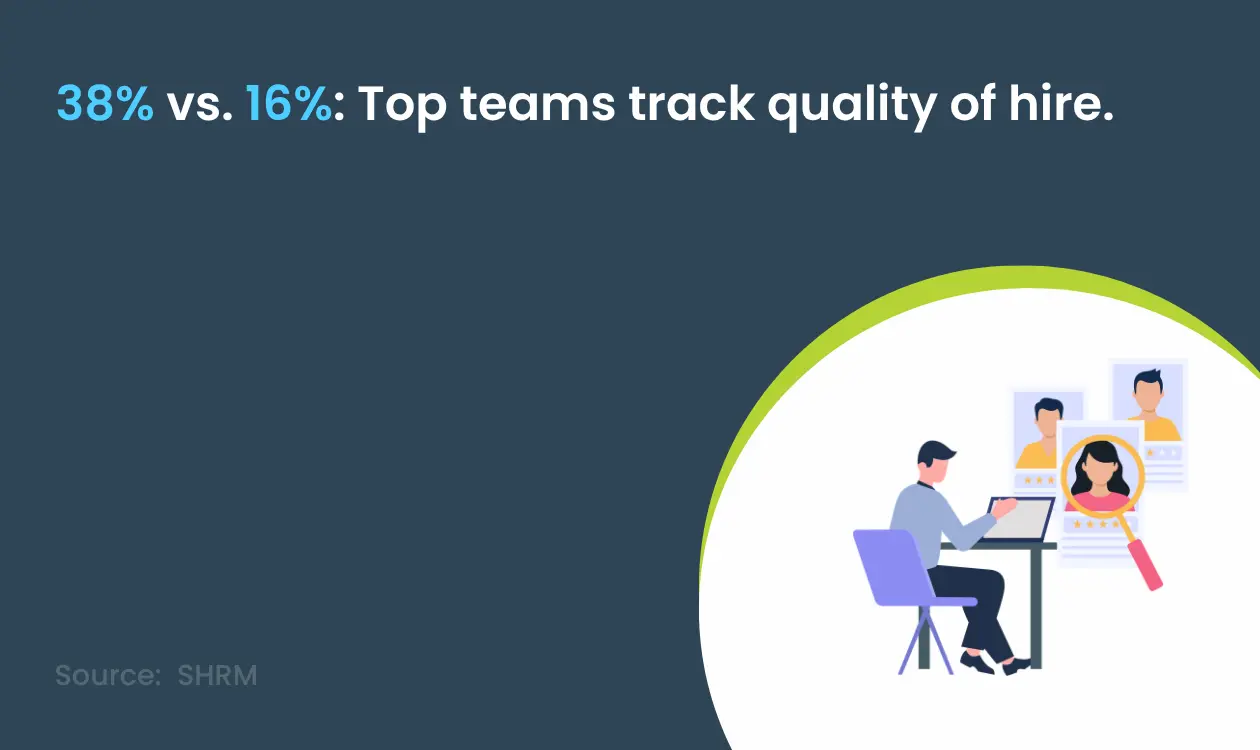
Research-backed insight : Measuring interview quality helps HR teams move beyond speed-based hiring metrics and focus on long-term hiring outcomes. SHRM’s 2026 recruitment data found that high-performing recruitment teams measure quality of hire at nearly twice the rate of average teams: 38% vs. 16%. This shows why HR teams should connect interview scoring, structured interviews, candidate experience, and retention metrics to quality-of-hire outcomes.
Tools And Technology That Help Measure Interview Quality
Technology is essential to scale measurement. Modern ATS systems, digital rubrics, and analytics platforms make it practical to capture consistent interview data across hundreds of roles and thousands of interviews.
Applicant Tracking Systems And Workflows
Configure your ATS to require rubric scoring fields before an interview is marked complete. That enforces data capture and stops post hoc judgments. Use dashboards to visualize compliance rates, score trends, and interviewer distributions so you can Measure Interview Quality without manual spreadsheets.
Digital Rubrics And Scoring Tools
Embed competency rubrics directly into interview guides. Digital scoring simplifies aggregation and supports anonymized reviews. When you Measure Interview Quality using digital rubrics you reduce transcription errors and speed up calibration cycles.
AI And Analytics
AI can highlight patterns, detect outliers, and flag potential bias. Use AI for signal detection, such as identifying interviewers with anomalous score distributions or surfacing language that correlates with lower candidate experience. Always pair automated signals with human review and governance so data driven recommendations are explained and validated before action.
Recorded Interviews And Calibration Libraries
Recording interviews creates training assets and a library of exemplars. Annotate recordings with scoring rationales to build a calibration library. Use those examples in training so new interviewers can see what a level three or a level five answer looks like in practice. This resource helps you Measure Interview Quality by making standards explicit.
Also track recruiter effectiveness KPI and interview effectiveness measures in the same analytics layer so talent acquisition leaders can see who needs coaching and what questions predict hiring success metrics. Integrating ATS data, scoring sheets, and LMS content closes the loop on operational improvement.
Simple Formulas to Measure Interview Quality
Metric | Simple Formula | What It Shows |
Inter-rater reliability | Matching interviewer ratings ÷ total shared ratings × 100 | Whether interviewers score candidates consistently |
Candidate NPS | % Promoters − % Detractors | How candidates feel about the interview experience |
Retention rate | Hires retained ÷ total hires × 100 | Whether interview quality connects to long-term hiring outcomes |
Step By Step Playbook To Start Measuring Interview Quality
Follow a pragmatic playbook to move from intuition to measurable improvement. These steps scale from pilot to enterprise.
- Define core competencies for each role and write behavioral anchors for each score level.
- Build digital rubrics and require scores in your ATS for every interview stage.
- Run calibration sessions using recorded interviews and sample answers.
- Track inter rater agreement and score distributions monthly and share results with hiring managers.
- Correlate interview scores with performance metrics and retention to validate predictive power.
- Report a concise set of KPIs to leadership and hiring managers every month.
- Iterate on questions, rubrics, and training based on data and qualitative feedback.
Real Examples And Insights
Example 1: A staffing firm serving a large retail client standardized four competency areas for a high volume sales role. They embedded digital rubrics in the ATS and required three scored interviews. Within three months inter rater variance dropped by thirty percent and performance reviews for new hires improved. The client reported faster onboarding and fewer early separations.
Example 2: An enterprise HR team used analytics to identify three interviewers whose average scores were consistently higher than peers. The HR team ran a targeted calibration program that included recorded interview review and scoring workshops. After coaching, the hires those interviewers recommended showed higher offer acceptance rates and a ten percent improvement in first year retention.
Insight: Small changes to question design can have outsized effects. One organization replaced broad competency questions with behaviorally anchored prompts and saw average interview time increase slightly while predictive correlation improved. Measuring interview outcomes revealed the trade off was worth it.
"When we began to Measure Interview Quality in a structured way we stopped guessing and started improving. Our interviews became a repeatable, auditable asset that managers trust."
Common Pitfalls And How To Avoid Them
- Relying Only On Averages. Look at distributions and outliers to find hidden issues rather than just a mean score.
- Overloading Interviewers With Metrics. Focus on a small set of core KPIs to drive improvement without causing burnout.
- Ignoring Qualitative Feedback. Combine open text feedback and short interviews with quantitative data to understand root causes.
- Deploying AI Without Guardrails. Validate models against real outcomes and maintain human oversight before operationalizing recommendations.
How To Prove ROI From Measuring Interview Quality
Demonstrating business value requires tying interview metrics to outcomes that matter. Connect improvements in rubric scores to higher first year performance, lower early turnover, and faster time to productivity. Even modest increases in predictive validity cut the cost of bad hires and boost team productivity. Build a dashboard that links interview KPIs to hiring cost, time to full productivity, and retention so leaders can see the financial case.
Some example ROI calculations include reduced churn savings and faster fill times for critical roles. If a bad hire costs approximately thirty percent of the first year salary to replace, reducing bad hires by even a few percent delivers measurable savings. Use cohort analysis to forecast the dollar impact of improved interview predictive validity.
Conclusion
HR teams that Measure Interview Quality get better hiring outcomes than those that focus on speed alone. Use structured interviews, digital rubrics, interviewer calibration, and analytics to capture consistent data. Monitor inter rater reliability, predictive validity, candidate experience, and bias indicators to maintain a healthy hiring process. Link your interview metrics to on the job performance and retention to validate the process and prove ROI. With clear KPIs, training, and the right tools you can turn interviews into a reliable competitive advantage for talent acquisition. Stay ahead of the curve and explore more HR insights on NextInHR.