
 7 mins read
Role-Based Hiring vs Skills-Based Hiring depends on the type of position and how performance can be evaluated. Role-based hiring is more suitable for jobs with fixed responsibilities, licenses, or mandatory qualifications, while skills-based hiring works well when demonstrated ability, adaptability, and transferable skills matter most. For many organizations, a hybrid approach offers the most practical balance.
Choosing between role-based and skills-based hiring affects how employers define requirements, assess candidates, and identify potential. This guide compares both approaches and explains how talent teams can combine essential role requirements with job-relevant skills assessments.
TL;DR
- Role-Based Hiring focuses on predefined duties and formal qualifications.
- Skills-Based Hiring prioritizes demonstrated skills and potential over titles.
- Role-Based Hiring offers structure and clarity for compliance and legacy roles.
- Skills-based hiring can broaden candidate evaluation beyond titles and credentials, provided assessments are job-related, accessible, and consistently reviewed.
- Use ATS taxonomies and AI to combine both approaches for better hires.
- Start with hybrid job profiles, objective skills tests, and measurable KPIs.
- Choose the approach that matches business strategy, time to hire, and training capacity.
What Is Role-Based Hiring?
Role-Based Hiring organizes recruitment around fixed job descriptions, defined responsibilities, and required credentials. Job titles, years of experience, and formal qualifications are the primary filters. Traditional ATS workflows, legacy compliance requirements, and union rules often reinforce role-based practices.
Advantages of Role-Based Hiring
- Clear accountability and expectations for compliance and regulatory roles.
- Faster shortlisting when specific credentials are must-haves.
- Simpler internal alignment when teams understand exact role boundaries.
Limitations of Role-Based Hiring
- May exclude candidates with transferable skills who lack exact titles.
- Can create rigid pipelines that do not adapt to technology shifts.
- Often reinforces credential inflation and narrows candidate diversity.
What Is Skills-Based Hiring?
Skills-Based Hiring centers on what candidates can do. Recruiters assess demonstrated competencies, practical tests, and on-the-job performance indicators. Skills taxonomies, microcredentials, and project portfolios replace strict title checks.
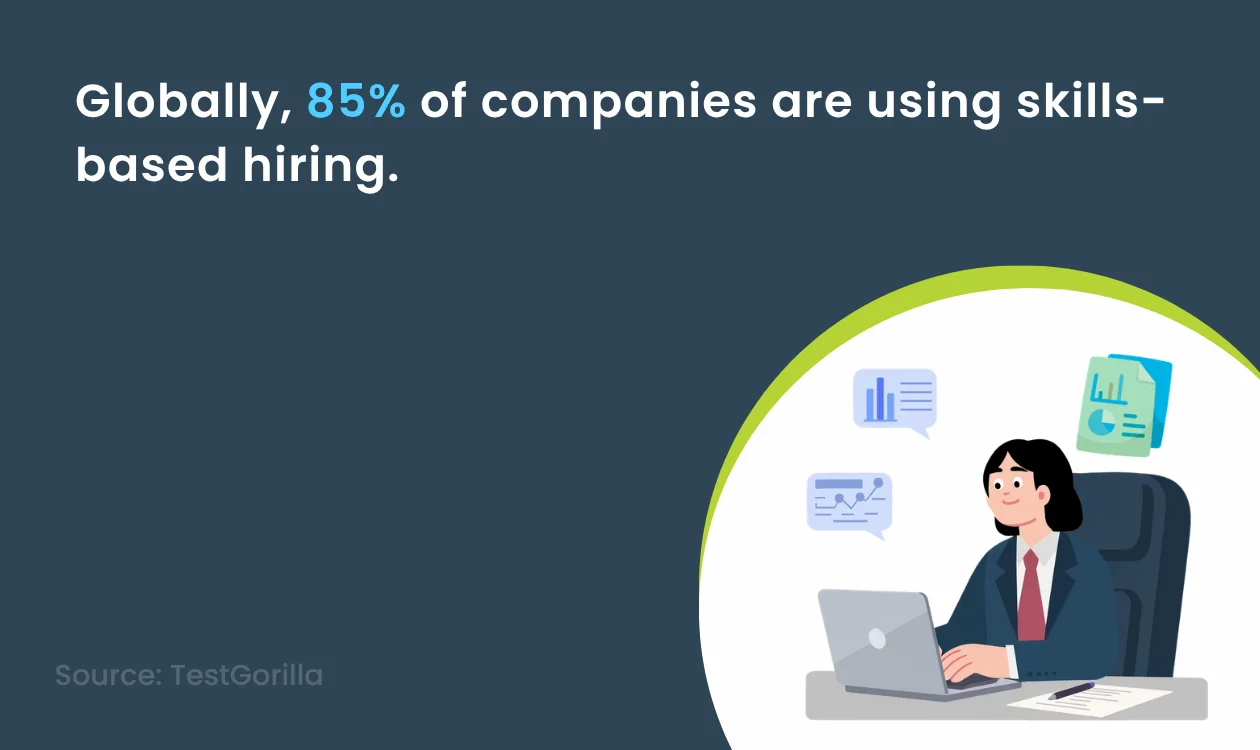
As per the latest report by TestGorilla, 85% of companies globally now use skills‑based hiring, highlighting the growing importance of skills assessments, competency tagging, and work-sample evaluations in modern recruitment.
Industry research from talent practitioners and HR bodies reinforces that skills-first hiring and competency mapping are central to workforce agility. Reports from professional HR organizations emphasize building skills taxonomies, linking skills to performance outcomes, and using microcredentials to fill critical gaps.
Advantages of Skills-Based Hiring
- Expands talent pools by valuing demonstrated ability and potential.
- Improves internal mobility through clearer skill mapping.
- Supports diversity and inclusion by reducing bias tied to pedigree.
Limitations of Skills-Based Hiring
- Requires reliable skills assessments and calibration across roles.
- Demands investment in mapping skills to business outcomes.
- Can be slower initially while new screening workflows are built.
Role-Based Hiring vs Skills-Based Hiring: Key Differences
In the debate over Role-Based Hiring vs Skills-Based Hiring, the differences become clear across sourcing, assessment, workforce planning, and long-term talent development. Each approach answers a different business need, so recruitment teams must choose with clarity.
Focus | Role-Based Hiring centers on titles and qualifications | Skills-Based Hiring centers on capability and measurable outcomes |
Sourcing | Role-based uses keyword matching of titles | Skills-based searches use competency tags and assessment results |
Assessment | Role-based reviews resumes and interviews | Skills-based adds work samples, simulations, and validated tests |
Mobility | Skills-based promotes internal movement | Role-based can silo talent within rigid job ladders |
Bias | Role-based correlates more with pedigree bias | Skills-based reduces that bias when assessments are fair |
How ATS and AI Affect the Choice in Role-Based Hiring vs Skills-Based Hiring
Modern ATS platforms and AI tools make it easier to implement a skills-first approach without abandoning role-based controls. When comparing Role-Based Hiring vs Skills-Based Hiring, technology is the enabler:
- Skills taxonomies in ATS let recruiters tag candidates by ability rather than title.
- AI can surface candidates with transferable skills by analyzing resumes and portfolios.
- Automated assessments can provide standardized and scalable candidate data, but automation does not automatically make an assessment valid, fair, or unbiased.
Best practice is to configure your ATS to hold both role-level metadata and skill-level metadata. That lets you run hybrid searches for immediate role fit or long-term competency fit. AI can speed discovery, but teams should validate models, monitor for bias, and maintain explainability for hiring decisions.
Adopt skills-first hiring tags, but keep role guardrails where compliance or certification matters. This dual approach preserves auditability while enabling skills-based pipelines and internal mobility programs.
Example: An ATS that maps skills to job families can recommend internal candidates for new roles. AI screening finds people with similar project work even if their title differed. This may help recruiters discover candidates whose relevant experience is described under different job titles.
Real-World Examples and Insights
Several large employers have shifted toward validated skills assessment as part of hiring strategy. For example, companies that adopted skills-based pipelines reported improvements in diversity, time to hire, and retention. One known consumer goods employer replaced screening by degree with digital assessments and reported measurable gains in hiring speed and entry-level diversity.
Another technology firm introduced structured skills assessments for mid-level engineers and saw faster ramp up in productivity and better internal mobility. These examples show how Role-Based Hiring vs Skills-Based Hiring tradeoffs play out in practice: skills-based programs often win on long-term alignment and agility.
When Role-Based Hiring Is More Reliable
Role-Based Hiring is often the better option when the job requires strict compliance, formal certification, or a narrow set of responsibilities. Examples include roles with licensing, security clearance, or well-defined process controls. Use role-based hiring when these constraints make credentials nonnegotiable.
In regulated industries, role-based recruitment reduces legal risk and simplifies audit trails. It also speeds hiring when credential checks are quick and nonnegotiable.
When Skills-Based Hiring Is More Reliable
Skills-Based Hiring wins when work is evolving, when innovation is a priority, or when you need to grow internal capabilities quickly. It is more reliable for roles where practical problem solving, coding tests, portfolio work, or situational judgment predict success better than a resume.
Skills-first hiring supports workforce agility and future-proofs talent pipelines. It is especially effective for roles that rely on collaboration, rapid upskilling, or cross-functional problem solving.
How to Blend Both: Practical Steps for Talent Teams
Most modern organizations benefit from a hybrid model that combines core strengths of both approaches. Here are practical steps:
- Start with hybrid job profiles that list required credentials and prioritized skills.
- Use an ATS to tag candidates by both role fit and validated skills.
- Introduce objective, role-relevant assessments and blind scoring where possible.
- Map skills to career ladders and create microlearning to close gaps.
- Monitor KPIs such as time to productivity, retention, and hiring funnel conversion.
Start small with a pilot function, measure impact, and scale where you see clear gains. Align learning and development so candidates can move from role-based entry points into skills-based career paths.
Metrics to Evaluate Hiring Effectiveness
- Time to fill and time to productivity for new hires.
- Internal mobility rate and percentage of hires from nontraditional backgrounds.
- Success rate on objective skills assessments versus performance reviews.
- Diversity outcomes at interview and offer stages.
Track conversion rates at each funnel stage separately for role-based and skills-based channels. That gives visibility into where bias or friction appears. Pair these KPIs with qualitative feedback from hiring managers and new hires to understand ramp and cultural fit.
Practical insight: Combine structured interviews with work samples. When teams used both, performance correlations improved and hiring bias declined.
Implementation Checklist for Recruiters
- Create a skills dictionary aligned with business outcomes.
- Configure your ATS to search by skills and certifications.
- Pilot skills assessments for one function before scaling across the company.
- Train hiring managers on interpreting assessment data and focusing interviews on competencies.
- Align learning programs to close critical skill gaps you identify during hiring.
- Define governance for assessment validity, data privacy, and AI explainability.
Conclusion
Role-Based Hiring vs Skills-Based Hiring is not a binary choice. Use role-based approaches where credentials are essential and compliance matters. Prioritize skills-based hiring where adaptability, diversity, and measurable capability matter most. The most reliable strategy for modern talent teams is a hybrid approach supported by ATS taxonomies, objective assessments, and clear KPIs. Adopting a combined model helps recruiters hire faster, build internal mobility, and match talent to real business needs. Stay ahead of the curve - explore more HR insights on NextInHR to refine your hiring approach and operationalize a skills-first hiring philosophy.