

 8 mins read
Talent acquisition (TA) execution determines whether a hiring strategy turns into successful hires that support business goals. Strategy sets direction and resources define capacity, while execution aligns processes, people, technology, and measurement. This article explains how to improve talent acquisition execution, strengthen TA performance, and achieve more consistent hiring outcomes. This article shows practical levers to improve talent acquisition execution, boost talent acquisition performance, and raise hiring execution quality.
TL;DR
- Talent acquisition execution is the bridge between hiring strategy and measurable outcomes.
- Clear processes, ATS integration, and data use cut time to hire and improve quality of hire.
- Candidate experience and recruiter enablement directly affect offer acceptance rates.
- Automation and AI reduce repetitive work but require governance and monitoring.
- Standardized metrics and cross functional alignment improve reliability of hires.
- Real examples show process changes can halve time to fill and increase retention.
- Focus on execution, not just strategy, to convert talent plans into business impact.
Why Execution Matters
Many organizations invest in employer branding, sourcing budgets, and HR tech but still miss hiring goals. The missing link is often execution. Talent acquisition execution is the operational practice of translating talent strategy into consistent hiring processes, candidate interactions, and measurable decisions. Without strong execution you face unpredictable time to hire, poor candidate experience, and higher early attrition.
Execution vs Strategy: The Difference That Drives Results
| Strategy | Execution |
| Answers what and why | Answers how and when |
| Example: “Hire diverse engineers quickly” | Example: Job postings, sourcing channels, interview training, ATS workflows, offer timelines |
Weak execution turns even the clearest strategy into missed opportunities. Improving the quality of hiring process execution reduces variability and helps teams repeat success.
Core Components of Talent Acquisition Execution
Effective execution rests on predictable processes and enabling technology. Focus on these five components.
1. Process Design and Standardization
Standardized workflows reduce variation. Define stages from screening to offer, set service level agreements for response times, and create scorecards for consistent evaluation. Standardization prevents handoff friction and reduces bias in decision making.
2. Technology and Integration
The ATS should connect with sourcing tools, assessment platforms, scheduling software, and candidate communication systems. A properly configured ATS centralizes candidate records, automates routine workflows, and makes hiring-stage bottlenecks easier to identify. Teams should measure administrative time, candidate withdrawal, workflow completion, and time to fill before and after implementing new integrations.
3. Data and Measurement
Track metrics that matter: time to fill, offer acceptance rate, quality of hire, source effectiveness, and candidate experience. Use dashboards to spot trends and trigger corrective actions. Data transforms talent acquisition execution into a learning machine and drives better talent acquisition performance.
4. Talent Operations and Enablement
Recruitment is a team sport. Talent operations provide governance, vendor management, and process documentation. Enablement trains recruiters and hiring managers on interview technique, scorecards, and system use. Well enabled teams boost TA team effectiveness and execute consistently under pressure.
5. Candidate Experience
Every interaction shapes perception. Fast, transparent, and respectful communication increases offer acceptance. Execution means setting expectations and meeting them, from response time to feedback delivery and onboarding coordination.
How talent acquisition execution Impacts Key Hiring Outcomes
Below are the main hiring outcomes influenced by talent acquisition execution, with examples and practical levers you can apply. Improving hiring process execution raises retention and performance while reducing cycle time.
Faster Time to Hire
Bottlenecks are the top reason for slow hiring. Simple execution changes like templated interview slots, recruiter-managed calendars, and ATS reminders can cut days from the hiring cycle.
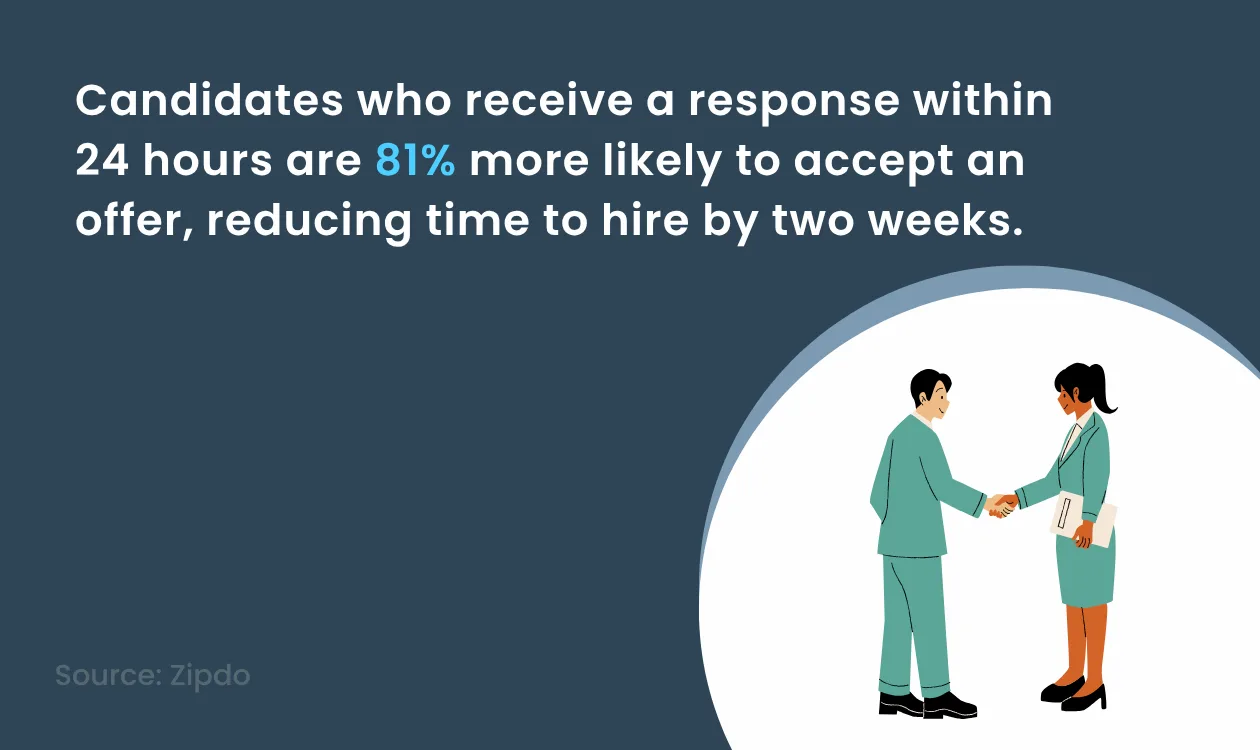
According to Zipdo, candidates who receive a response within 24 hours are 81% more likely to accept an offer, which can reduce the hiring cycle by over 2 weeks.
One recruiting team reduced average time-to-offer by over 40% after standardizing interview rubrics and automating scheduling, showing how execution directly drives measurable hiring outcomes.
Higher Quality of Hire
Quality of hire improves when evaluation is structured, and feedback loops exist. Execution that enforces scorecards and post-hire reviews helps match performance to selection criteria. Focus on hiring execution quality by using calibrated scorecards and structured interviews to predict first-year performance.
Better Candidate Conversion
Offer acceptance rates rise when the candidate journey is smooth. Execution tactics include faster decision cycles, clearer offers, and tailored communication. Recruiters who follow a negotiation script and assign single-point offer coordination see acceptance rates climb.
Lower Early Attrition
Onboarding is part of execution. If new hires face administrative delays or unclear role expectations, early turnover increases. Treat the handoff from offer acceptance to onboarding as part of talent acquisition execution. ATS or HRIS triggers can help teams coordinate documentation, equipment, manager actions, start-date communication, and role expectations. Measure the effect using onboarding completion, candidate-to-new-hire feedback, early withdrawal, and 30-, 90-, and 180-day retention rather than assuming the workflow itself causes retention.
Early retention is influenced by factors beyond recruitment execution, including role clarity, manager support, compensation, job design, workload, and organizational culture.
Real Client Stories: Execution in Action
Here are two anonymized client examples that show the practical impact of improving talent acquisition execution.
1. Technology Firm Optimizes Scheduling
- Manual scheduling caused long cycles.
- Solution: Recruiter-owned scheduling + ATS integration → Time-to-offer halved, candidate dropouts declined.
2. Retail Chain Standardizes Assessments
- Inconsistent hiring of store managers.
- Solution: Standardized assessments + scorecards + training → Predictive validity improved, early turnover decreased.
Execution separates strategy from results. Strategy without repeatable execution gives you noise rather than outcomes.
Practical Steps to Improve Talent Acquisition Execution
Improving execution is iterative. Use these practical steps to build momentum.
- Map your process end to end and document handoffs between recruiters, hiring managers, and HR operations.
- Set service level agreements for key stages such as interview scheduling, feedback return, and offer turnarounds.
- Integrate your tech stack so data flows between ATS, assessments, and communication tools.
- Use standardized scorecards and train hiring managers on calibration sessions.
- Automate routine tasks like interview reminders, offer letters, and candidate surveys to free recruiter time for strategic work.
- Monitor a small set of KPIs and run weekly or biweekly reviews to address bottlenecks.
- Close the loop by tying post-hire feedback to sourcing and selection decisions.
Start with a single job family as a pilot. Use the pilot to test SLA targets, refine scorecards, and validate technology integrations before scaling. This approach improves adoption and demonstrates the link between changes and TA outcome metrics.
Technology Choices That Support Strong Recruitment Execution
Not all technology is equally helpful. Consider capabilities that enable execution rather than add complexity.
- ATS with workflow automation and reporting
- Sourcing platforms with candidate pools and outreach templates
- Scheduling tools that sync with calendars
- Assessment platforms with integration and scoring APIs
- Communication platforms that centralize candidate touchpoints
When evaluating tools, prioritize those that remove friction in the hiring pipeline and produce actionable data. A common mistake is layering tools without aligning them to a documented process. Execution fails when systems contradict each other.
Metrics to Track for Execution Excellence
Use a focused set of recruitment metrics to measure hiring speed, candidate movement, sourcing quality, and post-hire outcomes.
KPI | Definition | Formula | What It Shows |
Time to Hire | Days from candidate entry to offer acceptance | Acceptance date − candidate entry date | Hiring-process speed |
Time to Fill | Days from requisition approval to offer acceptance | Acceptance date − requisition approval date | Total vacancy-fill time |
Quality of Hire | Post-hire performance, retention, productivity, and manager satisfaction | Organization-defined composite score | Success of new hires |
Source Effectiveness | Results produced by each sourcing channel | Compare hires, quality, cost, and retention by source | Best-performing talent sources |
Candidate Withdrawal Rate | Percentage of candidates who leave the process voluntarily | Withdrawals ÷ candidates × 100 | Candidate drop-off and process friction |
Offer Acceptance Rate | Percentage of offers accepted | Accepted offers ÷ offers issued × 100 | Offer competitiveness and candidate engagement |
Early Retention Rate | Percentage of new hires remaining after a set period | Retained hires ÷ eligible hires × 100 | Hiring alignment and onboarding effectiveness |
Review these KPIs together. Faster hiring is not a positive outcome if quality of hire, candidate experience, or early retention declines.
Use consistent definitions, date ranges, and ATS stages across every reporting period.
Common Execution Pitfalls and How to Avoid Them
Some common execution failures repeat across organizations. Recognize them early.
- Over reliance on tools: Tools help, but they do not replace governance. Create usage policies and train teams to use systems consistently.
- Lack of ownership: Define who owns each stage. Ambiguity causes delays. Assign process owners who measure and report adherence.
- Ignoring candidate feedback: Candidate surveys are not optional. Use feedback to refine communication and process steps.
- Too many metrics: Track the few metrics that drive behavior. Too many KPIs diffuses focus and weakens execution.
Conclusion
Talent acquisition execution is the operating system that translates strategy into hiring impact. By standardizing processes, integrating technology, measuring the right metrics, and enabling recruiters and hiring managers, you improve speed, quality, and candidate experience. Execution transforms good intentions into measurable business value. Start small, measure often, and iterate to make hiring outcomes predictable and repeatable. Stay ahead of the curve — explore more HR insights on NextInHR to deepen your TA team effectiveness and improve your TA outcome metrics.