

 10 mins read
Most talent leaders point to market tightness, salary competition, or employer branding when they explain slow hiring. Those factors matter, but they do not fully explain persistent internal delays. A frequent, overlooked source of hiring friction is recruiter judgment. When hiring teams rely heavily on subjective decision making, hiring bottlenecks appear in predictable ways: long candidate queues, stalled interviews, and offers that lag market windows. If your time to hire is creeping up, start by examining decisions people make at each touchpoint.
Hiring bottlenecks are stages in the recruitment process where candidates stop progressing at the expected speed. They often appear as screening backlogs, delayed interview feedback, repeated approval requests, slow scheduling, or stalled hiring decisions. While technology and process design can contribute to these delays, inconsistent recruiter judgment is often a hidden cause of hiring bottlenecks.
TL;DR
- Recruiter judgment is a top but underexamined cause of hiring bottlenecks.
- Subjective screening, inconsistent interview decisions, and decision fatigue delay offers.
- Data, standardized rubrics, and ATS workflows cut the delays significantly.
- AI can help surface candidates and reduce manual bias when used responsibly.
- Small process changes yield fast wins while tech upgrades deliver scale.
- Measure time, stages, and decision variance to remove the real blockers.
What Is Recruiter Judgment in the Hiring Process?
Recruiter judgment refers to the human choices made during sourcing, screening, shortlisting, interview evaluation, and offer approval. These choices include prioritizing one resume over another, deciding who moves to interview, and interpreting cultural fit. Judgment is necessary. But when it is unstructured, inconsistent, or influenced by fatigue and bias, it creates hiring bottlenecks that technology alone cannot fix.
How Unstructured Judgment Creates Hiring Bottlenecks
Here are the common failure modes that turn everyday decisions into persistent delays in your hiring pipeline.
1. Resume Roulette and Inconsistent Candidate Screening
When every recruiter applies their own filter, candidates move through the screening process at different speeds. Two similar applicants can have very different outcomes depending on who reviews them. This inconsistency creates backlogs in the hiring pipeline, slows early decisions, and leads to an uneven candidate experience.
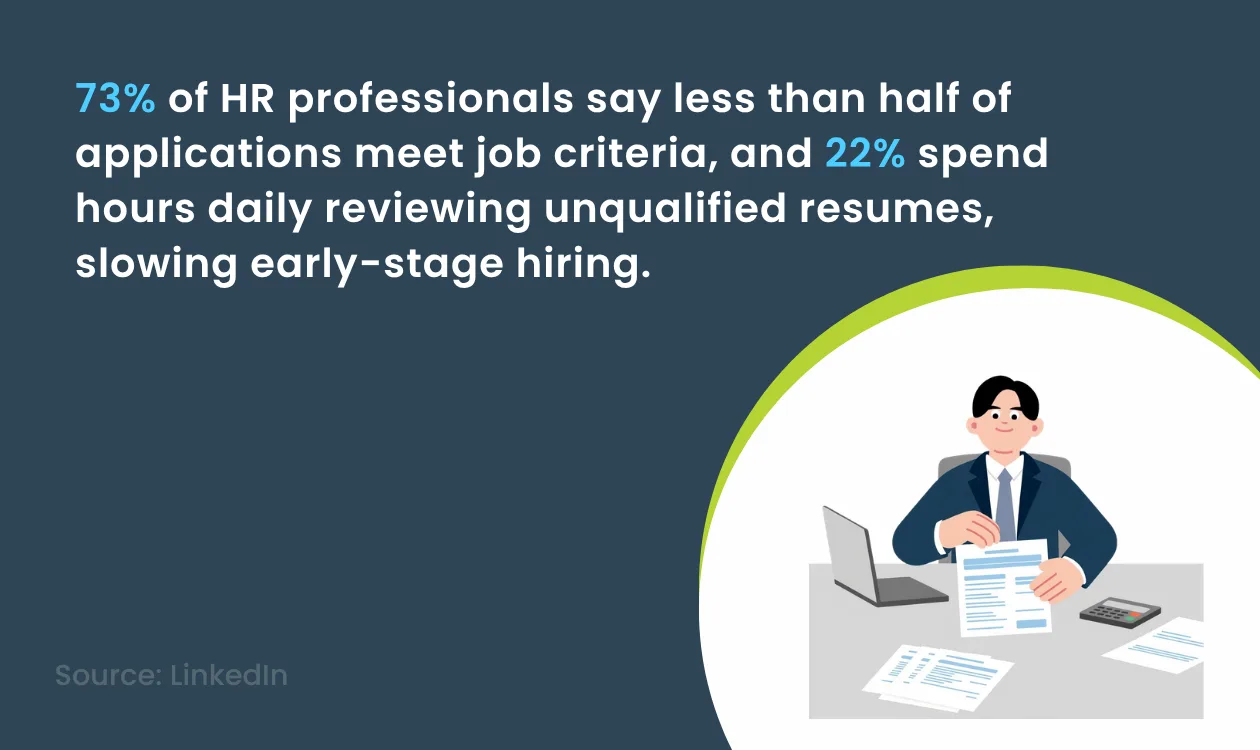
According to LinkedIn Talent Insights research, 73% of HR professionals say fewer than half of the applications they receive meet job criteria, and 22% spend three to five hours each day reviewing unsuitable resumes. That manual screening load consumes valuable decision time and creates early-stage hiring bottlenecks that contribute to a slow hiring process.
2. Decision Fatigue and Delayed Hiring Decisions
Recruiters and hiring managers review dozens of profiles and conduct several interviews a day. Decision fatigue leads people to postpone difficult calls. Rather than move a candidate forward or reject them, teams often leave candidates in limbo. Those stalled decisions create hidden queues and the appearance of action while no progress is made.
3. Cultural Fit Used as a Catch-all Rejection Reason
Vague terms like cultural fit let teams filter candidates without clear criteria. That soft rejection contributes to subjective tape loops where candidates are passed between recruiters and hiring managers with no clear resolution. Rework increases and time to hire grows.
4. Unclear Ownership and Approval Delays in Recruitment
When the hiring manager, recruiter, and hiring committee all believe the other party will make the final call, approvals stall. This is a common organizational blind spot. Clear decision rights reduce the bottleneck of waiting on approvals and shrink common hiring pipeline blockers.
Real Examples and Data Behind Hiring Bottlenecks
Consider a mid-size tech company where recruiters each had personal screening thresholds. Some prioritized role-specific keywords, others prioritized college pedigree, and some weighed referral presence most heavily. The result was uneven quality of interview slate and a backlog of candidates in screening. After implementing a standardized screening rubric and a short ATS workflow to enforce it, the company reduced time to first interview by 22 percent.
Data from recruitment studies show that structured hiring practices improve speed and quality. According to a major talent platform report, teams that use scorecards and consistent interview guides fill roles faster and report improved hiring manager satisfaction. Another survey found that slow internal processes, not lack of candidates, were the top reason offers fell through in over 40 percent of lost hires. SHRM 2026 similarly calls out that internal process delays are a leading cause of hiring delays and recommend governance and scorecards to restore speed and fairness.
Quote: "Speed without compromise is a product of process, data, and consistent human judgment."
Where Technology Helps and Where it Does Not
Technology is a force multiplier, but it cannot replace the need for better human decision frames. Here is how to use technology wisely to address hiring bottlenecks driven by judgment.
Using ATS Workflows to Enforce Faster Hiring Decisions
Configure your ATS to require completed scorecards before a candidate can advance. That prevents informal passes and orphaned candidates. Automated reminders and deadlines reduce hanging decisions that create invisible queues. Build simple dashboards that show stalled candidates so ownership is obvious.
Leveraging AI to Surface Qualified Candidates Faster
AI screening tools can rank and surface promising candidates, but they should not be a final arbiter. Use AI to prioritize work for recruiters and highlight candidates who meet objective criteria. When AI recommendations are paired with structured human review, teams reduce screening time and lower variance in decisions. Guard against overreliance to avoid introducing new recruitment bottlenecks through automation bias.
Automating Scheduling and Follow-Ups to Prevent Delays
Interview scheduling and feedback collection are frequent choke points. Automating these tasks frees up decision bandwidth for higher value work and reduces candidate dropoff. Integrations between calendar tools and ATS systems eliminate several manual handoffs that cause hiring bottlenecks and recruiting inefficiency.
Govern technology use with audit logs and periodic reviews. Maintain human-in-the-loop checks so AI suggestions can be validated and corrected. This reduces recruiter quality judgment drift and mitigates recruiter decision bias over time.
Practical Fixes to Reduce Recruitment Bottlenecks Caused by Recruiter Judgment
Fixes fall into three categories: process, people, and tech. Implementing a combination delivers the fastest results and prevents repeated slow hiring process patterns.
1. Standardize Screening with Structured Hiring Rubrics
Create a short, role-specific rubric with 4 to 6 criteria. Use defined scoring bands and examples for each band. Train recruiters and hiring managers to use it consistently. The rubric converts judgment into repeatable measurements that make candidate decisions faster and more defensible.
2. Set Decision SLAs to Speed Up Hiring Stages
Define service level agreements for each stage, such as reviewing an application within 48 hours and returning interview feedback within 24 hours. Build these SLAs into your ATS and report on them weekly. When people see where bottlenecks form, they act faster.
3. Reduce Decision Overload with Batching and Specialization
Batch resume reviews and assign specialized sourcers for initial screens. This reduces the cognitive cost of frequent context switching and creates consistent evaluation standards. Having a dedicated interviewer for technical assessment also removes variability between hiring managers.
4. Clarify Ownership and Improve Hiring Handoffs
Map the hiring workflow and assign an owner for each stage. Use a RACI chart to clarify who is responsible for decisions, who is consulted, and who must be informed. Clear ownership speeds approvals and reduces ping-ponging between stakeholders.
5. Use Hiring Metrics to Identify Hidden Bottlenecks
Report on conversion rates between stages, average time in stage, and variance across recruiters and hiring managers. Track the proportion of candidates left in a stage beyond SLA and examine root causes. When you can see that one stage absorbs most time, target it with a focused intervention. Data transforms anecdote into action and uncovers hiring pipeline blockers.
Implementation Roadmap to Remove Hiring Bottlenecks Faster
Start with changes that deliver impact quickly, then scale to larger infrastructure work. Address both the human behaviors and the system gaps that create recruiting inefficiency.
Quick Wins in the First 30 Days
- Implement a two-page screening rubric for open critical roles.
- Configure ATS to block advancement without completed feedback.
- Add auto-reminders for pending feedback and interviews.
Process and Training Improvements
- Train hiring managers and recruiters on the rubric and SLAs.
- Create a simple dashboard showing time in stage and decision variance.
- Pilot AI-assisted candidate surfacing for one role and evaluate impact on speed and quality.
Scaling Structured Hiring with Technology and Governance
- Embed scorecards into interview kits and job postings.
- Build governance around AI use to prevent unintended bias.
- Regularly review stage metrics and recalibrate rubrics based on hiring outcomes.
Measuring Hiring Bottlenecks: Metrics That Matter
Measurement should focus on both speed and quality. Use a small set of KPIs: time in stage, offer acceptance rate, quality of hire, and candidate net promoter score. Track decision variance by recruiter and hiring manager to ensure standardization works. Finally, be cautious about introducing too many controls that create administrative overhead. The goal is to reduce hidden queues and speed clear decisions, not to create new process steps that slow people down.
Hiring bottlenecks can be identified by matching visible delays with the right recruitment metrics. The table below highlights common symptoms, likely causes, and practical fixes.
Hiring stage | Common symptom | Metric to track | Likely cause | Recommended fix |
Candidate screening | Applications remain unreviewed | Time to first review | High volume or inconsistent screening criteria | Use structured rubrics, batch reviews, and ATS reminders |
Interview scheduling | Candidates wait too long for interviews | Time from screening to interview | Manual scheduling or unclear ownership | Automate scheduling and assign a stage owner |
Interview feedback | Decisions stall after interviews | Feedback turnaround time | Missing feedback or unclear evaluation criteria | Use interview scorecards and decision SLAs |
Final decision | Qualified candidates remain pending | Time from final interview to decision | Decision variance or too many approvers | Assign one decision owner and use structured debriefs |
Offer stage | Offers are delayed or declined | Time to offer and offer acceptance rate | Slow approvals or unclear compensation | Preapprove salary ranges and simplify offer workflows |
Add a periodic audit of decisions that flags outliers. Review cases where candidates waited beyond SLA or where variance between reviewers is high. These audits identify coaching opportunities and expose structural recruitment bottlenecks rather than people problems.
Find the Bottlenecks Slowing Down Your Hiring Process
Use our Hiring Bottleneck Audit Template to identify where candidates are getting stuck, measure delays across each recruitment stage, and assign practical fixes.
The template helps your team review:
- Time spent at each hiring stage
- Candidate drop-off and conversion rates
- Interview feedback delays
- Recruiter and hiring manager decision variance
- Hiring SLA ownership
- ATS workflow gaps
Download the Free Hiring Bottleneck Audit Template
Conclusion
Hiring teams often chase external causes of slow hiring when the real bottlenecks are internal and human. Hiring bottlenecks are frequently the result of unstructured recruiter quality judgment, inconsistent processes, and avoidable delays. The solution blends process, people, and technology: standardized rubrics, clear ownership and SLAs, ATS workflows, and responsible AI to surface candidates.
Start with small changes that reduce decision variance, measure impact, and scale the practices that both speed hiring and preserve quality. Address the human side of decision making and you will remove many of the invisible constraints that stop talent acquisition from moving at the speed your business needs. Stay ahead of the curve - explore more HR insights on NextInHR.