
 11 mins read
Artificial intelligence is changing how companies find, hire, and retain talent. For HR teams, the phrase AI for HR Professionals is no longer theoretical. It is a practical set of tools and methods that can reduce manual work, improve candidate experience, and deliver insights from hiring data. This guide helps HR leaders, recruiters, and talent teams separate signal from noise. You will get clear recommendations on what to learn, what to test, and what you can safely ignore. It also points to essential AI literacy for HR and AI training for HR teams to make pilots successful.
TL;DR
- AI for HR Professionals can automate routine tasks and improve hiring decisions.
- Focus on data quality, bias mitigation, and outcomes rather than hype.
- Adopt narrow use cases first: sourcing, screening, scheduling, and analytics.
- Ignore vendor buzz on impossible promises and unclear ROI.
- Train teams on explainability and compliance when deploying AI tools.
- Measure impact with pilot metrics and scale what improves quality and speed.
- Blend AI with human judgment; do not fully hand over candidate decisions to algorithms.
AI for HR Professionals: What to Learn, Pilot, and Ignore
Learn | Pilot | Ignore |
AI literacy for HR, including how AI tools work, where they help, and where human oversight is required. | Narrow AI in recruitment use cases such as resume parsing, interview scheduling, and candidate matching. | Broad vendor promises that claim AI can fully automate hiring decisions without human review. |
Data hygiene, ATS integration, and HR technology workflows so AI tools can use accurate, connected data. | Recruiter automation for repetitive tasks such as scheduling, outreach reminders, and candidate status updates. | Tools that require large data exports without clear privacy, security, or compliance controls. |
Bias mitigation, explainable AI, and auditability to make AI-supported decisions fair and accountable. | Hiring analytics dashboards that measure time-to-fill, interview-to-offer conversion, candidate experience, and quality of hire. | Black-box AI tools that cannot explain recommendations, scoring logic, or bias testing methods. |
NLP for HR, predictive analytics HR, and conversational AI hiring so teams understand practical AI capabilities. | Candidate-facing chatbots for FAQs, screening questions, and interview coordination, with human escalation. | Full replacement of recruiter judgment, especially for screening, rejection, shortlisting, or final hiring decisions. |
AI governance, compliance basics, and HR upskilling practices for responsible adoption. | Small pilots with clear baselines, success metrics, and review checkpoints before expanding AI across HR. | Vendor lock-in, vague reporting, weak ATS integration, and tools that cannot support migration or audit needs. |
Why HR needs a practical view of AI
Many HR teams feel pressure to adopt the latest AI tools. That pressure comes from vendors, executives, and competitors. However, adoption without a clear plan creates wasted budget and compliance risk. AI for HR Professionals should be approached as a capability that supports human decision making rather than replacing it. When used correctly, AI automates repetitive tasks, surfaces patterns in candidate data, and helps scale personalization across hiring funnels. Building basic AI fundamentals HR and AI knowledge for HR will help teams evaluate tools and design pilots.
Key stats and what they mean for AI for HR Professionals
Recent surveys show that a large percentage of talent leaders are piloting AI tools. For example, a study found that nearly nine in ten HR leaders plan to expand AI use in recruitment. Practical implications include faster resume screening, more consistent interview scheduling, and earlier detection of retention risks. Yet adoption also reveals common pitfalls: poor data, hidden bias, and unclear ROI. These realities shape what HR professionals should focus on first.
Nearly 90 percent of talent leaders expect increased AI use in recruitment this year, highlighting the need for clear pilots and governance (LinkedIn Talent Trends 2026).
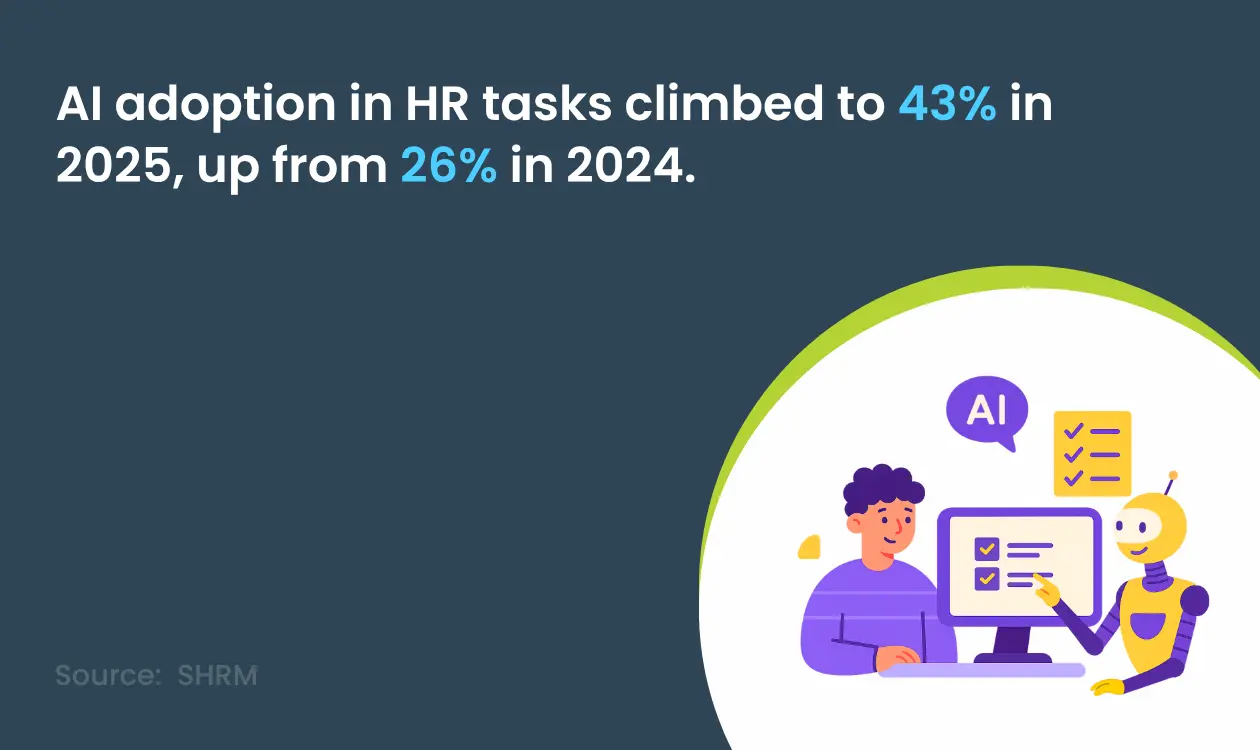
AI adoption in HR is growing quickly. According to SHRM’s 2025 Talent Trends research, AI adoption in HR tasks increased to 43% in 2025, up from 26% in 2024. For HR professionals, this shows that AI is no longer just an experiment. Teams now need AI literacy for HR, better data hygiene, bias mitigation practices, and clear AI governance before using AI in recruitment, hiring analytics, or recruiter automation.
Core areas HR should learn about
Below are the practical domains every HR team should understand when adopting AI for HR Professionals. Learning these basics will help your team evaluate tools and run effective pilots. Consider including structured HR AI education and role-specific training so recruiters can interpret signals and avoid common pitfalls.
1. Data hygiene and integration
AI models only perform as well as the data they receive. For HR teams this means cleaning candidate records, tracking consistent job codes, and making sure your ATS and HRIS share reliable fields. Spend time mapping where candidate data comes from, who owns it, and how often it is updated. Quality data reduces false positives in screening and avoids amplifying past biases. Practically, a short internal data audit and a data ownership playbook are must-know AI for HR steps before any vendor pilot.
2. Bias mitigation and fairness
AI for HR Professionals can unintentionally replicate biased patterns from historical hiring data. Learn methods for testing models for disparate impact, such as comparing recommendation rates across demographic groups. Work with suppliers that provide explainability reports and access to raw scoring logic when possible. Require vendors to share how they trained models and what features are excluded to reduce bias risk. Include basic tests for fairness in your pilot success criteria.
3. Explainability and auditability
Regulators and internal stakeholders need clear explanations of how automated decisions are made. HR teams should insist on tools that provide human readable rationale for recommendations. Explainability helps recruiters defend hiring decisions and supports compliant candidate communication. Keep logs of automated decisions so you can audit outcomes for quality and fairness. Adding a short explainability checklist to vendor contracts is a practical step toward actionable AI governance.
4. Narrow, high value use cases
Start small. The most impactful AI projects for HR are often narrow and measurable. Examples include automated interview scheduling, resume parsing to extract consistent skills, candidate matching for hard-to-fill roles, and attrition risk scoring. With these focused pilots you can measure time saved, candidate response rates, and quality of hire improvements before broader rollout.
5. Integration with ATS and workflows
Adoption fails when AI tools create new silos. Make sure any new capability for AI for HR Professionals integrates with your ATS, calendar systems, and communication platforms. Users should not have to export and reupload files. A smooth integration preserves recruiter time and avoids data fragmentation.
Practical technologies to prioritize
Not all AI is equally useful for HR. Focus on these technologies first.
1. Natural language processing for screening and analytics
NLP helps extract skills, summarize resumes, and identify role fit faster. When combined with structured job profiles, it can surface qualified candidates that might otherwise be missed. Use NLP tools that let recruiters review and adjust extracted attributes easily.
2. Intelligent automation for scheduling and outreach
Automating interview scheduling and follow up messages reduces time-to-hire. When implemented correctly, these automations improve candidate experience by providing timely updates and consistent communication. Track response and no-show rates to evaluate the impact.
3. Predictive analytics for hiring and retention
Predictive models can signal which candidates are likelier to succeed or which employees may be at risk of leaving. These models are useful but must be validated with local data and tied to interventions you can act on, such as tailored onboarding or targeted coaching.
4. Conversational agents for initial screening and FAQs
Chatbots can handle basic candidate questions and gather preliminary screening data. Use them to free recruiter time and provide 24/7 touch points. Ensure there is clear escalation to human recruiters for complex candidate interactions.
What HR can ignore or deprioritize
Not every shiny AI claim deserves attention. Here are things HR teams can safely deprioritize when evaluating tools marketed to AI for HR Professionals.
1. Broad promises without metrics
Ignore vendors that make sweeping claims like doubling hire quality without showing baseline metrics or case studies. Ask for concrete pilot results and sample dashboards. If a vendor cannot provide measurable outcomes, treat claims as marketing rather than evidence.
2. Full replacement of recruiter judgment
Any tool that claims it can fully replace human recruiters should be treated with caution. AI is best used to augment human judgment by reducing low value tasks and highlighting promising candidates. Final hiring decisions should remain with humans who can weigh context, culture, and potential.
3. Solutions that require massive data exports
Tools that demand you export large data sets to external platforms create security and governance headaches. Prioritize solutions that process data within your environment or provide secure connectors that meet your compliance needs.
4. Vendor lock in without migration paths
Avoid platforms that lock you into proprietary formats with no clear migration plan. Your HR technology stack will evolve. Choose solutions that provide standard APIs, data export options, and documented migration strategies.
How to run a pilot that shows value
Running a tight pilot helps separate genuine value from hype. Follow a simple pilot checklist designed for AI for HR Professionals.
- Define success metrics before you start. Examples are time-to-fill reduction, interview-to-offer conversion improvement, or candidate satisfaction scores.
- Limit scope to a single team or role type to reduce variables.
- Set a pilot duration and sample size that is realistic for your hiring velocity.
- Collect qualitative feedback from recruiters and candidates in addition to quantitative metrics.
- Review results and iterate before expanding the tool to more teams.
Governance, privacy, and compliance for AI for HR Professionals
Privacy and legal risks accompany AI deployments. Document data flows, implement role-based access, and maintain consent records for candidate communications. Work with legal and data protection officers to ensure your AI for HR Professionals approach aligns with employment law and data regulations. Keep in mind that compliance is not just a checkbox. It is part of maintaining trust with candidates and employees.
Change management, upskilling, and AI literacy for HR
People change determines success. Invest in training so recruiters understand where AI helps and where human judgment is essential. Create playbooks that explain how to interpret AI recommendations, when to override them, and how to provide feedback to vendors. Make a culture of continuous improvement part of your rollout plan. Building basic AI literacy for HR and targeted sessions on what AI skills HR needs will reduce resistance and improve outcomes.
Real examples from the field
Here are short, real-world examples that show practical use of AI for HR Professionals.
- Sourcing boost: A mid-size tech company used NLP to enrich candidate profiles, increasing the number of qualified passive candidates contacted per recruiter by fifty percent while maintaining response quality.
- Scheduling automation: A staffing firm implemented automated interview scheduling and reduced time-to-interview by one third and decreased no-shows through automated reminder messages.
- Retention signals: An enterprise HR team used predictive analytics to identify employees at risk and implemented targeted coaching. Voluntary attrition in the pilot cohort dropped compared to control groups.
Measuring success and avoiding common measurement traps
Good metrics separate real value from placebo. Don’t rely solely on adoption numbers. Measure outcomes that matter: cost per hire, time to productivity, candidate experience scores, and quality of hire. Avoid changing multiple variables at once during a pilot. If you deploy a new AI screen and alter sourcing channels at the same time, you will not know which change caused the result.
Vendor evaluation checklist
Use this quick checklist when evaluating vendors for AI for HR Professionals:
- Does the vendor provide explainability for automated decisions?
- Can the tool integrate with your ATS and calendar systems?
- Are training data sources disclosed and audited?
- Does the vendor support role based access and data export?
- Do they offer a realistic pilot with clear success criteria?
Conclusion
AI for HR Professionals is a strategic capability that can deliver real efficiency and insight when applied thoughtfully. Prioritize data quality, narrow use cases, explainability, and compliance. Ignore broad promises and tools that remove human judgment entirely. Run disciplined pilots, measure outcomes, and scale what demonstrably improves hiring speed and quality. With the right approach, AI becomes a multiplier that helps HR teams focus on strategy and people instead of repetitive tasks. Stay ahead of the curve - explore more HR insights on NextInHR.