
 12 mins read
Workplaces are changing fast, with hybrid work, AI, automation, and rising employee expectations reshaping how companies hire, engage, and grow talent. In 2026, building a future-ready HR strategy is essential for creating a productive, future-ready workforce. This guide explains how to connect technology, data, culture, and employee experience with business goals while supporting stronger HR strategic planning and HR business alignment.
TL;DR
- A strong future-ready HR strategy aligns people initiatives with business goals and long-term growth.
- Start with an HR audit, workforce analysis, and a clear understanding of skill gaps and future needs as part of HR strategic planning.
- Build a future-ready HR strategy framework covering talent acquisition, employer branding, employee experience, engagement, performance management, and learning and development.
- Leverage AI and HR technology to automate repetitive tasks, improve hiring quality, enhance employee journeys, and support a data-driven HR strategy.
- Focus on continuous learning, flexible work models, and personalized development paths to build a future-ready HR strategy.
- Future-shaping trends include skills-based hiring, advanced analytics, automation, and stronger employee-centric practices.
- Platforms like NextInHR help HR professionals stay updated with evolving trends and build more informed, strategic HR management and strategic HR planning approaches.
What a Modern HR Strategy Really Means
A Modern HR Strategy is simply a smarter, more human, more data-driven version of traditional HR. Instead of reacting to problems, HR teams now anticipate workforce needs, plan talent pipelines, and use digital tools often supported by the best digital marketing company strategies to create better employee experiences and stronger organizational growth. This shift brings HR strategic planning and strategic HR management into the center of business planning.
This shift comes from real workplace changes: employees want flexibility, meaningful work, and continuous growth; hiring has become more competitive; and organizations rely heavily on technology to stay efficient. Because of this, companies now use AI-powered HR strategy tools, data-driven insights, HRMS software and employee-first processes to build strong teams and a strong culture. A future-ready HR strategy makes these elements work together to deliver measurable business results.
A modern strategy connects your people strategy directly with your business strategy so that every hiring decision, engagement activity, training program, and performance conversation moves the company forward and improves HR business alignment.
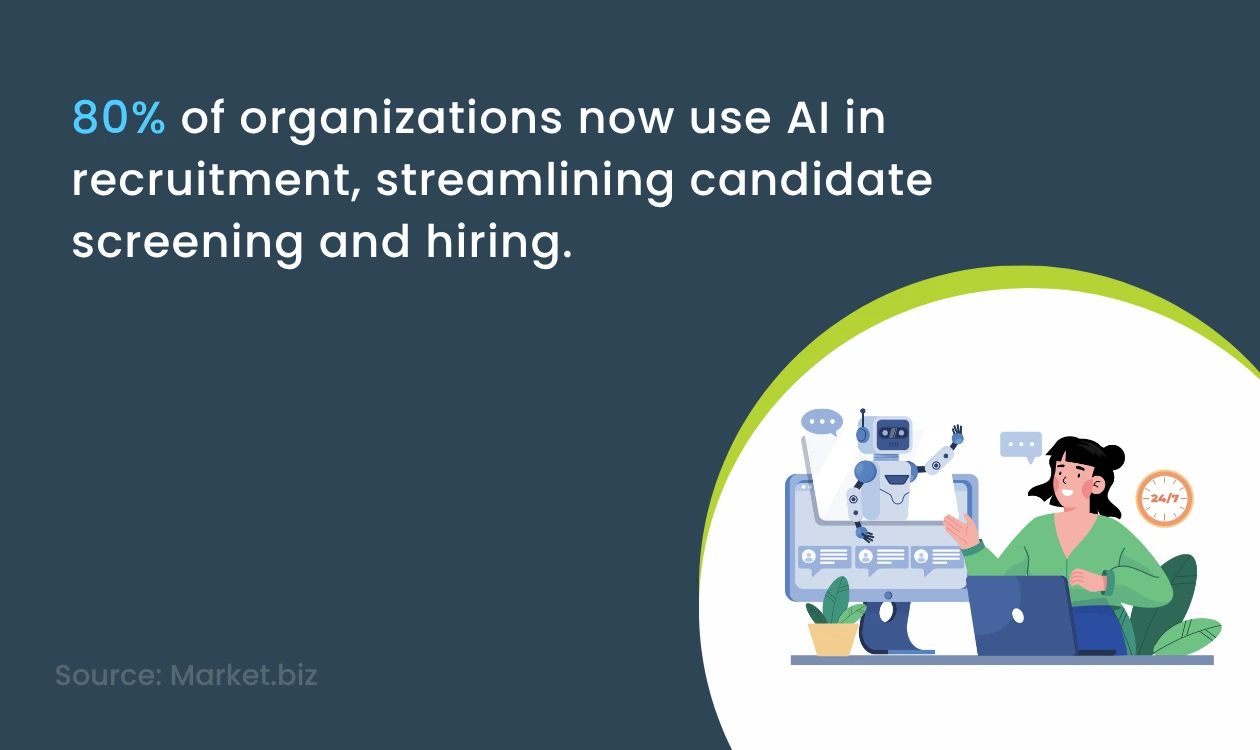
Market.biz reports that 80% of organizations now use AI in recruitment, streamlining candidate screening and hiring. This shows how central technology has become to any Modern HR Strategy.
Why a Strong Modern HR Strategy Matters in 2026: HR 2026 Roadmap
A well-designed Modern HR Strategy creates clarity. It tells your team what kind of workforce you are building, what skills you need, and how you plan to hire, support, and develop people. This clarity is the backbone of any HR 2026 roadmap.
With a good strategy, hiring becomes more focused, employee engagement improves, performance becomes easier to manage, and your overall culture becomes healthier. It also helps you build a strong employer brand, which is essential at a time when candidates research everything, work culture, growth opportunities, leadership style, and even HR practices before applying. A future-ready HR strategy amplifies employer branding by aligning purpose, candidate experience, and HR operations.
As organizations adopt more HR tech and automation, the right strategy helps HR teams reduce manual work, operate more efficiently, and focus on meaningful initiatives that genuinely move the business forward. This is the essence of strategic HR management and HR business alignment.
Core Components of a Modern HR Strategy
A strong Modern HR Strategy stands on a few key pillars. These are not separate activities; they work together to shape the entire employee lifecycle and support your HR strategic planning efforts.
1. Strategic Workforce Planning
This is where you look ahead and decide what kind of workforce you need in the future. Which skills are missing? What roles should you build internally? Which positions need fresh talent? Modern workforce planning is proactive and uses data, not guesswork. Integrate skills taxonomies and scenario planning so your workforce plans support strategic HR management and a future-ready HR strategy.
2. Smarter Talent Acquisition
A modern talent acquisition strategy focuses on hiring the right people through efficient, candidate-friendly processes. AI-based tools now help with resume screening, sourcing, and identifying job-fit patterns, making hiring faster and fairer. Strong employer branding also matters because candidates want to work with companies that are transparent, purpose-driven, and respectful. A future-ready HR strategy ties sourcing, assessment, and employer brand into a single hiring engine. Many teams now rely on ai generated presenter videos to produce employer-branding content at scale.
3. Employee Experience and Engagement
Today’s workforce expects more than a salary; they want career growth, good leaders, flexible work, and a sense of belonging. A modern employee engagement strategy pays attention to everyday experiences, not just annual surveys. Companies now track feedback more often, recognize achievements frequently, and create programs that genuinely improve well-being and connection. That is central to a future-ready HR strategy.
4. Modern Performance Management
The old method of once-a-year reviews is disappearing. Today’s performance management focuses on continuous feedback, real-time goals, and regular conversations. Leaders play a coaching role, and HR uses data to identify trends, strengths, and development areas. Use performance analytics to close skill gaps and support HR strategic planning cycles.
5. Learning and Development
A modern HR strategy prioritizes growth. Employees want opportunities to upskill, reskill, and explore new career paths, including technical credentials like a dba course for data-focused roles. Digital courses, personalized learning suggestions, leadership development, and cross-functional training all help build a future-ready workforce. A future-ready HR strategy embeds continuous learning into talent mobility and retention plans.
6. HR Technology and Automation
Technology is the backbone of modern HR. From AI tools that evaluate resumes to automation that manages repetitive tasks, HR tech helps teams operate more efficiently. It makes processes smoother, improves accuracy, and saves valuable time so HR can focus on strategy and culture. Building a future-ready HR strategy means selecting tools that support a data-driven HR strategy while preserving ethics and fairness.
Tool selection is where that strategy either holds or quietly falls apart. A large enterprise suite assumes a dedicated HR team to configure and run it, while a 40-person company usually has one HR generalist handling that configuration alongside everything else, so the same feature list can produce very different outcomes. The practical choice is whether to extend what is already in place, such as payroll, a spreadsheet for absence, or a shared drive for contracts, or move to a single system that supports the entire employee lifecycle. Modern HR software matters less for its feature list than for how much routine admin it removes, including absence tracking, document sign-off, onboarding tasks, and self-service reporting, while the audit findings should guide the decision.
How to Build a Modern HR Strategy: A Step-by-Step Framework
Building an HR strategy for 2026 does not have to be complicated. The best way is to follow a simple framework that guides you through understanding your current state, defining your goals, and designing the right solutions. This practical framework supports HR strategic planning and helps operationalize strategic HR management.
1. Align HR with Business Goals
Start by understanding where the company is headed. Are you expanding? Launching new products? Targeting new markets? Planning cost reductions? Your HR strategy must directly support these directions. When HR and business goals move together, decision-making becomes easier and more impactful. Alignment is the core of HR business alignment and a strong future-ready HR strategy.
2. Conduct an HR Audit
Next, look at what is working and what is not. Review your hiring processes, onboarding experience, engagement levels, turnover reasons, and performance outcomes. This will tell you exactly where improvements are needed and where your biggest gaps lie. Use audit findings to inform your HR 2026 roadmap and prioritization.
3.Sample HR 2026 Roadmap for Building a Modern HR Strategy
After completing the HR audit, HR teams should convert insights into a practical HR 2026 roadmap. The roadmap below shows how to prioritize workforce planning, HR technology, employee experience, analytics, and review across the year while keeping the future-ready HR strategy aligned with business goals.
Phase | Strategic Focus | Key HR Actions | Success Metrics |
Phase 1 | HR audit and business alignment | Review current HR processes, workforce gaps, employee data, and business priorities. Define the main HR goals for the year. | HR gaps identified, priority goals finalized, baseline HR metrics documented. |
Phase 2 | Workforce planning and talent strategy | Forecast hiring needs, identify critical roles, review skills gaps, and update talent acquisition and internal mobility plans. | Hiring needs mapped, skills gaps identified, workforce plan approved. |
Phase 3 | HR technology and employee experience | Improve HR technology, automate manual tasks, and strengthen onboarding, engagement, feedback, and retention initiatives. | Better process efficiency, improved engagement, reduced manual HR workload. |
Phase 4 | HR analytics and performance review | Track HR analytics, measure performance management outcomes, review employee experience data, and update the strategy for the next cycle. | HR goals measured, performance insights reviewed, strategy updated. |
4. Use Data to Understand Workforce Needs
A data-driven HR strategy relies on real insights, not intuition. Employee surveys, performance analytics, hiring trends, attendance patterns, and exit interviews all provide valuable information. Today, AI tools can even predict which employees are at risk of leaving or which candidates are most likely to succeed. Embedding these capabilities into a data-driven HR strategy makes your future-ready HR strategy measurable and defensible.
5. Redesign and Modernize HR Processes
Once you know the gaps, update your HR processes. Introduce better onboarding, improve communication, automate repetitive tasks, strengthen DEI efforts, or revamp your learning programs. The goal is to make the employee journey smoother and more meaningful at every stage. These changes turn strategic planning into operational practice within your future-ready HR strategy.
6. Set Measurable HR Goals
Goals bring focus. You might aim to reduce time-to-hire, increase engagement scores, improve onboarding completion, boost L and D participation, or lower turnover. Clear goals help you measure progress and show leadership the impact of your HR efforts. Tie these goals to your HR 2026 roadmap and strategic HR management metrics.
7. Integrate HR Technology and AI
This is where your HR strategy becomes modern and scalable. HR tech systems streamline work, improve data accuracy, and support better decision-making. AI helps with recruitment, performance insights, employee listening, L and D personalization, and predictive workforce planning. Integrating the right tools turns your HR team into a strategic powerhouse and strengthens HR business alignment under a future-ready HR strategy.
8. Focus on Culture and Employee Experience
A successful HR strategy goes far beyond policies; it shapes how people feel at work. Focus on creating a culture where employees feel valued, safe, respected, and supported. Open communication, recognition, career opportunities, and flexible working arrangements make a big difference. Culture and experience are the human core of any future-ready HR strategy.
9. Review, Improve, and Evolve
HR strategy is never "done." It evolves with your business, your people, and the market. Regularly review your outcomes, gather feedback, study trends, and adjust your approach. The most successful HR teams are agile; they learn, adapt, and innovate continuously. Continuous iteration keeps your Modern HR Strategy aligned with changing priorities.
The Role of AI and Technology in a Modern HR Strategy
Technology now sits at the center of every Modern HR Strategy. Here is how AI and HR tech are reshaping the function:
- Automates repetitive tasks: AI helps with resume screening, interview scheduling, and data entry, freeing HR teams to focus on strategic initiatives within your future-ready HR strategy.
- Improves hiring accuracy: Talent-matching tools and skill-based assessments help identify the right candidates faster and more objectively.
- Strengthens performance management: AI provides insights into productivity, skill gaps, and development needs, making evaluations more fair and consistent.
- Enhances employee engagement: Tools track sentiment, monitor burnout signals, and recommend timely interventions to support managers and employees.
- Creates a smooth HR experience: Automation makes processes faster, reduces errors, and supports more personalized experiences for employees and candidates.
Future Trends That Will Shape HR Strategy
HR strategy is evolving quickly, and the coming years will reshape how companies hire, develop, and retain talent. Data-driven HR will continue to grow as organizations rely more on analytics to understand workforce needs and predict risks like turnover. AI automation will also increase, helping HR teams handle repetitive tasks so they can focus on people-first work. This drives the shift toward a data-driven HR strategy and stronger strategic HR management.
Employee expectations are changing too. Flexible work, continuous learning, and personalized growth paths are becoming standard. Companies will also invest more in mental well-being, DEI initiatives, and building strong employer brands to stay competitive. These elements are essential when building HR strategy for the next wave of talent.
Another major shift will be skills-based hiring, where real capabilities matter more than degrees. This will push companies to rethink how they evaluate, reskill, and upskill their teams. Expect increased investment in strategic workforce planning and HR 2026 roadmap workstreams to operationalize skills frameworks and mobility pathways.
Finally, look for HR functions to become more embedded in business strategy. Strategic HR management and HR business alignment will be key differentiators for organizations that want to move faster and keep talent engaged. A Modern HR Strategy that is tightly coupled to business metrics will deliver measurable outcomes and competitive advantage.
Conclusion
A Modern HR Strategy combines people, technology, data, and continuous development to support business growth and workforce success. By aligning HR initiatives with organizational goals and embracing modern tools, companies can build a more engaged, productive, and future-ready workforce. Platforms like NextInHR help HR teams streamline processes, enhance employee experiences, and focus on long-term talent development. Explore more HR insights on NextInHR to stay ahead in the evolving world of work.