

 9 mins read
AI in Recruitment is changing how hiring decisions are made and who answers for them. Automation speeds sourcing and screening, but the real challenge for talent teams is ensuring transparent, fair outcomes and clear human accountability when algorithms influence hiring.
What is recruiter accountability in AI-assisted hiring? Recruiter accountability in AI-assisted hiring means the employer, recruiters, and hiring managers remain responsible for every decision influenced by an AI tool. AI can support screening, ranking, or assessment, but it cannot assume legal or ethical responsibility. Human reviewers must validate outputs, document decisions, monitor fairness, and correct harmful outcomes.
TL;DR
- AI in Recruitment shifts responsibility from manual tasks to outcome ownership.
- Recruiters must validate AI outputs and document decision logic.
- Bias control, transparency, and audit trails are central to new accountability standards.
- Combine ATS data, human review, and monitoring metrics to maintain fairness.
- Governance, training, and vendor SLAs reduce legal and reputational risk.
- Practical steps: map workflows, set KPIs, log decisions, run fairness tests.
Why AI in Recruitment Changes Recruiter Accountability
When recruiters use algorithms, they rely on models trained on historical data. That training data reflects past decisions, which may include unintentional biases or systemic gaps. As tools assume more of the screening workload, organizations face questions about who is responsible when an unfair outcome arises. The shift is not just technical. It is organizational. Recruiters maintain accountability for final hiring decisions even when AI in Recruitment contributes recommendations.
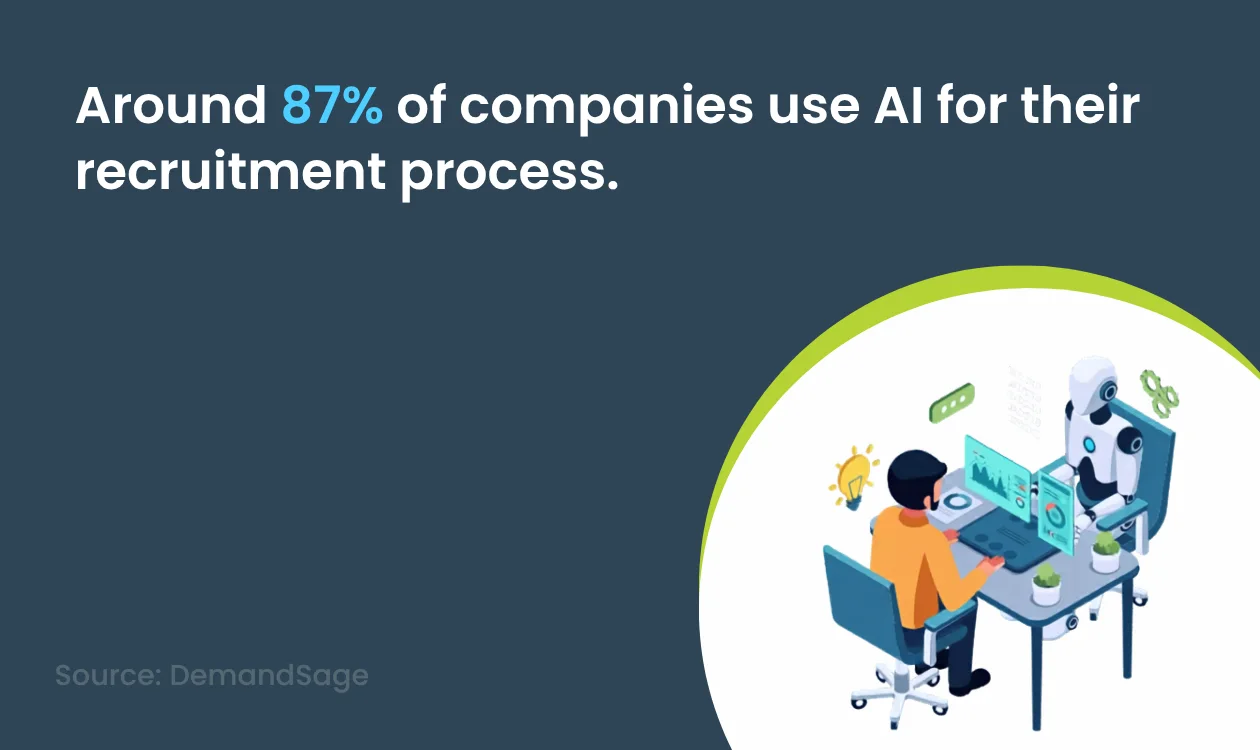
According to DemandSage, nearly 87% of companies now use AI in recruitment, making accountability a present-day challenge rather than a future concern.
Example: Screening Automation and Unintended Bias
A staffing firm used a resume parsing and ranking tool to prioritize candidates. The model favored candidates from certain universities and past roles. The recruiter accepted the shortlist without additional checks. A complaint from a candidate prompted an internal review. The firm discovered the model amplified historical hiring tendencies. This outcome shows that using AI in Recruitment does not remove a recruiter from the accountability loop. It requires them to ask different questions about model behavior and impact.
Recruiter Accountability in AI-Driven Recruitment: Core Principles
Accountability in AI-powered hiring rests on a few practical principles. Recruiters and HR teams should treat AI as a decision support system, not a substitute for human judgment. They should demand transparency, maintain audit logs, and measure impact. Below are five principles that guide accountable use of AI in Recruitment.
1. Treat AI as Assistive Technology
AI in Recruitment can speed repetitive tasks. But recruiters must validate recommendations and intervene when outputs contradict job criteria or company values. For example, when a matching engine recommends candidates, recruiters should cross-check with role-specific competencies before advancing applicants.
2. Require Explainability and Documentation
Vendors must provide explanations for model choices. Recruiters should document why they accepted or rejected AI suggestions. Maintain a simple justification log linked to the ATS record to show human oversight. This practice helps during internal audits and candidate inquiries.
3. Maintain Audit Trails and Version Control
Every AI model update or parameter change can affect outcomes. Keep a record of model versions, training data snapshots, and date-stamped configuration settings. When disputes occur, auditors can trace a decision back to the tool state at the time of hiring.
4. Monitor Performance and Fairness Metrics
Use quantitative KPIs to track tool behavior. Key metrics include selection rates by demographic group, interview-to-offer ratios, and false negative rates for high-potential candidates. Regular monitoring ensures AI in Recruitment supports equitable hiring rather than perpetuating past gaps.
5. Establish Clear Governance and Roles
Define who approves model deployment, who reviews adverse outcomes, and who communicates with candidates. Accountability improves when responsibilities are explicit. A governance committee can review vendor risk, compliance, and fairness reports on a scheduled basis.
How Recruiters Should Use AI in Recruitment: A Practical Accountability Playbook
Adopting AI in Recruitment requires process updates and new habits. Recruiting with AI is practical when teams update workflows to include validation steps and clear owners. The following playbook gives concrete steps recruiters and talent teams can implement the same day they turn on a new tool.
Step 1: Map the Workflow
Document every point the AI tool touches the hiring process. Does it source, screen, or schedule? Note handoffs and decision points. When you can visualize where AI influences outcomes, you can assign accountability at those checkpoints.
Step 2: Set Acceptance Criteria
Define when you will accept AI recommendations and when you will override them. For instance, accept automated shortlists only after passing a skills validation step or an interview calibration session with hiring managers.
Step 3: Log Decisions in the ATS
Use fields in your ATS to record the reason for moving a candidate forward or for rejecting a profile. Link to the AI output that prompted the action. This creates an auditable trail and clarifies the recruiter’s rationale when AI in Recruitment contributed to the choice.
Step 4: Run Continuous Fairness Checks
Schedule periodic checks that compare candidate outcomes across groups. If the AI tool introduces disparities, pause automated decisions and investigate whether training data or model features cause the issue.
Step 5: Train Recruiters and Hiring Managers
Provide short training sessions on how AI in Recruitment works in your environment, what its limitations are, and how to evaluate outputs. Training increases confidence and reduces blind reliance on automation.
AI Recruitment Accountability Matrix and ATS Logging Template
Every AI-assisted hiring decision should have a clear owner, a required human checkpoint, a documented record, and a defined escalation path. This prevents recruiters from treating AI outputs as final decisions and helps the organization explain how each hiring outcome was reached.
Accountability Matrix
Activity | Owner | Human checkpoint | Record | Escalation |
Approve an AI hiring tool | HR or talent leader | Legal, privacy, security, and procurement review | Risk assessment and approval | AI governance or senior leadership |
Configure screening criteria | Recruiter and hiring manager | Confirm criteria are job-related | Approved criteria and approvers | HR or legal |
Review AI recommendations | Recruiter | Validate output against candidate evidence | AI output, decision, and rationale | Hiring manager or system owner |
Monitor fairness | HR analytics | Review selection rates, impact ratios, and overrides | Fairness report and findings | Governance, legal, and vendor |
Handle complaints or incidents | HR or compliance | Conduct an independent human review | Complaint, investigation, and resolution | Legal or senior leadership |
The employer remains accountable for hiring outcomes, even when operational responsibilities are shared with recruiters, hiring managers, analytics teams, and technology vendors.
ATS Logging Template
For every decision materially influenced by AI, recruiters should record:
- Candidate and job requisition
- AI tool and model version
- AI score, ranking, or recommendation
- Human reviewer
- Final decision
- Job-related rationale
- Reason for accepting or overriding the AI output
- Supporting candidate evidence
- Fairness or accuracy concerns
- Escalation owner and resolution
- Decision date and timestamp
Avoid vague notes such as “AI rejected the candidate.” The record should explain the job-related evidence reviewed by the recruiter and how the final decision was made.
Escalation Path
Recruiters should escalate an AI output when it cannot be explained, conflicts with verified candidate evidence, repeatedly requires overrides, or produces potentially unfair outcomes. The affected decision should be paused where practical, the issue documented in the ATS, and the system owner notified. Serious or recurring concerns should be reviewed by HR governance, legal, compliance, analytics, and the vendor before the tool is returned to normal use.
Vendor Management and Legal Considerations: AI recruiter responsibility
Recruiters must work with legal and procurement to manage vendors that supply AI in Recruitment tools. Contracts should require transparency about data sources, testing for bias, and commitments to support audits. Service level agreements should include response times for issues that affect fairness or candidate experience.
Part of vendor oversight is confirming the vendor will support investigations and provide model documentation on request. Establish clear terms for data retention, model explainability, and remediation steps when issues arise. These clauses clarify AI recruiter responsibility and limit downstream legal exposure.
"If you cannot explain the model behavior, you cannot fully defend the hiring decision."
That quote reflects the practical reality recruiters face. Whether defending a placement to a hiring manager or responding to an outside complaint, documented human judgment matters.
Key Metrics to Measure Accountability in AI-Driven Recruitment
Measure the right things to prove your team uses AI responsibly. Track time-to-hire, quality-of-hire, and candidate satisfaction as usual. Add quality checks that reveal the AI contribution. Useful additional metrics include:
- Percentage of AI recommendations accepted versus overridden
- Disparate impact ratios across demographic groups
- Accuracy of role fit predictions compared to interview outcomes
- Number of escalation incidents tied to AI outputs
These KPIs help HR leaders quantify both gains and risks from AI in Recruitment.
Real-World Examples of AI in Recruitment and Accountability Risks
Industry reports show recruiters who pair AI with structured human review reduce screening time while maintaining hiring quality. For example, organizations that adopt AI-assisted screening often see faster sourcing and higher interview conversion rates. At the same time, independent audits reveal that models trained on historical hiring data can reproduce inequities if not corrected. This dual reality highlights why accountability processes matter as much as technology selection.
In practice, a mid-sized tech company implemented AI in Recruitment to shortlist candidates for software engineering roles. The recruiting team required a technical test before the interview phase. That extra gate helped the team verify algorithmic recommendations and avoided candidate exclusion based solely on career labels. The team tracked outcomes and adjusted the model features to prioritize demonstrated skills. Over time, this approach reduced bias and improved offer acceptance.
AI in Recruitment Checklist: Immediate Actions for Recruiters
- Ask vendors for explainability documentation and fairness reports.
- Build a simple ATS field to log why an AI suggestion was accepted.
- Run a one-time fairness audit on recent hires influenced by AI tools.
- Create a governance owner who signs off on model changes.
- Train hiring managers on interpreting AI outputs and on shared accountability.
Conclusion
AI in Recruitment delivers clear gains in speed and efficiency, but it also raises the bar for accountability. Recruiters can no longer rely on process alone. They must take ownership of outcomes influenced by algorithms and embrace new practices that prove decisions were fair and justifiable.
The organizations that succeed will not be those that adopt AI the fastest, but those that manage it responsibly through governance, transparency, and human oversight. In this shift, accountability becomes a defining capability, not just a compliance requirement. Teams that treat AI in Recruitment as a shared responsibility between vendors, recruiters, and hiring managers will build more defensible, fair, and effective hiring systems.
AI may change how hiring decisions are made, but responsibility for those decisions still rests with recruiters and HR leaders. Stay ahead of the curve and explore more HR insights on NextInHR to strengthen your AI hiring accountability and recruiter role in the AI era.