

 8 mins read
Human-Centric AI in HR is now a strategic priority for talent teams that need to scale without sacrificing empathy. Recruiters and HR leaders must adopt people-first AI that amplifies human judgment, protects human HR values, and preserves the human touch in HR while delivering measurable business results.
TL;DR
- Human-Centric AI in HR blends automation with empathy to improve hiring and employee experience.
- Design AI to augment human decisions not replace them, with explainability and oversight.
- Measure impact with clear metrics like time to hire, quality of hire, and candidate satisfaction.
- Mitigate bias by auditing data, using diverse training sets, and keeping humans in the loop.
- Practical steps include pilot programs, clear governance, and cross-functional ownership.
- Real examples show efficiency gains and improved candidate experience when human touch is preserved.
- Implement responsible AI policies and continuous monitoring to build trust and drive adoption.
Why Human-Centric AI in HR Matters
Recruiters and HR leaders face pressure to fill roles faster, reduce cost per hire, and deliver consistent candidate experiences. Human-Centric AI in HR can automate repetitive tasks, surface insights, and scale personalized communication while keeping people-first AI principles front and center. But when AI is used without human oversight it can create bias, erode trust, and damage employer brand. Human-Centric AI in HR focuses on three priorities: fairness, transparency, and collaboration between humans and machines. When done right, AI becomes a force multiplier for recruiting teams and a better experience for candidates and employees.
AI Adoption in HR Is Accelerating
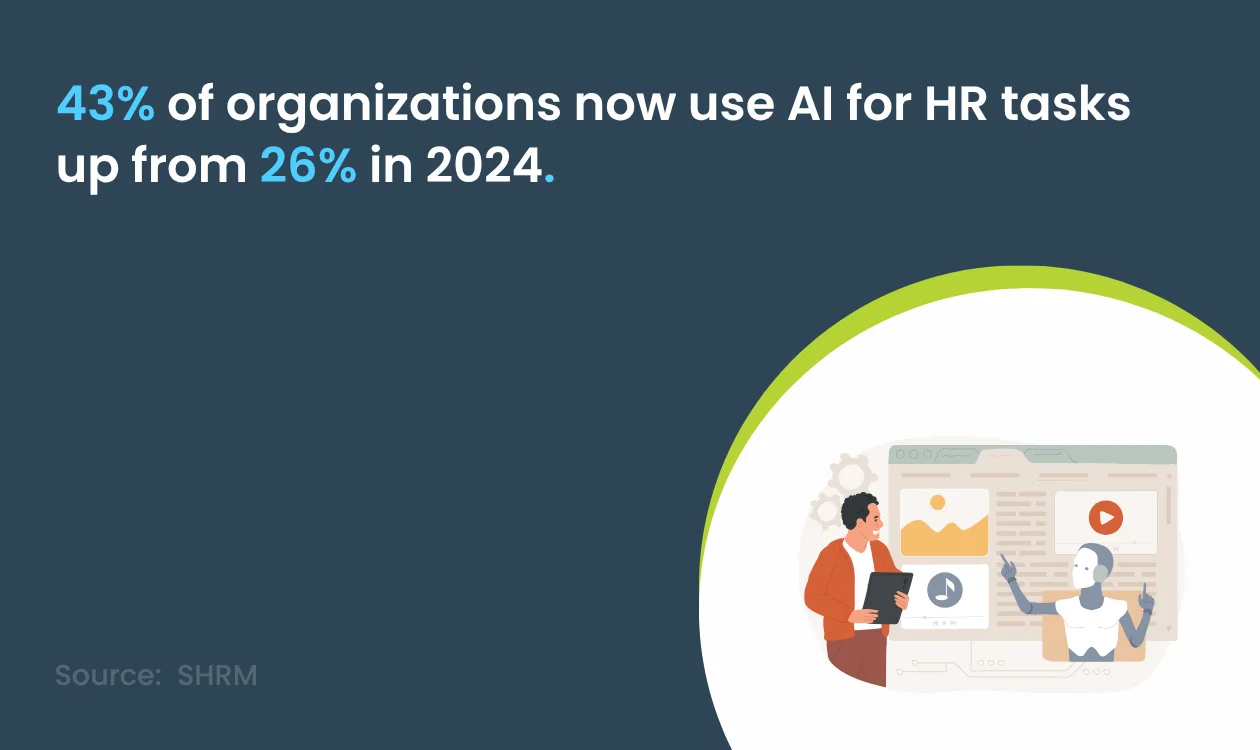
AI adoption in HR is accelerating. SHRM’s 2025 Talent Trends research found that 43% of organizations now use AI for HR tasks, up from 26% in 2024. This growth makes Human-Centric AI in HR more important because organizations need clear governance, recruiter oversight, bias mitigation, and candidate experience safeguards as AI moves from experimentation into everyday HR workflows.
Key Principles of Human-Centric AI in HR
Adopt a clear set of principles before rolling out tools. These include:
- Augmentation over automation: Use AI to free time for relationship-building and strategic tasks so recruiters spend more time on high value work.
- Explainability: Ensure decisions suggested by AI are understandable and auditable, enabling recruiters to communicate rationale to candidates.
- Fairness: Proactively identify and reduce bias in data and models through audits and diverse training sets.
- Privacy: Protect candidate and employee data with strict controls and consent, and clearly document data use policies.
- Accountability: Assign clear ownership for outcomes and remediation so humans remain responsible for final decisions.
Real Examples and Insights
Several organizations show how human-centric approaches work in practice. A multinational company used AI to screen resumes and reduce time to shortlist, but kept recruiters involved in final selection to avoid false positives. A staffing agency integrated conversational AI to handle routine candidate questions and scheduled interviews, while human recruiters handled salary discussions and final negotiations. These cases highlight a consistent pattern: automation improves efficiency, but the human touch preserves quality and candidate sentiment. Recent industry research indicates many HR teams are expanding AI use while emphasizing governance and transparency.
"We saw a forty percent reduction in scheduling time, but our candidate Net Promoter Score improved only after adding human follow up. Automation started the process and humans finished the relationship."
Practical Roadmap to Implement Human-Centric AI in HR
Follow a staged approach to reduce risk and ensure adoption.
- Assess needs. Map current workflows and identify pain points where AI adds value without replacing human judgment.
- Pilot small. Start with narrow use cases like interview scheduling, resume parsing, or candidate screening with human review.
- Define guardrails. Create policies on explainability, acceptable error rates, and privacy requirements that reflect your organizational values.
- Measure outcomes. Track key metrics such as time to hire, retention, diversity metrics, and candidate satisfaction.
- Scale responsibly. Expand use cases after audits and adjustments, keeping stakeholders involved and continuing human oversight.
Bias and Fairness: How to Mitigate Harm
Bias often creeps in through training data, proxy variables, or model design. A human-centric program uses multiple tactics to reduce bias. Practical steps include:
- Audit data. Examine historical hiring data for skewed patterns and correct imbalances before training models.
- Use diverse teams. Involve stakeholders from recruiting, legal, and diversity teams to test models and decisions.
- Limit sensitive inputs. Avoid using explicit or proxy attributes that correlate with protected classes unless strictly necessary and mitigated.
- Run counterfactual tests. Evaluate whether model outputs change when non-job-related attributes vary.
Explainability and Human Oversight
People trust AI when they understand its reasoning. Implement tools that provide clear, human readable explanations of model outputs. For example, show which skills or experiences the model weighed most heavily when ranking candidates. Maintain a human review step for all critical decisions such as final offers, role fit assessments, and performance rating changes. This preserves a check and balance and helps detect model drift early. Training recruiters to interpret these explanations supports a people-first AI culture and reinforces human HR values.
Governance and Policy
Set a governance framework with roles and responsibilities. Common elements include an AI steering committee, documented policies for data use, and a review cadence for models in production. Require vendor assessments when using third party AI in HR. Demand transparency reports, data lineage, and the ability to audit model decisions. These controls protect your company and build confidence among recruiters and candidates. Responsible AI HR is a continuous program that needs executive support and cross-functional ownership.
Integrating Human-Centric AI in Day-to-Day HR Workflows
When integrating tools into applicant tracking systems and HR suites, think about the recruiter experience. Human-Centric AI in HR should reduce busy work and surface high-quality candidates. Example workflow enhancements include:
- Smart sourcing that provides ranked candidate lists with rationale
- AI-assisted interview guides that tailor questions to candidate backgrounds
- Automated candidate messaging with easy handoff to human recruiters
- Real-time alerts when a diversity metric or fairness threshold is triggered
Measuring Success
Define a balanced scorecard to evaluate impact. Typical measures are time to fill, cost per hire, candidate Net Promoter Score, interviewer satisfaction, and quality of hire. Also monitor fairness metrics such as selection rates across groups. Combine quantitative data with qualitative feedback from recruiters and candidates. Set up model monitoring for drift and retraining cadence, and tie measurement to business outcomes so teams buy into people-first AI goals.
Talent Experience: Keep the human touch in HR
Automation should enhance, not replace, human interactions. Use AI to personalize communications while preserving opportunities for real conversations. For instance, an AI can summarize a candidate profile before an interview so the recruiter can ask focused, relevant questions. That preparation leads to richer conversations and a better candidate experience. Empathetic HR technology should make every touchpoint feel intentional and human, reinforcing human HR values even as volume scales.
Case Study: Scaling with Care
A mid size staffing firm implemented AI to screen initial applications and automate interview scheduling. They required human review for any candidate ranked in the top twenty percent. The result was faster throughput and improved placement accuracy. Recruiters reported less administrative burden and more time for coaching candidates. Candidate feedback improved once humans rejoined final decision stages. This example demonstrates how human-centric rules and thresholds can balance speed and quality and shows AI vs human HR as a partnership that plays to each side's strengths.
Technology Stack Considerations
Choose tools that support human-centric principles. Look for platforms with built in explainability, audit logs, configurable pipelines, and integration with ATS systems. Consider vendors that provide transparent model documentation and compliance support. Prioritize modular solutions that let you replace or update models as needed. Emphasize tools that enable recruiters to override suggestions easily and provide feedback that feeds model improvement.
Building Skills and Change Management
Successful adoption depends on people. Train recruiters to interpret AI outputs, challenge model suggestions, and provide feedback into model improvement. Communicate changes clearly to teams and candidates. Share success metrics and early wins to build trust. Encourage a culture where AI is seen as a collaborator, not a judge. Change management that centers on empathy and transparency encourages adoption of people-first AI and responsible AI HR practices.
Common Pitfalls and How to Avoid Them
Avoid these common mistakes when applying Human-Centric AI in HR.
- No governance. Lack of policies leads to inconsistent outcomes and liability exposure.
- Blind trust in models. Treat model outputs as recommendations, not final decisions.
- Ignoring candidate experience. Over automation can feel impersonal and harm brand.
- Poor data hygiene. Garbage in leads to biased or inaccurate outputs.
Future Outlook
AI will continue to expand in HR, powering better matchmaking, predictive retention insights, and more personalized employee development. The organizations that succeed will be those that design systems around people, with clear guardrails and ongoing oversight. Human-Centric AI in HR is not a one time project. It is a continuous practice of measurement, adjustment, and collaboration between technology and human expertise. The next wave of empathetic HR technology will prioritize trust, explainability, and measurable fairness.
Conclusion
Human-Centric AI in HR is about striking the right balance between automation and human empathy. By following clear principles, setting governance, and measuring outcomes, recruiters and HR leaders can unlock productivity while preserving fairness and trust. Start small, measure impact, and scale thoughtfully. When AI amplifies human strengths and humans remain accountable, the result is a more efficient, fair, and human hiring experience. Stay ahead of the curve - explore more HR insights on NextInHR.