

 10 mins read
Understanding pre-screening vs resume screening is critical for recruiting teams that want faster time to hire and better quality of hire. This article clarifies what each step must accomplish, where they sit in the funnel, and how to design an HR screening process that uses resume review vs pre-screen as complementary activities.
TL;DR
- Pre-screening vs resume screening serve different goals and require different tools.
- Resume screening focuses on credentials and keywords; pre-screening assesses fit, availability, and soft skills.
- Relying only on resumes increases time to hire and risk of bad fits; structured pre-screens reduce that risk.
- Use ATS plus phone or video pre-screens and automated assessments for efficiency and fairness.
- Combine human judgment, structured questions, and AI to improve quality of hire and candidate experience.
- Track metrics like time to hire, interview-to-offer ratio, and quality of hire to optimize workflows.
- Clear documentation and compliance processes keep pre-screens consistent and fair.
Why the Distinction Matters
The phrase pre-screening vs resume screening points to two different checkpoints in the recruiting funnel. Resume screening is largely document driven. Recruiters or an ATS scan resumes for skills, titles, locations, and keywords. Pre-screening goes beyond documents. It confirms availability, salary expectations, culture fit, and basic capability with targeted questions or short assessments. Treating these activities as the same wastes time and reduces hiring quality.
In practice, resume review vs pre-screen often collapses when teams lack clear process ownership. That blur increases interview no-shows, interview-to-offer waste, and poor candidate experience. Clarifying the HR screening process prevents these inefficiencies and protects hiring manager time.
Quick Stat to Set Context
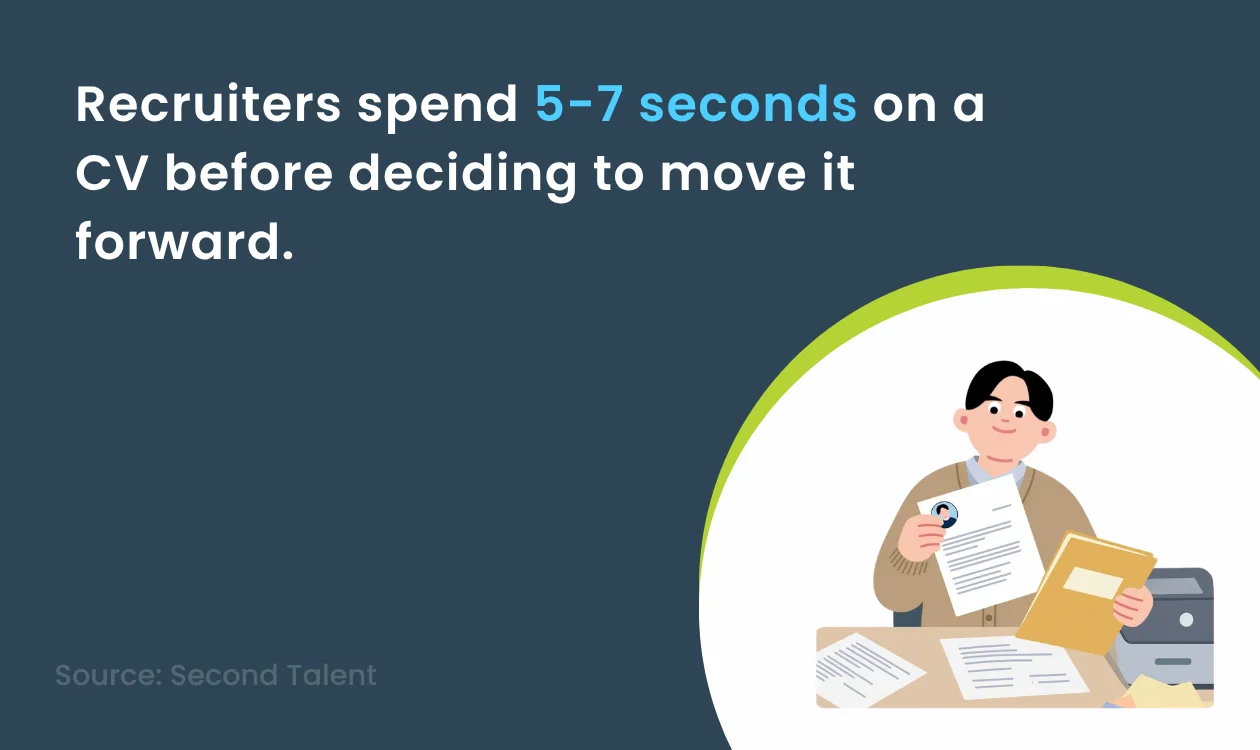
According to Second Talent’s Hiring Trends report, recruiters typically spend just 5–7 seconds reviewing a resume during the initial screening pass before deciding whether to move a candidate forward.
This reinforces a critical point: resume screening is designed for speed and qualification checks, not for evaluating communication ability, motivation, or long-term fit. That deeper evaluation happens during structured pre-screening.
Resume Screening vs Pre-Screening at a Glance
Resume screening evaluates the information provided in a candidate’s application, while pre-screening verifies key details before the candidate advances to a full interview.
Factor | Resume screening | Pre-screening |
Purpose | Check qualifications, skills, and experience. | Confirm availability, expectations, interest, and basic suitability. |
Timing | After the application is submitted. | After resume review and before a full interview. |
Methods | ATS filters, keyword matching, and manual review. | Phone screens, questionnaires, video calls, or brief assessments. |
Result | A shortlist of potentially qualified applicants. | Candidates who are ready to move to the interview stage. |
In simple terms, resume screening asks, “Does the candidate meet the basic requirements?” Pre-screening asks, “Should the candidate move forward to a full interview?”
Key Differences Between Pre-Screening vs Resume Screening
- Purpose and Decision Impact: Resume screening validates qualifications. Pre-screening verifies fit and readiness.
- Timing in the Recruitment Funnel: Resume screening is first pass. Pre-screening sits after the first pass to reduce false positives.
- Data source: Resume screening uses the resume and LinkedIn. Pre-screening uses short interviews, assessments, and questionnaires.
- Tools: ATS and parsing for resume screening. Phone, video, automated assessments, and chatbots for pre-screening.
- Outcomes for Hiring Teams: Resume screening creates a shortlist. Pre-screening creates an interview roster of candidates who are realistically available and aligned with the role.
Example: How a fast-growing staffing firm separates the two
Consider a staffing agency filling 50 technical roles a month. They use their ATS to parse resumes and tag relevant skills. That produces a pool of 500 candidates. Without pre-screens recruiters would waste time scheduling interviews with many who are not truly available or whose salary expectations do not match. By inserting a 7-minute phone pre-screen with three structured questions they cut the interview workload by 40 percent and improved the hire-to-interview ratio by 25 percent.
When Resume Screening Is Enough
There are cases where resume screening can be sufficient. For high-volume, low-skilled roles with clear, objective requirements a resume or application filter may be enough to create a shortlist. However, even in volume hiring adding a brief pre-screen that confirms availability and transportation can reduce no-shows and improve retention.
For example, retail, events, or entry-level roles often rely on resume parsing and application questions only. Still, adding a one-question confirmation about availability or shift preferences reduces early drop-off and saves scheduling time for recruiters.
When Pre-Screening Is Essential: pre-screening definition
For skilled roles, leadership hires, and positions requiring specific soft skills or clearances, pre-screening is essential. A resume cannot reliably demonstrate communication skills, salary transparency, or cultural fit. Pre-screening closes that gap early.
For clarity, a simple pre-screening definition is: a brief, structured interaction that verifies logistics, core competencies, and cultural signals before a full interview. Candidate pre-screening can be synchronous by phone or video, or asynchronous via recorded answers or online assessment software.
How to Design a Structured Pre-Screening Process
A good pre-screen is short, consistent, and measurable. Use three components:
- Structured questions that are scored the same way for every candidate.
- One or two brief assessments or work samples when relevant.
- Documentation in your ATS so any recruiter can pick up the candidate file with the same context.
Suggested Pre-Screen Questions
Ask targeted questions that relate to the role and logistics. Examples include:
- Are you authorized to work in this country?
- What is your target compensation range?
- When can you start?
- Describe a recent project that demonstrates the core skill for this role.
Structured pre-screens reduce bias and offer a repeatable view of candidate readiness that a resume alone cannot provide.
Technology’s Role in Pre-Screening vs Resume Screening
Modern hiring stacks pair an ATS for resume screening with automation tools for pre-screens. For example, an ATS can parse resumes, tag candidates, and auto-route those who match basic requirements into a pre-screen workflow. Recruiters can also use a pre-employment skills assessment platform like TestTrick to evaluate candidates through role-specific tests, coding challenges, psychometric assessments, and one-way video interviews before moving them to live interviews. Chatbot pre-screens or automated video assessments can collect answers asynchronously. AI can help surface discrepancies between a resume and responses, but human review remains critical for context and judgment.
At the resume-screening stage, Jarvi can help recruiters move beyond basic keyword filters by evaluating CVs against actual job requirements, ranking applicants by fit, and explaining where each candidate matches or falls short. This gives recruiting teams a stronger shortlist before structured pre-screening begins, while keeping the final decision with the recruiter.
When you define the difference between resume screening vs interview or resume screening vs pre-screen you can apply the right automation at each stage. Use parsing and semantic search to narrow volume. Use automated assessments and short video responses to flag candidate pre-screening issues before live interviews.
AI and Bias Considerations
AI can speed screening but it can also perpetuate bias if models are trained on historical hiring data. When implementing automated resume ranking or interview scoring make sure you monitor fairness metrics, audit decision patterns, and allow for manual overrides. The best practice is to use AI as an assistant not an arbiter.
Operationally, build guardrails in the HR screening process. Track parity across demographic groups for pass rates at both resume and pre-screen stages. Keep clear logging for auditability and implement human review thresholds when automated scores cross critical decision points.
Metrics That Prove the Difference
Measuring the impact of separating pre-screening vs resume screening helps justify process changes. Track these KPIs:
- Time to hire
- Interview-to-offer ratio
- Offer acceptance rate
- First-year turnover
- Candidate satisfaction scores
Teams that add structured pre-screens typically lower interview-to-offer ratios and reduce time spent per hire. One staffing survey found structured pre-screens cut early-stage interview time by roughly 30 percent while increasing the quality of candidates moving forward. Use these metrics to show ROI for candidate pre-screening and to iterate on your screening techniques.
Practical Workflow Example
Here is a practical flow to illustrate pre-screening vs resume screening in a modern hiring process:
- Resume screening: ATS parses applications and tags candidates who meet base requirements.
- Auto-qualification: The ATS auto-sends a short pre-screen questionnaire or schedules a 7-minute phone screen for auto-tagged candidates.
- Pre-screen: Recruiter or automated tool confirms logistics, salary range, and asks one role-specific question or sends a short assessment.
- Interview scheduling: Only candidates who pass the pre-screen are scheduled for full interviews with hiring managers.
- Tracking: All notes and scores are stored in the ATS and reported in hiring dashboards.
Common Mistakes to Avoid
Many teams conflate the two steps and make avoidable mistakes. Here is how to avoid common pitfalls.
- Relying only on keywords: Improve resume screening with semantic search and human review to reduce false positives.
- Unstructured pre-screens: Use scoring rubrics to keep pre-screens consistent and fair.
- Too many touchpoints: Keep the pre-screen short to avoid losing candidates early in the funnel.
- Poor data hygiene: Ensure pre-screen results are captured in the ATS for future reference and compliance.
Example of a failed approach
A mid-size company used only an ATS keyword filter to shortlist candidates. Interviewers arrived to find many candidates lacked basic availability or had wildly different salary expectations. The company lost time and hires. After adding a brief pre-screen that confirmed key logistics and expectations they improved conversion and candidate experience.
Legal and Compliance Considerations
Pre-screening introduces more live interaction with candidates which can raise compliance questions. Keep pre-screen scripts standardized and avoid asking protected class questions. Document consent for recorded video or assessments and store data according to privacy laws. Coordinate with your legal and compliance teams when you add new pre-screen tools or AI-assisted screening.
Also define retention windows for pre-screen recordings and assessment results in your ATS. That discipline helps with audits and supports transparent candidate communications about data use in the HR screening process.
How to Structure Resume Screening vs Pre-Screening in Your Hiring Process
Below is an outline you can adapt as a policy to clarify roles and process:
- Step 1: Resume screening in ATS with mandatory minimums defined.
- Step 2: Auto-invite to 7-minute pre-screen for candidates who pass Step 1.
- Step 3: Recruiter scores pre-screen and flags candidates for interviews.
- Step 4: Hiring manager interviews only those who pass pre-screen.
- Step 5: All outcomes captured in ATS and reviewed monthly for quality and fairness.
Make sure to document the resume review vs pre-screen decision criteria in one shared playbook. That playbook becomes the single source of truth for recruiters, hiring managers, and compliance partners.
Conclusion
Understanding pre-screening vs resume screening is not academic. It is tactical. Resume screening filters for credentials and keywords. Pre-screening verifies readiness, fit, and logistics. Teams that separate the two and apply the right tools cut wasted time, reduce early-stage attrition, and improve quality of hire. Use your ATS to do the heavy lifting on resumes, then use structured pre-screens to confirm the human aspects a resume cannot reveal. Track key metrics and iterate. That approach delivers faster, fairer hiring outcomes and better candidate experience. Stay ahead of the curve - explore more HR insights on NextInHR.