

 10 mins read
An employee relations manager is an HR professional responsible for handling workplace investigations, resolving employee conflicts, coaching managers, interpreting workplace policies, and supporting fair and legally compliant employment practices. They work with employees, HR teams, legal advisers, and business leaders to improve workplace relationships, reduce organizational risk, and strengthen employee engagement. Employees perform best when they feel heard, respected, and treated fairly. This is where an employee relations manager plays a critical role. From resolving workplace conflicts to ensuring policy compliance and improving engagement, an employee relations manager helps organizations build healthier and more productive work environments while partnering with HR, legal, and people analytics to reduce risk.
TL;DR
- An employee relations manager mediates conflict, enforces policy, and boosts engagement.
- Core skills: communication, investigation, labor law knowledge, and data literacy.
- Daily work blends case management, training, policy design, and leadership advising.
- Use HRIS, case tracking, ATS integrations, and AI for sentiment and automation.
- Measure success with engagement, resolution time, recidivism, and compliance metrics.
- Hire for behavioral fit, technical skill, and strategic influence; use structured interviews.
Why this role matters
Employee engagement and retention should be measured together. Gallup’s workplace research identifies turnover as one of the business outcomes associated with employee engagement, although organizations should avoid claiming that every employee relations intervention directly prevents an employee from leaving.
When workplace issues escalate, the employee relations manager acts as a skilled neutral, helping to resolve disputes, protect legal compliance, and improve employee engagement. A strong employee relations manager reduces turnover, lowers litigation risk, and supports leaders in applying consistent, fair practices.
Real context and a quick stat
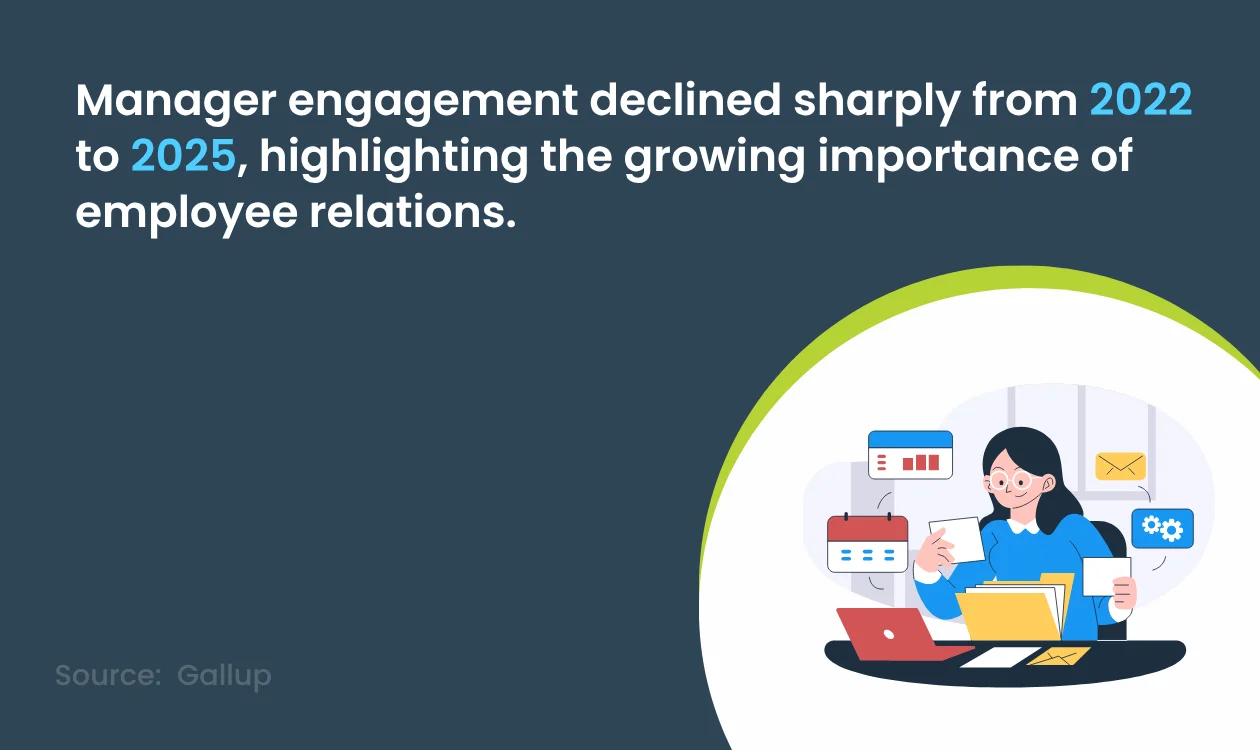
Gallup research shows that manager engagement declined noticeably between 2022 and 2025, reinforcing the importance of employee relations managers in supporting leaders, improving workplace communication, and maintaining employee engagement.
What Does an Employee Relations Manager Do? (employee relations job description)
The primary responsibility of the employee relations manager is to maintain healthy workplace relationships and enforce fair policies. That includes investigating complaints, coaching managers, creating or revising policies, and advising on disciplinary actions. This employee relations job description often also lists cross functional collaboration and data-driven decision making as core expectations.
Sample Employee Relations Manager Job Description
An employee relations manager handles workplace complaints, conducts fair investigations, resolves conflicts and advises managers on conduct, performance and policy matters.
Key responsibilities :
- Investigate employee complaints and document findings
- Support dispute mediation and conflict resolution
- Coach managers on performance and conduct issues
- Interpret workplace policies and employment requirements
- Track case trends, KPIs and confidential records
- Collaborate with HR, legal and leadership teams
Candidates should have relevant HR or employee relations experience, strong investigation skills, employment-law knowledge, sound judgement and the ability to manage sensitive cases confidentially.
Example scenario
Imagine a high performer raises concerns about a manager's biased assignments. The employee relations manager interviews witnesses, reviews documentation through the HRIS, and recommends a corrective action plan that includes manager coaching and a follow-up audit. The outcome both addresses the complaint and prevents recurrence.
Essential Skills Every Employee Relations Manager Needs
Successful employee relations managers combine soft skills with technical HR knowledge. Recruiters should prioritize demonstrated experience in conflict resolution and investigations, plus comfort with HR systems and data. For ER specialist HR hires, look for documented case outcomes and references that speak to neutrality and influence.
Qualifications and Experience Requirements
Employee relations managers typically have a bachelor’s degree in human resources, employment relations, business administration, organisational psychology, law or a related field. Employers may also consider candidates with equivalent practical HR experience.
Manager-level positions commonly require around five years of progressive experience in human resources or employee relations. Candidates should have direct experience handling workplace complaints, conducting interviews, reviewing evidence, documenting findings and recommending fair corrective actions.
Strong knowledge of applicable employment laws, workplace policies, disciplinary procedures, discrimination and harassment requirements, confidentiality and employee data protection is also important. Because employment requirements vary by location, employee relations managers must understand the laws and regulations that apply to their organisation’s workforce.
Professional HR qualifications can strengthen a candidate’s profile but should be treated as preferred rather than mandatory unless they are essential to the role.
Essential soft skills
- Advanced communication: Clear, neutral written and verbal communication is essential.
- Emotional intelligence: Reading situations and responding calmly while maintaining objectivity.
- Influence and coaching: Guiding leaders to better behavior without formal authority.
- Critical thinking: Assessing facts quickly and making balanced recommendations.
Technical and legal know-how
- Employment law fundamentals: Understanding discrimination, wage and hour, and leave laws relevant to your jurisdiction.
- Investigation methodology: Documentation standards and evidence handling.
- HR systems proficiency: HRIS, case management, and ATS integrations for hiring-related disputes.
- Analytics: Using engagement and attrition data to target interventions.
A Day in the Life of an Employee Relations Manager
A typical day for an employee relations manager mixes case work, coaching, policy review, and data analysis. Efficiency often depends on the right tools and clear triage rules to keep high-risk issues prioritized.
Common daily activities
- Respond to new complaints and prioritize based on severity.
- Conduct interviews and collect evidence for investigations.
- Coach managers on performance documentation and corrective plans.
- Update policy documents and craft communications for leaders and staff.
- Review dashboards for trends in grievances and engagement.
How HR Technology Supports Employee Relations
HR case-management technology can centralize case histories, evidence, investigation records and access permissions. Reporting tools can also help employee relations teams monitor resolution times and identify recurring issues. Because these systems contain sensitive employee information, organizations should use role-based access, appropriate data-protection controls and meaningful human oversight when applying analytics or AI.
Modern HR teams use a combination of systems to streamline employee relations work. A case management tool built into your HRIS centralizes records and ensures auditability. Integrations with an ATS help when issues are tied to hiring or selection processes. AI tools can help surface sentiment trends in pulse surveys or flag high-risk patterns from employee feedback.
For an HR conflict resolution role, automation can handle intake and initial triage while preserving escalation rules for investigators. ER specialist HR professionals should champion secure access controls and retention rules so sensitive data stays protected.
Pro tip: Use secure case tracking where investigators can log interviews, evidence, and resolutions to maintain compliance and reduce risk.
Essential Tools Used by Employee Relations Managers
- HRIS for personnel records and case logging
- Case management system with role-based access
- Survey and sentiment analysis tools powered by AI
- Learning platforms for manager and employee training
Best Practices for Employee Relations Investigations
Investigations are a core deliverable for the employee relations manager. Follow a repeatable process to protect confidentiality and ensure defensible outcomes.
How to Conduct Fair Workplace Investigations
Fair workplace investigations should be prompt, thorough and impartial. Employers should protect confidentiality as far as reasonably possible, document the process and prevent retaliation against employees who report concerns or participate in an investigation. Investigation procedures must also follow the employment laws and workplace requirements of the relevant jurisdiction.
- Intake and triage: Classify the severity and determine immediate safety needs.
- Plan the investigation: Identify witnesses, documents, and key questions.
- Conduct interviews: Use neutral language and document answers verbatim when possible.
- Analyze evidence: Compare statements against records and policies.
- Decide and document: Record findings, rationale, and recommended actions with timelines.
- Follow-up: Monitor implementation and measure for recurrence.
Employee Investigation Documentation Tips
- Keep notes concise, factual, and dated.
- Limit access to sensitive files and maintain a secure audit trail.
- Avoid conclusions in interview notes; present facts and let analysis section draw conclusions.
KPIs and Metrics for Employee Relations Managers
Employee relations managers must show impact through measurable outcomes. Tracking the right metrics helps prioritize work and demonstrate ROI. Combine qualitative feedback with quantitative indicators to tell the full story.
Key Metrics to Track
- Employee engagement scores and trends from surveys
- Case volume and average resolution time
- Repeat complaint rate or recidivism
- Manager compliance with documentation and coaching requirements
- Legal incidents and cost avoided through early intervention
Use dashboards in your HRIS to pair these metrics with attrition data and performance trends. That combination reveals whether relations efforts translate into retention and productivity gains.
How to Hire the Right Employee Relations Manager
When recruiting an employee relations manager, focus on evidence of fair-minded decision making, experience handling complex investigations, and ability to advise leaders. Cultural fit and influence matter as much as technical skill. Use structured assessments that reflect the real work of the role.
Interview Questions and Assessment Tips
Behavioral Interviews | Ask for specific examples of past investigations and outcomes. |
Role Plays | Simulate a mediation or difficult coaching conversation to observe skills in real time. |
Case Review | Give candidates a redacted investigation and ask for key steps and decisions. |
Reference Checks | Verify handling of sensitive matters and stakeholder feedback. |
Employee Relations Manager Onboarding and Training
New hires ramp faster when they shadow ongoing investigations and receive training on your HRIS and case tools. Ongoing learning in labor law and investigation techniques is essential. Pairing with legal and compliance teams improves decision quality.
How Employee Relations Managers Collaborate Across Departments
Collaboration is core to the role. Employee relations managers work closely with Talent Acquisition, Legal, Learning and Development, and Operations to address root causes and support systemic change.
Cross-Functional Collaboration Examples
- With Talent Acquisition: Analyze hiring feedback to prevent mismatch and bias.
- With Legal: Escalate cases requiring legal review and align on disclosure policies.
- With L&D: Build manager training programs to reduce performance conflicts.
- With People Analytics: Use data to identify hotspots and deploy targeted interventions.
Common Employee Relations Challenges and Solutions
Employee relations work can be emotionally heavy and politically sensitive. Here are typical challenges and practical solutions.
Challenge: Perceived Bias
Solution: Use transparent processes, documented steps, and neutral investigators to build trust.
Challenge: Manager Resistance
Solution: Frame interventions as risk mitigation and performance enablement. Provide data showing benefits and offer coaching rather than punishment first when appropriate.
Challenge: High Case Volume
Solution: Prioritize cases by risk and impact, automate intake with forms, and use triage rules in your case system.
Employee Relations Manager Salary and Career Path
Employee relations manager salaries vary by location, experience, industry, company size and the complexity of workplace investigations or compliance responsibilities.
Average Salary by Geography
Country | Approximate annual salary |
United States | $93,400 |
United Kingdom | £45,500 |
India | ₹8 lakh |
These figures are market estimates and may vary by employer, city and experience level. Review salary data regularly and link each figure to its original source.
Career Progression
Employee relations professionals may progress from ER specialist or HR generalist roles into positions such as senior employee relations manager, head of employee relations, HR business partner or HR director.
Skills that support promotion include workplace investigations, dispute mediation, manager coaching, employment-law knowledge, people analytics and HR technology experience.
Skills that Accelerate Promotion
- Data-driven decision making and storytelling with people metrics
- Strategic program design to reduce systemic issues
- Cross-functional influence and leadership coaching experience
Conclusion
As workplaces become more employee-centric, the role of the employee relations manager is becoming increasingly strategic. Organizations that invest in strong employee relations practices are better positioned to improve retention, strengthen culture, reduce legal risk, and build long-term workforce stability. Stay ahead of the curve and explore more HR insights on NextInHR to sharpen your employee relations manager strategy and hiring approach.