

 8 mins read
Workplace culture initiatives that drive hiring, retention, and performance are practical and measurable. This guide strips away the flashy perks and reveals the specific, repeatable actions HR and recruiting teams can take to improve outcomes quickly.
HR teams invest heavily in workplace culture initiatives, yet engagement scores and retention often barely move. The problem isn’t effort, it’s focus. Too many programs look good on paper but fail to change how work actually happens.
This guide breaks down which workplace culture initiatives truly drive retention and performance, and which are just noise.
TL;DR
- Focus on targeted, measurable workplace culture initiatives that link to retention and performance.
- Prioritize small pilots and data before scaling to avoid spending on noise.
- Use ATS, HR tech, and people analytics to track outcomes not activity.
- Real examples show values in action beat slogans every time.
- Invest in manager capability and onboarding for outsized impact.
- Cut programs that lack clear owners, metrics, or adoption within 90 days.
- Create a repeatable cycle of assess, design, pilot, scale, and measure.
Why workplace culture initiatives matter to recruiters and HR
Strong workplace culture initiatives influence attraction, retention, and productivity. Candidates and employees evaluate culture as a core signal when deciding where to work. According to Glassdoor, a large share of job seekers rate company culture highly when applying. For staffing firms and talent acquisition teams, culture is part of the employer value proposition. When culture is aligned to business outcomes, recruiting costs fall and time to fill improves.
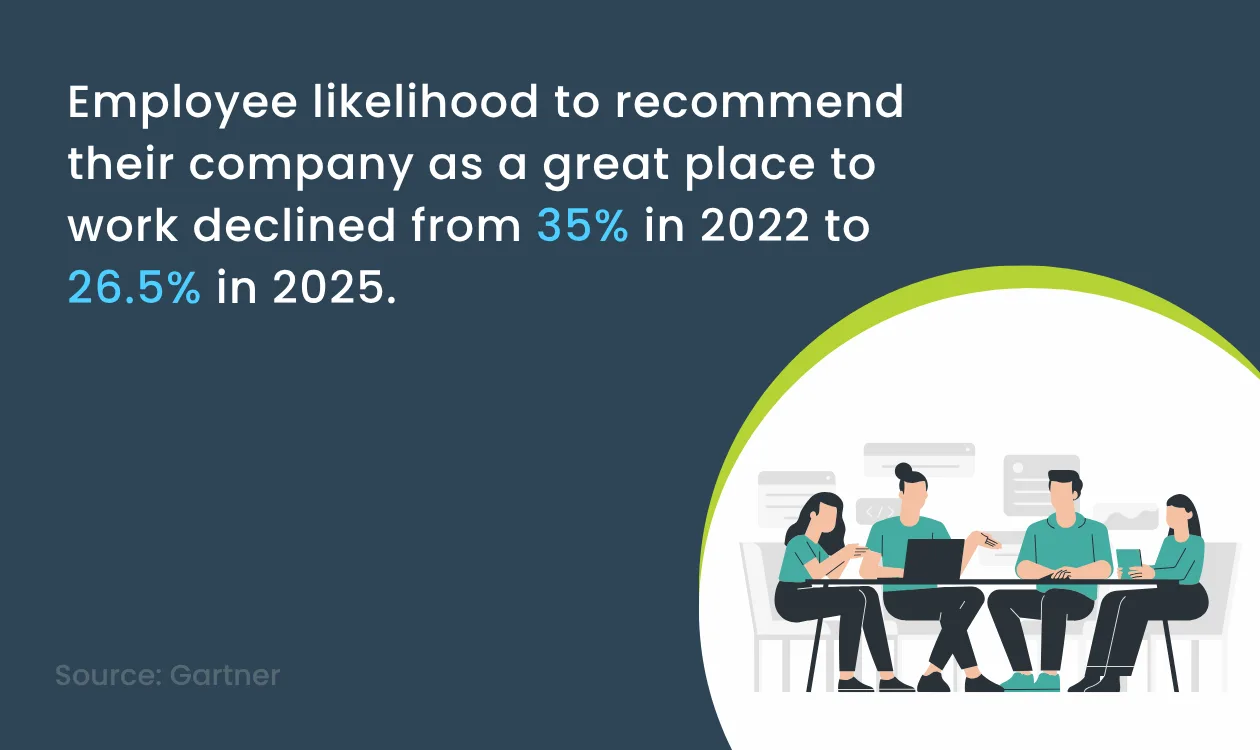
Strong culture directly affects retention and recruiting, but not all initiatives deliver results. Gartner’s 2025 research shows that the share of employees who would recommend their company as a great place to work dropped from 35% in 2022 to 26.5% in 2025, emphasizing that many programs fail to shift employee perceptions.
What workplace culture initiatives actually work: Principles and examples
Effective workplace culture initiatives share common characteristics. They are measurable, owned, aligned to business goals, and repeatable. Below are high-impact categories and real examples you can adapt. These examples show what builds workplace culture in practical terms.
1. Manager enablement and training
Why it works: Managers are the daily experience for most employees. Equip them with skills and simple tools and you improve engagement fast. A small investment in manager coaching often outperforms one-off perks. When workplace culture initiatives prioritize manager capability, teams see clear changes in day-to-day behavior.
Example: A mid-size software firm implemented a manager training sprint focused on one-on-one coaching and feedback. Within six months voluntary turnover in coached teams dropped by a clear margin and engagement scores rose. The program was short, tracked, and tied to manager performance goals.
2. Onboarding that scales the culture promise
Why it works: First impressions matter. Onboarding is a repeatable moment to demonstrate culture, norms, and expectations. Make it practical and measurable.
Example: A staffing company built a two-week onboarding path integrated with their ATS so new hires completed role-specific checklists and culture modules. The process cut time-to-productivity and raised satisfaction survey scores for new hires. This is a strong example of an effective culture initiative that ties onboarding to measurable outcomes.
3. Clear values translated into behaviors
Why it works: Values on posters are noise unless they translate to observable behaviors. Define specific actions that show the value in practice and reward them.
Example: A retail brand translated the value "customer focus" into three observable behaviors and included them in performance reviews. Recognition was tied to these behaviors. Over time customer satisfaction and repeat hiring from internal referrals improved.
4. Measurement-first pilots
Why it works: Pilots reduce risk. Define a hypothesis, a metric, and a test period. This approach separates signal from noise quickly.
Example: An enterprise HR team piloted a flexible work schedule in two business units with explicit productivity metrics. The pilot kept measurable KPIs and scaled only after demonstrating neutral or positive results on output and engagement.
What is noise: company culture programs that often fail
Not all initiatives deserve the label culture. Some are activity heavy but impact light. Here are common traps for HR teams working on culture building HR and employee culture strategy.
1. Perks without purpose
Free snacks and flashy events can be nice. But they are insufficient substitutes for meaningful policies and manager behavior. Perks fail when not tied to real needs or when they mask bigger issues such as workload or leadership gaps.
2. One-off swag and slogans
Branded gifts and slogans create momentary positivity. They do not drive retention or performance. If a campaign cannot point to a clear behavioral target or metric, treat it as noise.
3. Too many conflicting programs
Multiple simultaneous initiatives with no owner confuse employees. If programs compete for attention, none will achieve scale. Consolidate and assign accountable owners with KPIs.
Workplace culture initiatives: What works vs what is noise
The best workplace culture initiatives create measurable behavior change. Noise usually creates temporary attention but does not improve employee experience, engagement, or retention.
What works | What is noise |
Manager training that improves feedback, recognition, and team communication. | Generic leadership slogans that do not change daily manager behavior. |
Structured onboarding that helps new hires understand values, expectations, and team norms. | One-time welcome sessions with no follow-up or measurement. |
Behavior-based values that show employees what good culture looks like in action. | Posters, swag, and culture campaigns that only promote values visually. |
Pilot programs with clear owners, KPIs, and people analytics to measure impact. | Too many disconnected programs with no owner, budget, or performance metrics. |
A simple rule: if a culture initiative has an owner, a clear KPI, and a visible impact on employee experience or retention, it is worth testing. If it only creates short-term excitement, it is probably noise.
How to decide: A simple evaluation framework
Use a scoring model to prioritize workplace culture initiatives. Score proposals on four dimensions: alignment, measurability, effort, and ownership. Weight each dimension by importance and pilot high scoring items first.
Assessment checklist
- Alignment: Does the initiative tie directly to retention, engagement, hiring, or performance?
- Measurability: Can you define 1 to 2 clear metrics to track?
- Effort: Does the effort match expected return?
- Ownership: Is there a single accountable leader and a cross-functional sponsor?
Metrics that matter for culture work
Shift from activity metrics to outcome metrics. Track at least one from each category below:
- Retention: voluntary turnover in target groups.
- Engagement: pulse survey scores on manager support and role clarity.
- Performance: productivity or customer metrics tied to the team.
- Recruiting: offer acceptance rate and time to fill for key roles.
- Adoption: percentage of employees completing culture-linked behaviors or trainings.
Technology and automation for culture work
HR tech and ATS systems can automate measurement and scale programs. Use automation for routine follow ups and people analytics for deeper signals. AI in recruiting can free time for relationship building while also identifying patterns that correlate with culture fit.
Examples of practical use cases:
- Automated onboarding checklists in your ATS to track completion and time-to-productivity.
- Pulse surveys and sentiment analysis to detect early problems.
- People analytics dashboards that tie engagement to retention and performance.
For culture building HR work, automation helps deliver consistent experiences at scale. Use your ATS and people analytics to test effective culture initiatives, measure adoption, and report impact to stakeholders. When HR leaders treat culture work as data-driven change, HR culture change becomes achievable rather than aspirational. This is how teams learn what builds workplace culture in repeatable ways.
Budgeting: Where to spend and where to cut
Allocate budget to high impact and measurable programs. Typical priority order for spend is manager development, onboarding, measurement tools, and then culture activation. Cut things that fail pilots or lack ownership. A rule of thumb is to sunset programs that show low adoption and no metric improvement after 90 days.
A small playbook to get started
Follow five steps to move from ideas to impact.
- Assess: Run a quick culture audit using surveys, interviews, and data from your ATS and HRIS.
- Design: Define 2 to 3 initiatives with clear metrics and owners.
- Pilot: Test small, track outcomes, and document lessons.
- Scale: Expand successful pilots with a rollout plan and technology support.
- Measure: Maintain a quarterly review and retire initiatives that underperform.
Case studies: What real organizations did
Case 1: A national staffing firm linked recruiter incentives to quality of hire and candidate experience instead of fill numbers. The change required ATS integration and a new scorecard. Result: higher retention clients and stronger candidate referrals.
Case 2: A tech company redesigned onboarding to include manager checklists and role simulations. They integrated the onboarding steps with their ATS and HRIS. New hire ramp time improved and new hire NPS rose.
Common pitfalls and how to avoid them
- No owner: Assign accountability and a budget lead for each initiative.
- No metrics: Define outcomes before you spend budget.
- Overreliance on perks: Focus on policy and manager behavior before toys.
- Poor communication: Use regular updates and transparent dashboards.
When culture initiatives are measurable and owned they become a predictable lever for talent success.
Conclusion
Workplace culture initiatives are essential but not all are effective. The highest return comes from manager enablement, onboarding, translating values into behaviors, and measurement-first pilots. Use technology like ATS and people analytics to scale what works and cut what is noise. Follow a simple assess, design, pilot, scale, measure cycle and tie every program to clear metrics and an accountable owner. That approach lets recruiters and HR teams focus time and budget on initiatives that actually improve retention, hiring, and performance.