
 10 mins read
Artificial intelligence is rewriting the workplace playbook fast. Recent projections suggest AI's impact on culture will transform roughly 70% of company environments by 2026, fundamentally altering how teams collaborate, communicate, and innovate. Understanding the impact of ai on organizational culture and leadership is now essential for HR leaders, talent teams, and executives who must align people strategy with new digital capabilities.
As companies navigate this uncharted territory, understanding the organizational culture AI shift becomes critical for survival and growth. Forward-thinking leaders are discovering that embracing AI does not dilute human connection, but instead amplifies strategic decision-making and unlocks measurable leadership wins. This article explores actionable strategies, real-world applications, and practical frameworks to harness the impact of ai on organizational culture and leadership and build resilient, future-ready teams.
TL;DR
- AI is transforming workplace culture by shifting organizations toward data-driven, collaborative, and adaptive ways of working.
- Automation frees employees for strategic and creative tasks while improving productivity and engagement.
- AI-driven leadership blends human judgment with predictive insights to enable proactive, empathetic management.
- Successful AI adoption requires cultural alignment, upskilling, transparency, and trust.
- The future of AI in culture depends on explainable AI, continuous learning, and human-centered leadership.
Core Elements of impact of ai on organizational culture and leadership
At its core, the impact of ai on organizational culture and leadership reshapes how work gets done, decisions are made, and value is created. These elements define the shift from intuition-led operations to adaptive, data-enabled collaboration across the organization.
How AI Reshapes Company Culture AI Effects
This shift highlights the practical AI Impact on Company Culture in daily workflows.
The company culture AI effects manifest in surprising ways across modern workplaces. Automation removes repetitive administrative tasks, freeing employees to focus on creative problem-solving and strategic initiatives. This shift naturally creates collaboration hubs where cross-functional teams tackle complex challenges together, fundamentally changing how departments interact.
Data-driven decision-making replaces gut instinct as the primary leadership compass. When organizations implement analytics platforms, they trigger an AI culture revolution that values evidence over hierarchy. Teams become empowered to propose initiatives backed by concrete metrics, democratizing innovation and flattening traditional corporate structures. This approach aligns perfectly with modern HR strategy principles that prioritize adaptability and employee empowerment.
Leadership Wins AI in Action
Predictive analytics tools transform managers into proactive strategists rather than reactive firefighters. Leaders equipped with AI-powered dashboards anticipate workforce trends, identify engagement risks before they escalate, and allocate resources with surgical precision. These capabilities represent tangible leadership wins AI delivers consistently.
The connection to digital transformation culture runs deep. Successful AI adoption requires psychological safety, where experimentation is encouraged and failure becomes a learning opportunity. Organizations that master this balance see measurable improvements in retention, productivity, and innovation velocity, positioning themselves ahead of competitors still relying on outdated management approaches. These outcomes demonstrate measurable AI Impact on Company Culture at the leadership level.
AI-Driven Leadership Amid AI culture change
Data-first thinking reinforces the broader impact of ai on organizational culture and leadership across teams. AI-driven leadership sits at the intersection of technology and human judgment. As this impact accelerates, leaders must evolve from controllers of work to enablers of insight, trust, and continuous learning.
Evolving Roles in Organizational Culture AI Shift
Today's AI-driven leadership looks dramatically different from traditional management models. AI coaching platforms provide real-time feedback on communication patterns, helping managers develop empathetic leadership styles tailored to individual team members. This technology does not replace human judgment, it enhances emotional intelligence by highlighting blind spots and suggesting alternative approaches.
Progressive organizations avoid common mistakes in leadership transitions by training managers to interpret AI recommendations critically rather than following them blindly. The most effective leaders blend algorithmic insights with contextual understanding, creating hybrid decision-making frameworks that respect both data and human experience. These changes reflect a deeper impact of ai on organizational culture and leadership within leadership practices.
Measuring Leadership Evolution with AI
Quantifying leadership evolution with AI requires sophisticated engagement metrics tracked before and after implementation. Pulse surveys, sentiment analysis from internal communications, and performance dashmarking reveal how cultural shifts impact daily operations. These measurements tie directly to culture transformation AI benchmarks that separate superficial changes from genuine organizational evolution.
Smart companies establish baseline metrics across communication frequency, decision-making speed, and cross-departmental collaboration rates. Post-implementation comparisons expose friction points and validate successful initiatives, creating accountability loops that sustain momentum. This analytical approach mirrors best practices found in HR operations frameworks that emphasize continuous improvement.
What HR Data Shows About AI Adoption
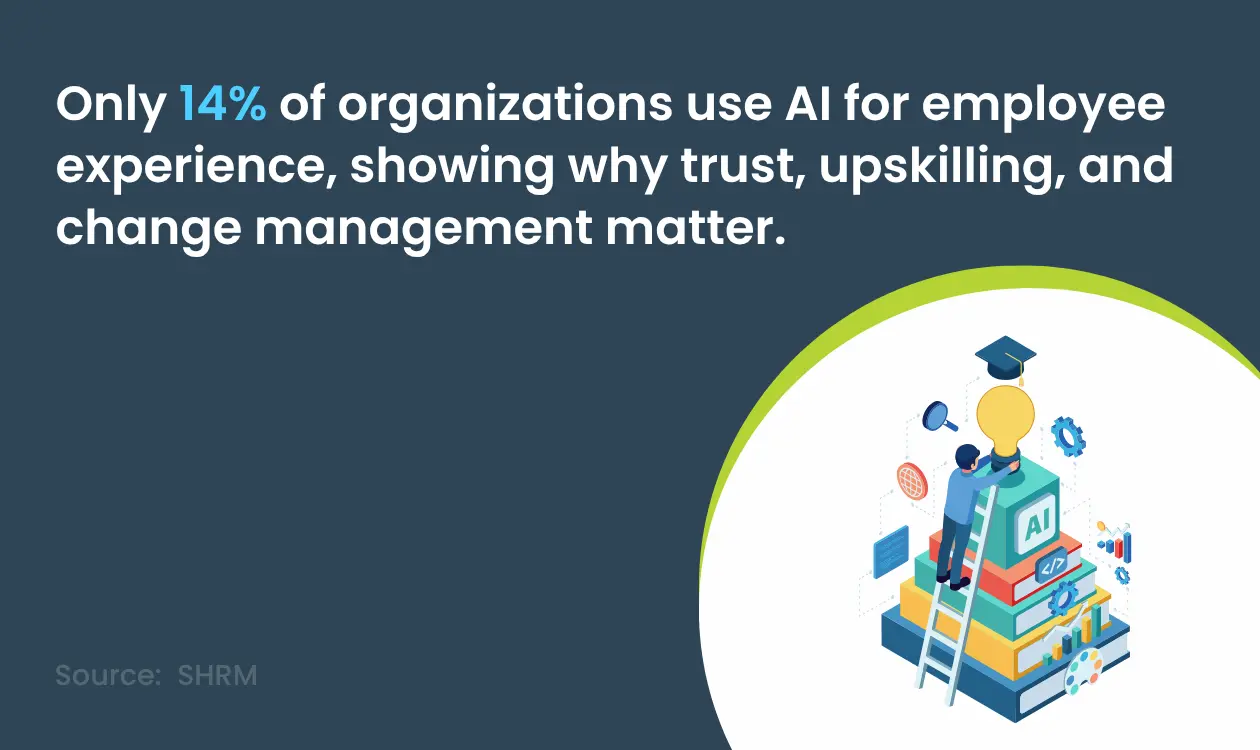
Recent HR research shows that AI adoption is growing, but it is still uneven across organizations. SHRM’s 2026 State of AI in HR report found that less than half of organizations use AI in HR, with the most common use cases appearing in recruiting at 27%, HR technology at 21%, learning and development at 17%, and employee experience at 14%. These numbers show why leaders should use workforce analytics, employee feedback, and AI upskilling metrics to measure whether AI is truly improving company culture.
Strategies for AI culture change and impact on company culture success
A clear strategy is essential to maximize the impact of ai on organizational culture and leadership. Successful strategies focus on alignment between technology, people, and values. Without intentional planning, AI adoption risks fragmentation rather than the leadership wins organizations seek.
How AI's Impact on Culture Unleashes Leadership Wins
Understanding how AI's impact on culture unleashes leadership wins begins with creating hybrid feedback systems. Combine algorithmic performance analysis with regular human check-ins to maintain authentic connections while leveraging computational power. This dual approach prevents the depersonalization that often accompanies technological change. This balanced approach strengthens the positive AI Impact on Company Culture.
Custom tools designed for your specific AI influence on corporate values yield better results than off-the-shelf solutions. Organizations should audit existing cultural strengths and pain points before selecting AI platforms, ensuring technology amplifies existing advantages rather than imposing incompatible workflows. This strategic alignment accelerates adoption and minimizes resistance.
Tactics from Strategies for AI Impact on Company Culture
Comprehensive upskilling programs form the foundation of successful strategies for AI impact on company culture. Invest in training that demystifies AI capabilities, addresses employee concerns transparently, and demonstrates practical applications relevant to daily responsibilities. When teams understand how AI enhances rather than threatens their roles, adoption rates rise. Education accelerates acceptance of the AI Impact on Company Culture organization-wide.
ROI trackers customized for short-tail AI culture initiatives provide visibility into transformation progress. Monitor metrics like time saved through automation, improved decision accuracy rates, and enhanced employee satisfaction scores. These tangible outcomes justify continued investment and build organizational confidence in AI-driven approaches, complementing insights from talent acquisition technologies.
Tools Boosting AI Impact on Company Culture
The right tools act as cultural accelerators, not just productivity enhancers. Platforms designed to measure sentiment, collaboration, and engagement translate AI insights into meaningful cultural action.
Frameworks for Artificial Intelligence Organizational Culture
Specialized platforms offering Culture Amp AI integrations and similar technologies provide turnkey solutions for measuring artificial intelligence organizational culture dynamics. These systems aggregate feedback from multiple sources, identify patterns invisible to human observation, and recommend targeted interventions that address specific cultural challenges.
Ensuring synergy between these frameworks and existing AI leadership structures prevents technological silos. Integration across HR systems, communication platforms, and project management tools creates a cohesive ecosystem where cultural insights inform strategic planning at every organizational level, as explored in generative AI applications.
Early 2026 industry pulse checks such as LinkedIn Talent Trends 2026 report growing expectations that AI will redefine leadership responsibilities and talent practices. Teams prioritizing explainability and integration see faster adoption and less resistance.
AI adoption is also extending beyond HR analytics into workplace safety and physical security. Modern business access control systems, such as those offered by Coram, can combine access management with AI-powered video surveillance to help organizations manage who can enter offices, restricted areas, and other sensitive spaces. By giving security and operations teams greater visibility into access activity and potential risks, these technologies can support a safer workplace while allowing leaders to manage physical security as part of a broader, technology-driven operational strategy.
Long Tail Fixes for Resistance
Addressing resistance requires targeted workshops explaining AI's company culture dynamics through relatable scenarios. Long tail solutions focus on niche concerns-from data privacy anxieties to job security fears-providing personalized reassurance that generic communications miss. Interactive sessions where employees experiment with AI tools in low-stakes environments build confidence organically.
These interventions complement broader change management efforts without duplicating previous tactics, creating multiple entry points for different personality types, learning styles, and communication needs to engage with transformation initiatives. For organizations with multilingual teams, even small details in workplace communication can make a difference, such as knowing the best regards in French for a multilingual team when communicating across cultures. This inclusive approach particularly benefits organizations navigating employee engagement challenges.
Future Outlook on impact of ai on organizational culture and leadership
The future of the impact of ai on organizational culture and leadership will be defined by transparency, adaptability, and trust. Organizations that prepare now will lead with confidence as AI becomes embedded in everyday work and leadership practices.
Trends in Leadership Wins AI Horizon
Explainable AI represents the next frontier in leadership technology. Transparent algorithms that reveal decision-making logic build trust faster than black-box systems, enabling leaders to advocate for AI-recommended actions with confidence. This transparency becomes essential as organizations tackle increasingly complex strategic challenges.
Preparing for advanced culture transformation means developing organizational agility today. Companies investing in continuous learning infrastructures, cross-functional collaboration norms, and adaptive leadership development position themselves to capitalize on emerging technologies rather than scrambling to catch up, aligning with future HR competencies.
7-Step Checklist for AI Impact on Company Culture
- Audit current cultural strengths and technological readiness
- Define specific outcomes tied to business objectives
- Select AI tools aligned with organizational values
- Train employees through hands-on, role-specific programs
- Pilot implementations in controlled environments first
- Monitor engagement metrics and gather qualitative feedback
- Iterate based on data insights and employee input
This actionable framework provides clear milestones without prescribing rigid timelines, accommodating different organizational scales and industry contexts while maintaining strategic focus.
Conclusion: Master impact of ai on organizational culture and leadership for Wins
The impact of ai on organizational culture and leadership represents the defining challenge and opportunity for contemporary organizations. Leaders who embrace this transformation strategically balance technological capability with human-centered design and unlock sustainable competitive advantages through enhanced collaboration, data-informed decision-making, and empowered teams.
Implementing the outlined checklist for AI leadership transformation positions your organization to navigate complexity with confidence. As artificial intelligence capabilities expand, the companies thriving tomorrow are those investing in cultural foundations today. The question is not whether AI will reshape your workplace culture, but whether you will guide that evolution intentionally or react to it passively. Will your organization harness these changes to unleash leadership wins and build an innovative, united future? The tools, strategies, and frameworks exist; success depends on committed action. Stay ahead of the curve - explore more HR insights on NextInHR.