
 10 mins read
HR specializations are essential in 2026 as companies shift to data-driven, tech-enabled HR functions. Choosing the right HR specializations affects career trajectory, pay, and market relevance. This guide helps recruiters, HR leaders, and staffing professionals compare roles like Talent Acquisition, HRIS, and People Analytics, and it highlights salary ranges, in-demand skills, and negotiation tactics that move the needle on total compensation.
TL;DR
- High-demand HR specializations include Talent Acquisition, People Analytics, HRIS, Compensation, and L&D.
- Salary ranges vary by specialization from roughly $50k to $200k depending on role, level, and location.
- Tech skills in ATS, HRIS, AI sourcing, and analytics boost pay and career mobility for many HR specializations.
- Certifications like SHRM, PHR, and WorldatWork add credibility and often lift compensation.
- Staffing firms prioritize recruiters with automation, sourcing expertise, and measurable placement outcomes.
- People Analytics and HR Tech roles see the fastest salary growth due to AI adoption in HR specializations.
- Choose a specialization by combining interests, skill gaps, and future tech trends to maximize long-term pay and impact.
Why HR Specializations Matter Now
HR teams no longer operate as generalists only. Organizations expect depth. HR specializations shape strategy, reduce risk, and drive performance. Recruiters, staffing firms, and in-house teams must understand which paths command higher pay and where AI and ATS tools are changing work.
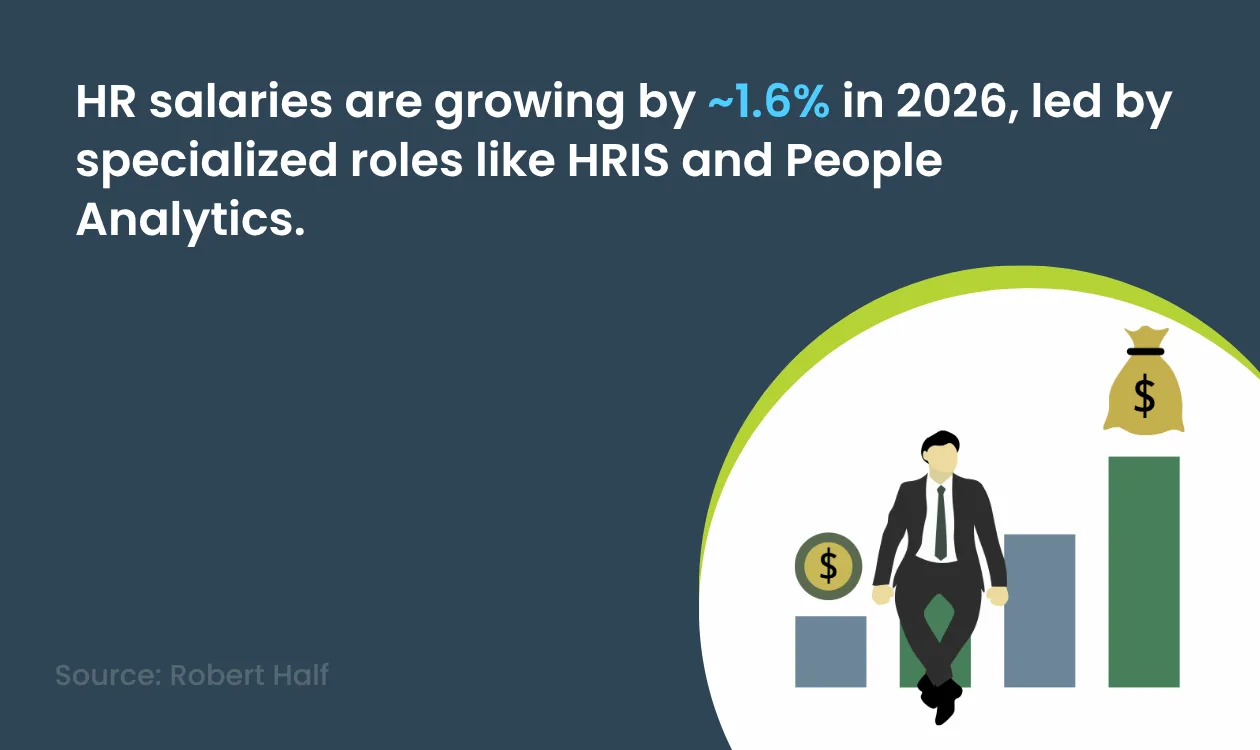
According to the Robert Half Salary Guide 2026, HR salaries are projected to increase by approximately 1.6% year-over-year, with higher growth in specialized roles such as HRIS, compensation, and people analytics.
How to Read the Salary Ranges: HRBP salary and talent acquisition salary
The salary ranges below reflect typical U.S. market pay across mid-level to senior roles. They account for base pay only and exclude bonus, equity, or commission. Salaries vary by city, industry, company size, and remote policies. For recruiting and staffing leaders, total compensation often includes placement incentives and performance pay.
When you compare HRBP salary and talent acquisition salary to roles like HRIS or People Analytics, note that technical skills and measurable impact increase earning potential. Use compensation surveys and local market data as benchmarks when negotiating.
HR Specializations Salary Comparison for 2026
The table below compares representative US manager-level roles across ten HR specializations. Salaries vary by experience, location, industry and company size.
HR specialization | Representative role | Indicative US salary | Most relevant skills |
Talent Acquisition | Talent Acquisition Manager | $100,876–$127,608 | ATS, sourcing, recruitment automation |
HR Business Partner | HR Business Partner | $86,447–$103,961 | Workforce planning, analytics, commercial skills |
HRIS and HR Technology | HRIS Manager | $126,321–$153,106 | HRIS configuration, integrations, SQL |
People Analytics | People Analytics Manager | $105,001–$125,602 | Data analysis, dashboards, Python or R |
Compensation and Benefits | Compensation and Benefits Manager | $119,256–$142,490 | Pay benchmarking, benefits, total rewards |
Learning and Development | L&D Manager | $112,790–$140,933 | Instructional design, LMS, programme evaluation |
DEI | DEI Manager | $123,873–$151,633 | Workforce data, inclusive programmes, engagement |
Employee Relations | Employee Relations Manager | $108,784–$133,014 | Investigations, employment law, conflict resolution |
Organisational Development | Organisational Development Manager | $109,908–$128,340 | Change management, facilitation, diagnostics |
Workforce Planning | Workforce Planning Manager | $106,504–$128,286 | Forecasting, skills analysis, talent mobility |
Salary Methodology and Sources
The salary ranges in this guide compare representative manager-level roles across ten HR specializations in the United States. Unless otherwise stated, the figures show the 25th-to-75th-percentile annual base-salary range reported by Salary.com in July 2026.
Base salary refers to fixed annual pay and does not include bonuses, commissions, equity, profit sharing, retirement contributions, insurance or other employer-provided benefits. Actual compensation may vary based on experience, location, industry, organisation size, technical expertise and job responsibilities.
Salary.com role-level benchmarks are used for the individual salary ranges. Robert Half’s 2026 Human Resources Salary Trends report is used for broader salary-growth observations. These figures are intended as market estimates rather than guaranteed salary or total-compensation amounts.
Top HR Specializations in 2026: Roles, Skills & Salaries
1. Talent Acquisition and Recruiting
Talent Acquisition focuses on sourcing, selecting, and onboarding candidates at scale. Recruiters use ATS platforms, sourcing tools, and recruitment automation daily. In staffing, expert sourcers cut time-to-fill and improve hire quality.
Typical salary range: $60,000 to $160,000 for senior or embedded recruiting leads. Recruiting directors and head of TA roles can reach $180,000 to $220,000 with bonuses. These figures align with common talent acquisition salary bands for high-demand markets.
Key skills: Boolean sourcing, ATS administration, employer branding, candidate experience, interview design. Recruiting teams can evaluate AI-enabled sourcing by tracking time-to-fill, qualified candidates per opening, recruiter productivity and offer acceptance rates. Results vary according to hiring volume, role complexity, data quality and how effectively the technology is implemented.
2. HR Business Partner (HRBP)
HRBPs align HR programs with business objectives. They advise leaders on workforce planning, performance, and change. HRBPs often bridge strategy and execution and require strong commercial acumen.
Typical salary range: $85,000 to $150,000 depending on industry and complexity of the business unit. This reflects common HRBP salary ranges reported by market surveys and internal benchmarking.
Key skills: Consulting skills, workforce metrics, coaching, change management. HRBPs who add analytics skills command higher pay.
3. HRIS and HR Technology
HRIS specialists manage HR systems such as Workday, SAP SuccessFactors, Oracle, ADP, and smaller niche tools. They own integrations, data integrity, and automation. As organizations move to cloud HR platforms, demand rises.
Typical salary range: $80,000 to $160,000 for senior HRIS managers and architects.
Key skills: System configuration, integrations, SQL, API knowledge, vendor management. A well-implemented HRIS may reduce manual data entry, improve reporting efficiency and support more consistent payroll processes. The actual impact depends on system configuration, data quality, integrations, employee adoption and existing workflows.
4. People Analytics
People Analytics turns HR data into business insights. Analysts build dashboards, predictive models, and hiring propensity reports. With AI, demand for these skills has increased sharply.
Typical salary range: $90,000 to $170,000 for experienced analysts and heads of people analytics.
Key skills: Statistics, Python or R, data visualization, causal inference. Insight: People Analytics can help organisations identify turnover patterns, evaluate workforce risks and improve workforce-planning decisions. However, business outcomes depend on data quality, analytical capability and whether leaders act on the findings. Professionals who combine analytics skills with business knowledge may be well positioned for specialist and leadership opportunities.
5. Compensation and Benefits (Total Rewards)
Total Rewards teams design pay structures, bonus plans, equity, and benefits programs. These specialists ensure pay equity, market competitiveness, and compliance.
Typical compensation and benefits salary: $80,000 to $160,000 for senior compensation analysts and directors. ECompensation professionals with expertise in incentive design, market benchmarking, pay transparency and regulatory compliance may command higher salaries, particularly when those skills support business-critical priorities.
Key skills: Market benchmarking, modeling, executive compensation, WorldatWork knowledge. Employers value those who can model total rewards and demonstrate ROI through improved retention and performance.
6. Learning and Development (L&D)
L&D develops learning strategies, leadership programs, and skill-building initiatives. With hybrid work, digital learning specialists are in demand.
Typical salary range: $60,000 to $140,000 for senior learning designers and heads of L&D.
Key skills: Instructional design, LMS administration, coaching, program evaluation. Example:Internal mobility and development programmes may reduce reliance on external hiring and support employee retention when training is aligned with genuine internal career opportunities. Results vary according to programme quality, participation and the availability of suitable roles.
7. Diversity, Equity, and Inclusion (DEI)
DEI specialists build inclusive programs, measure progress, and lead cultural change. Organisations may use DEI programmes to support representation, employee experience, accessibility and employer-brand objectives. The effectiveness of these programmes should be evaluated using clearly defined workforce measures rather than assumed outcomes.
Typical salary range: $70,000 to $150,000 for mid to senior DEI roles.
Key skills: Program design, data tracking, stakeholder engagement, training design. DEI leaders with measurable impact on representation and retention are highly valued.
8. Employee Relations and Compliance
Employee Relations manages investigations, dispute resolution, and disciplinary processes. Compliance specialists ensure labor law adherence and risk management.
Typical salary range: $60,000 to $130,000 for experienced ER partners and compliance leads.
Key skills: Employment law knowledge, investigations, negotiation, policy design. Labour relations expertise may strengthen salary potential in roles involving collective bargaining, union relationships, dispute resolution and complex employment requirements. Actual compensation varies by industry, location, responsibility and experience.
9. Organizational Development and Change Management
OD professionals design organizational structures, manage transitions, and support leadership effectiveness during major change.
Typical salary range: $85,000 to $165,000 for senior consultants and OD leads.
Key skills: Diagnostics, intervention design, facilitation, program evaluation. Organisational Development professionals who can demonstrate measurable results in change adoption, leadership effectiveness or organisational performance may strengthen their case for promotion and higher compensation.
10. Workforce Planning and Talent Mobility
Workforce planners forecast demand, model scenarios, and design mobility programs. This role ties strategic planning to talent supply.
Typical salary range: $90,000 to $160,000 for leaders in workforce strategy.
Key skills: Scenario modeling, cross-functional influence, internal mobility design. Effective talent-mobility programmes can help organisations fill selected roles internally, develop critical skills and reduce reliance on external recruitment. The impact depends on workforce demand, employee readiness and the availability of internal opportunities.
Industry insight: According to the U.S. Bureau of Labor Statistics, HR managerial roles maintain strong median wages, and demand remains steady as organizations invest in people strategy.
How AI and Automation Are Changing HR Salaries in 2026
AI is reshaping workflows across HR. Tools that automate resume screening, candidate outreach, and onboarding reduce transactional work. That increases the value of strategic specializations like people analytics, HRIS, and compensation. Recruiters who combine AI-enabled sourcing and ATS expertise with measurable hiring results may strengthen their case for higher fees, promotion or salary growth. Using an AI tool alone does not guarantee increased compensation.
Practical tip: Demonstrating measurable improvements from automation, for example reduced time-to-fill or increased offer acceptance rates, is a direct way to negotiate higher pay. Track these outcomes and present them alongside industry benchmarks when seeking raises or pitching clients.
Which HR Certifications Increase Salary the Most?
Certifications show commitment and domain knowledge. Consider:
- SHRM-CP / SHRM-SCP for strategic HR credibility
- PHR / SPHR for compliance and operational HR
- WorldatWork for compensation and benefits
- Workday / SuccessFactors certifications for HRIS roles
- Data science and analytics courses for people analytics
In addition, NextInHR offer free HR certifications tailored to specific roles, with a focus on practical skills such as sourcing, ATS tools, and workforce analytics. These certifications are designed to help professionals develop practical skills in sourcing, ATS tools and workforce analytics. Certifications may strengthen credibility and support career progression, but salary outcomes also depend on experience, role demand and demonstrated business impact.
How to Choose the Right HR Specialization in 2026
Evaluate three factors: interest, market demand, and transferable skills. Start with a gap analysis. If you enjoy data and have quantitative skills, people analytics or HRIS is a strong choice. If you prefer influence and coaching, HRBP or OD may be better. For staffing firms, focus on talent acquisition and sourcing automation to deliver immediate ROI for clients.
Action plan: Try a cross-functional project, earn a targeted certification, and track results you can present in performance reviews or client pitches.
How to Negotiate a Higher Salary in HR Roles
- Document measurable outcomes and business impact.
- Benchmark using compensation surveys and job market data.
- If you work in staffing, quantify placements, time-to-hire, and candidate retention.
- Highlight tech skills like ATS administration, integrations, and AI tools.
- Negotiate total compensation including bonus, equity, and benefits.
Conclusion
Developing expertise in an HR specialization can strengthen career value and create access to more focused HR career paths. Professionals working in Talent Acquisition, People Analytics, HRIS, Total Rewards and other specialist areas may improve their salary potential by combining relevant expertise with measurable results, business knowledge and technology fluency. For recruiters and staffing leaders, invest in skills and certifications that align to client needs and automation trends to maximize compensation and impact. Stay ahead of the curve by tracking market pay bands and using targeted evidence to support salary conversations. Stay ahead of the curve - explore more HR insights on NextInHR