

 9 mins read
High-volume hiring challenges strain recruiting teams and technology when application spikes overwhelm processes. This guide focuses on practical fixes for pre-screening at scale, addresses bulk hiring problems and mass recruitment challenges, and shows how to scale hiring process without losing quality or diversity.
TL;DR
- High-volume hiring challenges often come from rigid automation and poor candidate experience.
- ATS parsing errors and keyword filters frequently reject qualified candidates.
- Long applications and irrelevant assessments increase candidate drop-off.
- AI screening tools must be monitored to prevent bias and over-filtering.
- Skills-based micro-assessments and mobile-first workflows improve completion rates.
- Tracking screening metrics helps teams continuously improve hiring efficiency.
What Is Pre-Screening in High-Volume Hiring?
Pre-screening is the initial filtering stage of recruitment where companies narrow thousands of applicants into a manageable shortlist.In high-volume recruitment, this stage determines whether qualified candidates reach recruiters or are excluded before human review.
Typical pre-screening methods include:
- Resume screening through ATS
- Knockout questions
- Automated assessments
- AI candidate ranking
- Recruiter phone screens
In high-volume hiring environments, pre-screening must balance speed with accuracy so teams do not exclude suitable candidates or create unnecessary bottlenecks.
Why high-volume hiring challenges occur
Hiring at scale magnifies every weakness in the screening process. Small issues, such as a keyword mismatch or parsing error, can eliminate hundreds of strong candidates. Automation tools help manage volume, but poorly designed screening workflows create unintended consequences for high volume recruitment and volume recruiting issues.
Common problems include rigid filters, candidate drop-off, biased algorithms, and poorly designed assessments. These problems commonly appear in large-scale hiring and require deliberate fixes when pre-screening candidates at scale.
Where pre-screening breaks in high-volume hiring challenges
1. Overreliance on Keyword Filters
Teams often configure strict keyword filters to cut candidate pools fast. That works when applicants use identical language to the job posting. It fails when applicants use synonyms, different job titles, or nonstandard resume formats. The result is false negatives: qualified applicants removed before human review. In high-volume hiring challenges the absolute number of false negatives can be large, reducing the available talent pool dramatically.
2. Resume Parsing Errors in ATS
Resume parsing technology is improving, but parsing still misreads unconventional formats, images, or multi-column layouts. When an ATS extracts incorrect skill tags or misses critical experience, automated filters and ranking models mis-score candidates. Parsing errors can cause viable candidates to be incorrectly scored or removed from consideration, especially when applicant volumes are high.
Many teams address these issues by configuring their Applicant Tracking Systems more carefully. Platforms like iSmartRecruit allow recruiters to adjust parsing rules, manage screening pipelines, and automate candidate communication, helping reduce errors that commonly appear in high-volume pre-screening challenges.
3. Poor Candidate Experience
Lengthy applications, unclear pre-screen questions, and slow response times lead to high drop rates. In a high-volume hiring context even a small percentage of drop-off can translate into hundreds of lost applicants. Candidate experience is a major driver of candidate conversion when scaling hiring process.
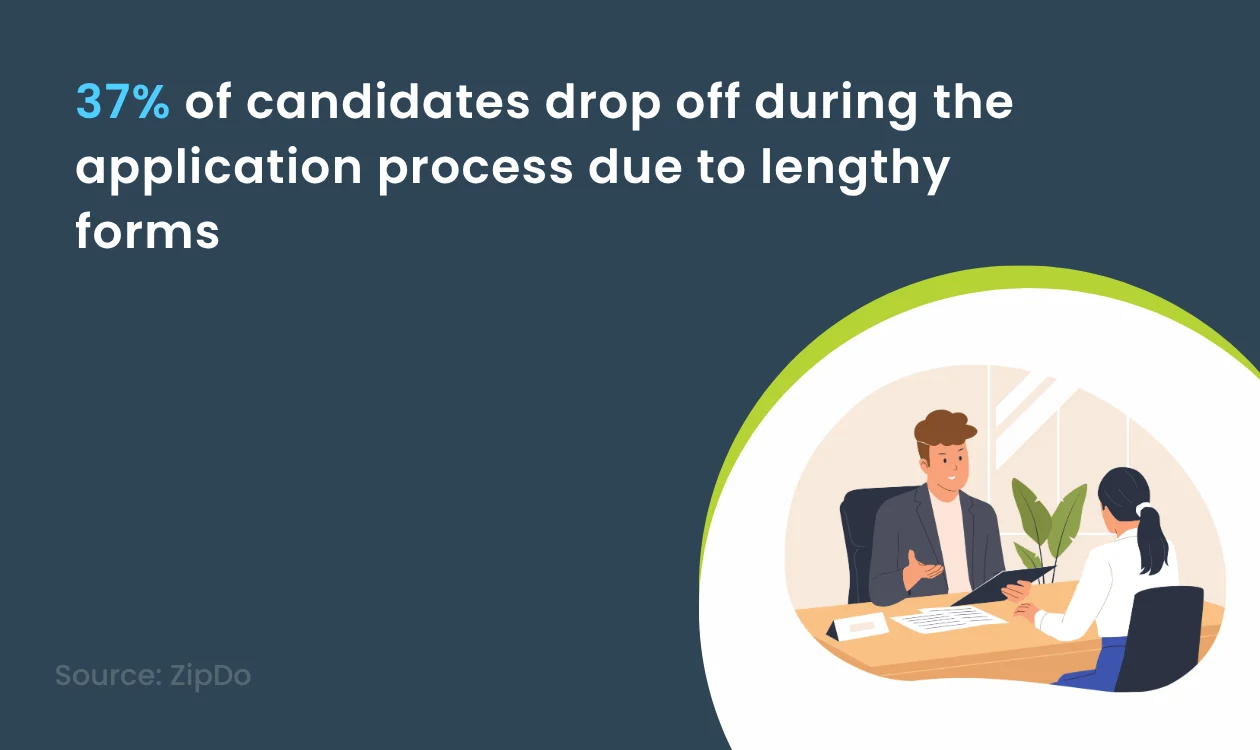
According to research by ZipDo, around 37% of candidates abandon job applications because they are too long or complicated. This highlights how friction in the early screening stage can quickly shrink the candidate pipeline and worsen mass recruitment challenges.
SMS open rates exceed 90% and mobile-first interactions convert far better than desktop-only forms. In a high-volume hiring context even a few percentage points of drop-off turn into hundreds of lost applicants. Prioritizing mobile workflows is one proven way to cut drop-off in volume recruiting issues.
4. Assessment Fatigue
Long assessments or assessments that measure unrelated traits create candidate fatigue. When you apply one-size-fits-all assessments across thousands of applicants you increase washout of potentially good hires. Evaluate if your assessment is predictive for that role and consider ultra-short, job-specific tasks instead. Micro-assessments reduce fatigue while improving signal for high volume recruitment.
5. Biased or Poorly Trained AI Screening
AI screening models are powerful but reflect their training data. If historical hiring data reflects bias or limited diversity, AI can amplify those patterns. In high-volume hiring challenges a biased model will prune entire demographic segments quickly. Human oversight, bias testing, and continuous retraining are essential to keep automated screening fair and effective when scaling hiring process.
6. Lack of Staged Screening
Applying a single screening gate for every applicant is risky. Staged screening reduces false negatives with progressive filters: quick resume parsing, a mobile-first micro-screen, a brief skills check, then a short video or phone screen. Orchestration tools that automate sequencing and scheduling cut time-to-hire and keep candidates engaged in high-volume hiring challenges.
One practical way teams handle high-volume pre-screening challenges is by introducing asynchronous interview steps. Tools like the one-way interview feature from ScreeningHive allow candidates to record responses to standardized questions on their own time. Recruiters can then review submissions when convenient, making it easier to evaluate large applicant pools without scheduling bottlenecks. Asynchronous steps help resolve many bulk hiring problems by making evaluation scalable and consistent.
Here is a quick summary of the main pre-screening problems, recommended fixes, and metrics to monitor.
Failure Point | Best Fix | Metric to Track |
Rigid keyword filters | Add synonyms and manual review | Rejected-candidate audit rate |
ATS parsing errors | Test resume formats and parsing accuracy | Parsing error rate |
Poor candidate experience | Shorten and simplify the application | Application completion rate |
Assessment fatigue | Use brief, role-specific assessments | Assessment completion rate |
Biased AI screening | Add human oversight and bias checks | Selection-rate difference |
Single-stage screening | Use a staged screening workflow | Interview conversion rate |
Real Examples of High-Volume Pre-Screening Challenges
Case: Seasonal Retail Hiring
A staffing team received thousands of applications for seasonal retail roles. An initial boolean filter excluded candidates who did not explicitly list "retail" as experience. Hundreds of storefront associates who used terms like "store associate," "sales floor," or "customer associate" were filtered out. After replacing strict keyword rules with a mix of synonym dictionaries and skills-based micro-tests, the team increased qualified pipeline by nearly 30% and reduced time-to-schedule by 40%.
Case: Contact Center Recruitment
A contact center used long online tests to pre-qualify candidates. Completion rates were low and many who completed the test still failed early on. The team switched to a 90-second voice simulation and a two-question situational judgment test delivered by SMS. Candidate flow improved, quality rose, and early attrition dropped because the new screen tested essential on-the-job tasks, not generic cognitive measures.
Practical insight: Replace fragile hard filters with layered micro-screens and human review at key decision points.
How to Solve High-Volume Pre-Screening Challenges
1. Use Skills-Based Micro-Screens
Replace long forms with short, mobile-compatible screens that measure a core skill or behavior. For customer service roles a 60-second simulated call or a micro-skill quiz predicts performance better than a long resume parsing step. Mobile-first delivery by SMS or a lightweight link improves response rates dramatically. Micro-screens are central to many high volume hiring solutions.
2. Improve ATS Filtering
Audit your ATS filters and remove rigid exclusions. Add synonym lists for job titles and skills so parsing and filters map related language properly. Enable a human review bucket for borderline rejects so a recruiter can spot false negatives before the candidate is lost. These steps directly address common bulk hiring problems and parsing failures.
3. Use AI With Human Oversight
AI can triage volume by ranking candidates, identifying skill clusters, and predicting fit. But always pair models with explainability logs and human review for top-ranked and borderline applicants. Regularly monitor model performance metrics and test for bias by subgroup to avoid amplifying inequities in high-volume hiring challenges. Treat AI as an amplifier of good design, not a replacement for guardrails.
4. Implement Staged Screening Workflows
Design a staged workflow: resume parse, micro-screen, skills micro-test, short phone screen, and offer. Automate scheduling, reminders, and follow-ups to reduce manual work. Orchestration reduces candidate drop and lets recruiters focus on decision-making instead of logistics. Staged workflows are a core practice when scaling hiring process across multiple roles.
5. Track the Right Metrics
Measure screening yield (percentage moved to next stage), false negative rate (samples of rejected applicants who would pass manual review), time-to-first-contact, completion rate for micro-screens, and candidate NPS. In high-volume hiring challenges these metrics reveal where the funnel leaks and which fixes move the needle. Use weekly dashboards to spot regressions quickly and run A/B tests for continuous improvement.
Implementation Checklist: Fast actions for teams
- Audit ATS filters and remove hard exclusions
- Add synonym mapping for titles and skills
- Introduce mobile-first micro-screens (30 to 90 seconds)
- Run bias tests on any AI models used for screening
- Set up an automated staged screening workflow
- Measure screening yield and false negative rate weekly
- Run A/B tests on screening questions and assessment lengths
Measuring Success and Getting Continuous Improvement
Improving pre-screening is an iterative process. Use short experiment cycles: change one variable, run it on a subset of postings, measure outcomes, and decide. Typical improvements include higher move-to-interview rates, lower time-to-hire, and better early performance metrics among hires. In high-volume hiring challenges these wins scale quickly and translate to measurable cost savings.
Make experiments small and measurable. For example, test a 60-second micro-assessment against a 5-minute test on a single role. Track completion rate, move-to-interview, and early hire performance. Small wins compound when you apply them across many open roles in mass recruitment challenges.
Conclusion: Pre-screening is strategic, not tactical
High-volume hiring challenges expose the weaknesses of simplistic pre-screening. When pre-screening is treated as a tactical checkbox the pipeline suffers. Treat pre-screening as a strategic system: design layered screens, calibrate automation, monitor metrics, and focus on a strong candidate experience. With the right mix of ATS tuning, mobile-first micro-assessments, AI with oversight, and orchestration you can reduce false negatives, increase throughput, and hire the right people faster. Stay ahead of high-volume hiring challenges and explore more practical HR guidance on NextInHR.