

 9 mins read
The workplace will look very different in a few years. This post explains what HR in 2030 will mean for recruiters, HR teams, and staffing leaders. I will cover trends, practical steps, tools, and metrics you can adopt today to prepare. The goal is to make change feel manageable and tactical rather than overwhelming. You will get examples, recent stats, and a playbook to begin implementation this quarter. Preparing for HR in 2030 is a strategic priority you can act on now.
TL;DR
- HR in 2030 will be driven by AI, automation, and skills-based hiring.
- Data and people analytics will shift decisions from intuition to evidence.
- Employee experience and continuous learning will determine retention and agility.
- Remote work, gig talent, and internal marketplaces will reshape workforce design.
- Privacy, ethics, and bias controls are essential when deploying AI.
- Invest in HR technology, reskilling programs, and cross-functional partnerships now.
- Build flexible processes and metrics to track outcomes rather than inputs.
Why the Next Decade Matters for HR and the HR future 2030
Change is accelerating. Generative AI, skills marketplaces, and distributed work models are not future concepts. They are in production at many firms now. Preparing for HR in 2030 means designing people programs that scale, protect employees, and unlock productivity. Businesses that plan now will have a talent advantage when competition intensifies. The HR future 2030 requires action on skills, data, and ethics today.
Key Trends Shaping HR in 2030
Below are core shifts every HR leader should monitor. Each trend includes examples and a quick action you can take this year. These trends explain what will HR look like in 2030 and how you can start preparing now.
1. AI and Automation Will Augment HR Work
AI will automate repetitive recruiting tasks, surface high-potential candidates, and personalize learning paths. When executed well, these tools speed processes and free HR to focus on strategy and coaching. For example, chatbots can handle initial candidate questions while AI-driven screening ranks applicants based on skills and performance predictors. Expect to see more HR automation embedded in applicant tracking systems and talent CRMs. This transformation is a core part of HR in 2030 and the broader HR evolution you should track.
Action: Pilot AI tools with a clear success metric such as time to fill or candidate satisfaction. Add a human review step to catch false positives and maintain fairness.
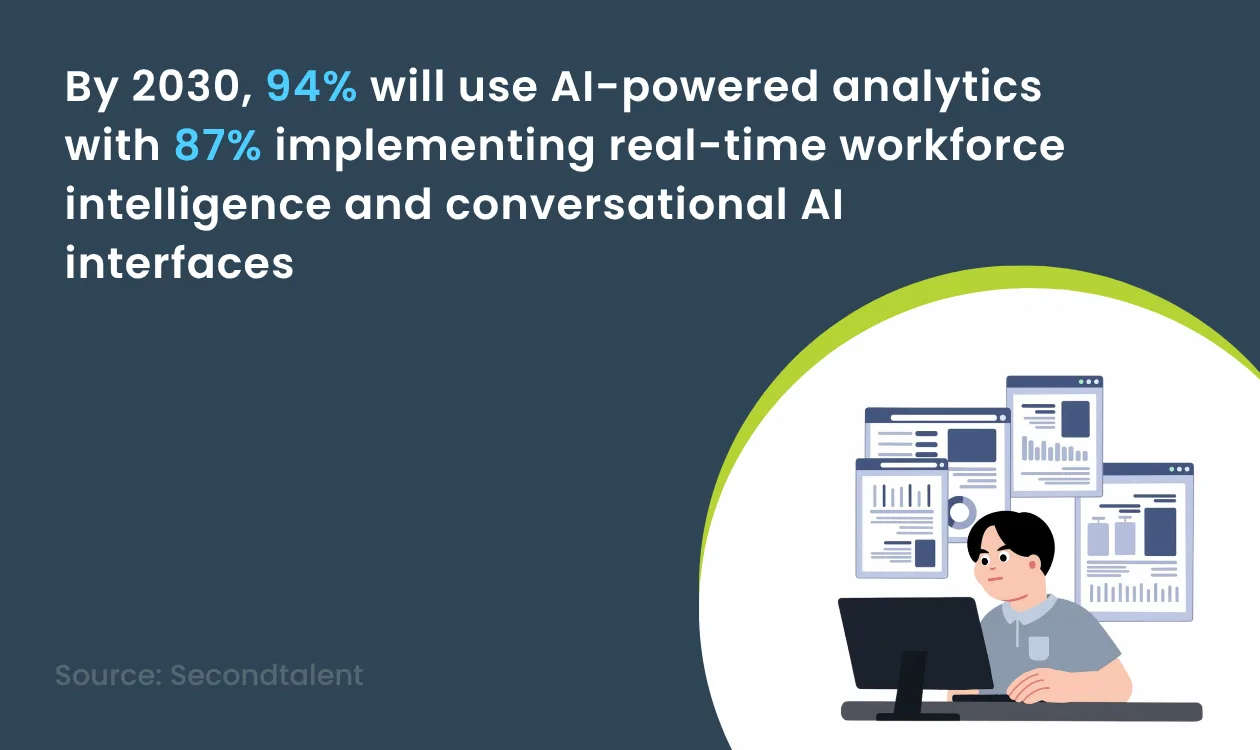
A SecondTalent survey forecasts that by 2030, 94% of companies will adopt AI-powered analytics, while 87% plan to implement real-time workforce intelligence and conversational AI solutions to enhance decision-making and productivity.
2. Skills-Based Hiring Will Replace Job Titles
Organizations will move from role-centric job descriptions to skills taxonomies. Skills-based talent systems increase mobility and reduce bias by focusing on measurable competencies. Large companies are already mapping internal skills to career pathways and pay bands. Recruiters will source for skills, not just titles, and ATS filters will evolve to surface skill matches. Starting now is the best way to influence how your processes are evaluated in HR in 2030.
Action: Start tagging roles and candidates with standardized skills. Build a pilot internal mobility board to test skills-based matching.
3. Employee Experience Will Become a Revenue Driver
Employee experience will be measured like customer experience. Companies will invest in seamless onboarding, continuous performance feedback, and tailored career journeys. This will directly affect retention and productivity. Use pulse surveys, analytics on engagement, and lifecycle touchpoint mapping to identify friction points. Focusing on employee experience now will improve outcomes in HR in 2030 and support long-term workforce resilience.
Action: Map a 90-day onboarding journey and instrument it with simple surveys and completion metrics.
4. Distributed Work and Talent Marketplaces Will Scale
Remote work and gig platforms will be common. Organizations will use internal talent marketplaces to allocate short-term projects and build capacity without long hires. Staffing teams will manage portfolios of direct employees, contractors, and vendors. This hybrid talent strategy will require flexible policies and new compliance models. If you are preparing for future HR, build the policies and billing models that allow flexible capacity.
Action: Pilot an internal marketplace for one business unit to track outcomes, billing, and satisfaction.
5. Continuous Learning and Micro-Credentials Will Become the Standard
Learning will shift from episodic training to micro-learning and on-the-job stretch assignments. Digital credentials and blockchain verification will make skills portable. HR in 2030 will track learning impact rather than completion rates, linking skill gains to performance improvements. Micro-credentials will be a primary signal for redeployment and promotions in the HR workforce 2030.
Action: Launch a competency-based learning path with measurable outcomes and manager endorsements.
6. People Analytics Will Guide Strategic Decisions
Data will move beyond reporting to prescriptive insights. Effective people analytics will answer questions such as which segments of talent drive revenue and which onboarding steps predict retention. Legal and privacy teams will need to be involved early to ensure ethical use of data. Build analytics capability now so you can deliver business answers that matter in HR in 2030.
Action: Build a cross-functional analytics sprint team to deliver one business question answer in 30 days.
7. Ethics, Privacy, and Bias Controls Will Become Mandatory
With widespread use of AI, HR teams must enforce guardrails. This includes bias testing of models, transparent candidate sourcing, and clear consent for people data. Regulators are increasing scrutiny, so documentation and governance are non-negotiable. Ethical controls will be a baseline expectation in the world of HR transformation 2030.
Action: Define an AI ethics checklist for every HR tech procurement and require bias testing reports.
A Practical Playbook to Prepare for HR in 2030
Below is a step by step guide HR leaders can follow in the next 12 to 24 months. Each step is pragmatic and measurable. Use this playbook as the foundation for your HR evolution and to clarify how to approach the future of work HR.
Step 1: Audit Your Technology and Data Maturity
Inventory your ATS, LMS, HRIS, and analytics tools. Identify data silos and estimate time to a single source of truth. Prioritize integrations that unlock recruiting workflow improvements or reporting. Real example: A mid-market staffing firm reduced time to hire by 18 percent after integrating ATS data with interview scheduling and candidate messaging tools. Document gaps now so you can show measurable progress toward HR in 2030.
Step 2: Define a Skills Taxonomy and Map Roles
Create a shared skills library with input from hiring managers. Use third party taxonomies as a starting point and adapt them to your business. Measure how many roles can be reframed to skills-first postings and set a target for conversions. Clear definitions make internal mobility and hiring decisions simpler as you prepare for the HR workforce 2030.
Step 3: Pilot AI Tools with Clear Guardrails
Run low-risk AI pilots such as resume parsing or scheduling automation. Require vendor transparency on data usage and model training. Track false positive rates and candidate feedback. Example: A recruiting team reduced scheduling time by 40 percent while increasing candidate NPS after adding an AI scheduling assistant. Small pilots will prove value and reduce risk on the path to HR in 2030.
Step 4: Build an Internal Talent Marketplace
Start small with a project-based matching tool. Track utilization, project outcomes, and employee satisfaction. Use results to expand marketplace scope and budget. Staffing firms can mirror these marketplaces to manage contractor pools efficiently. Internal marketplaces are a foundational capability for the future of work HR.
Step 5: Tie Learning Programs to Measurable Outcomes
Design learning programs that map to performance indicators. Reward managers for coaching and validating skill growth. Use micro-credentials to accelerate redeployment across functions. This approach supports continuous learning and the HR transformation 2030 most organizations will undergo.
Step 6: Shift Metrics and Reporting to Business Outcomes
Shift from input metrics like headcount to outcome metrics like time to productivity, internal mobility rate, and skills coverage. Publish a quarterly HR scorecard that ties people metrics to business KPIs. One clear outcome metric tied to revenue or customer satisfaction drives executive attention as you prepare for HR in 2030.
Organizational Design and Culture Changes to Expect
HR in 2030 requires new team structures. Embed data scientists in HR, hire AI ethics specialists, and create talent operations roles to run marketplaces. Encourage cross-functional squads that include HR, IT, Legal, and Business leaders. Real companies are creating central talent design teams to oversee workforce architecture and guide HR evolution.
Leadership Capabilities and Skills HR Teams Will Need
HR professionals should gain fluency in data interpretation, change management, and vendor evaluation. Recruiters need sourcing skills across internal and external talent pools. Upskill HR business partners to advise on workforce design and scenario planning. These capabilities will define what will HR look like in 2030 across industries.
Budgeting and Procurement Best Practices
Negotiate pilots with clear exit criteria and performance metrics. Ask vendors for audit logs, bias mitigation documentation, and interoperability standards. Consider subscription models that scale with outcomes rather than headcount. These procurement choices influence your readiness for HR in 2030.
Measuring success
Use a balanced scorecard with three pillars: Talent Acquisition, Talent Development, and Talent Retention.
Examples of metrics to track include time to productivity, skills coverage percentage, internal mobility rate, and cost per outcome. Link at least one HR metric to revenue or customer satisfaction for executive buy-in. Tracking the right metrics will make the benefits of preparing for future HR visible to leaders.
Tip: Start with one high-impact metric and iterate. Too many metrics dilute focus.
Conclusion
Preparing for HR in 2030 is about practical modernization. Focus on people first and technology second. Invest in skills, data foundations, ethical AI, and flexible workforce models. Small pilots that demonstrate measurable impact will gain executive support and reduce risk. The organizations that plan now will have a clear advantage in talent acquisition, agility, and resilience as the HR evolution accelerates.
HR in 2030 will be more dynamic, more data driven, and more human at scale. Start today by auditing your tools, tagging skills, and running a closed pilot to show value. Stay ahead of the curve - explore more HR insights on NextInHR.